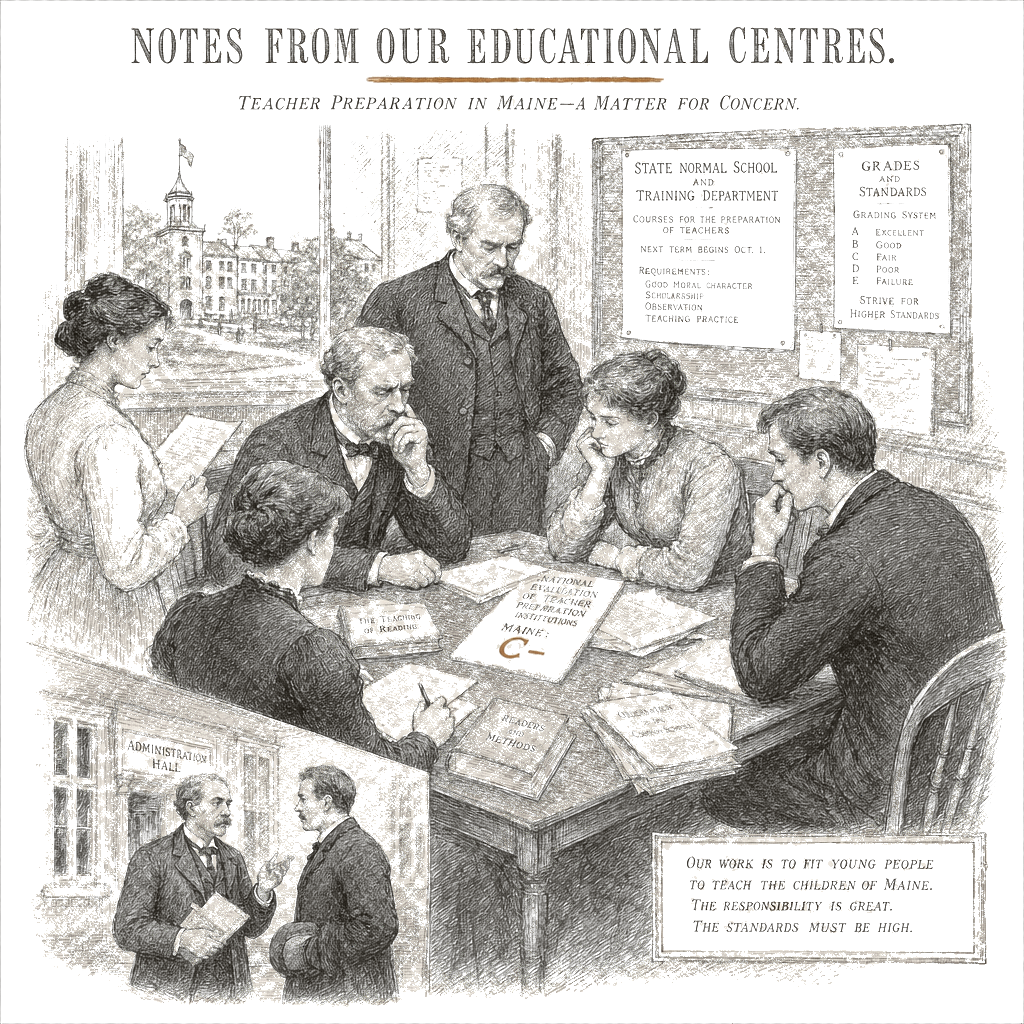
Three Maine public universities received failing grades from a national education think tank for how they prepare teachers to teach reading, a finding the universities strongly disputed as methodologically flawed.
The National Council on Teacher Quality, a Washington, D.C.-based think tank, gave the University of Maine in Orono, the University of Southern Maine, and the University of Maine at Farmington failing marks as part of its 2023 review of 702 elementary teacher preparation programs at 580 institutions nationwide.
The dispute arrives as reading test scores among Maine students have been declining. Forty-four percent of Maine fourth graders and 35 percent of eighth graders could not demonstrate even a basic understanding of reading in 2024, according to the National Assessment of Educational Progress — a pattern the think tank said is linked to inadequate teacher preparation.
“We are not serving Maine students well when our teachers who teach in Maine are not prepared in line with our best science,” said Heather Peske, president of the National Council on Teacher Quality.
What the council found
The council evaluated programs based on whether they taught five pillars of effective reading instruction identified by the National Reading Panel, a body created by Congress in 2000: phonemic awareness, phonics, fluency, vocabulary, and comprehension.
The University of Southern Maine and the University of Maine at Farmington adequately addressed zero of the five pillars, the council found. The University of Maine at Orono sufficiently taught only one — comprehension.
Nationally, 25 percent of programs suitably addressed all five pillars, the council said.
Maine programs did not respond to the council’s invitations to submit course materials for review, the organization said. The council then obtained syllabi and other documents through public records requests, reviewing only materials no older than five years.
Three other Maine programs — at the University of Maine at Presque Isle, Husson University in Bangor, and the University of New England in Biddeford — received no rating because they did not provide documentation. The council attempted to review six of Maine’s 16 teacher preparation programs recognized by the Maine Department of Education.
Universities push back
University of Maine System spokesperson Samantha Warren said in an email that the system has long rejected the council’s ratings.
“Like many of the nation’s leading institutions and education researchers, the University of Maine System has historically rejected the NCTQ’s deeply misleading ratings, which ignore student and program outcomes; contain concerning methodological flaws; rely on a review of course syllabi rather than observations of actual teaching and learning; and have a well-documented history of data inaccuracies,” she wrote.
Warren said the system’s programs are “fully approved” by the state and are nationally accredited by the Council for the Accreditation of Educator Preparation. Graduates of Maine educator preparation programs are often recognized as top teachers or leaders in the field, she said.
William Dee Nichols, director of UMaine’s School of Learning and Teaching, told The Maine Monitor that he was confident in his program’s practices but questioned the accuracy of the council’s assessment, saying UMaine had not fully participated in the data collection because it considered the data used for evaluating programs too narrow.
The University of Southern Maine said the council may have misunderstood its syllabi. USM literacy professors Andrea Stairs-Davenport and Melinda Butler said they have always taught evidence-based reading methods and that the failing grade was a surprise.
“I think we recognize that there’s some work that we can do to make things more explicit in the syllabus, because certainly we’re teaching all of the areas that are mentioned in NCTQ,” Stairs-Davenport said.
The University of Maine at Farmington’s co-provost, Katherine Yardley, who also serves as dean of the College of Education, Health and Rehabilitation, wrote in an email that the university has an excellent reputation for teacher preparation. Students build a deep understanding of the five pillars of reading in their literacy coursework and are prepared to teach and assess students, she wrote.
The reading instruction debate
How children best learn to read has been debated in education for decades. Some approaches have relied on contextual cues such as pictures and semantic signals to help children unlock words — a method found in texts called leveled readers. Others center on explicit phonics and phonemic awareness instruction, which a broad body of research has found are critical for young children to build reading foundations. This emphasis on decoding skills has fueled a movement known as the “science of reading.”
A 2024 study from the Maine Education Policy Research Institute found that Maine schools commonly use methods considered ineffective for teaching children to read.
UMaine literacy instructor Michelle Kearney said the university’s program critically examines a range of reading methods and helps future teachers understand how research evolves.
“We’re trying to be really explicit with our students about how research does change, and we get new pieces of it, but it doesn’t push it all the way back,” Kearney said. “I think that’s been dangerous in our field, this sort of black and white, binary thinking of ‘either/or,’ instead of working to see how all these things fit together in a comprehensive way that’s still grounded in research.”
Nichols said UMaine has been updating its approach for several years, including ending its participation in the Reading Recovery program, which critics said incorporated phonics too sparsely.
“I’ve been doing this for 32 years,” Nichols said. “I guarantee the pendulum will swing again.”
The think tank’s challenge
Peske said states that have improved reading test scores credit comprehensive changes to teacher preparation grounded in decades of research, citing Mississippi as an example.
“We have 50 years of research with thousands of studies across tens of thousands of kids that tell us how to teach reading,” she said. “Right now, Maine needs to look itself in the face and say, ‘Why is it that 44 percent of fourth grade students in Maine scored below basic in the most recent (National Assessment of Education Progress) test?’”
This story was originally reported by The Maine Monitor and distributed through a partnership with The Associated Press.