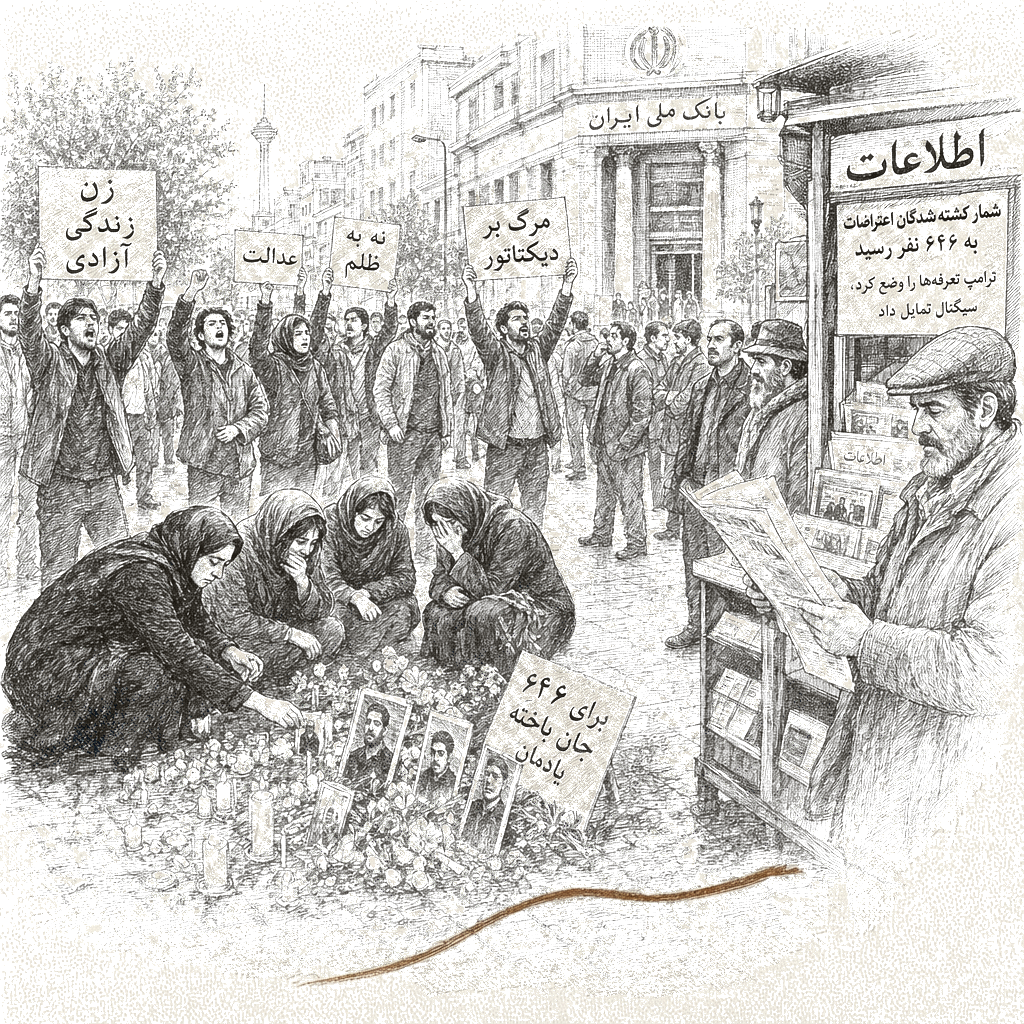
At least 646 people have been killed since protests erupted in Iran on Dec. 28, according to a U.S.-based human rights monitoring group, as President Donald Trump on Monday announced 25 percent tariffs on countries that do business with Tehran and said the Islamic Republic wants to negotiate. The announcements came after Oman’s foreign minister traveled to Iran over the weekend in a visit that activated a channel Muscat has long used as an intermediary between Washington and Tehran, though Tehran did not issue a public statement in response to Trump’s comments.
The dual moves mark the Trump administration’s sharpest economic escalation yet against Iran over a crackdown the United Nations has not been able to independently verify, reflecting competing pressures between punitive action and diplomatic opening. Iran’s foreign minister said Tehran is open to diplomacy even as he blamed the United States and Israel for the violence without offering evidence, and the White House said Iran’s private messages to Washington diverge from its public statements.
WASHINGTON — President Donald Trump on Monday announced 25 percent tariffs on any country that does business with Iran and said the Islamic Republic wants to negotiate, as activists reported at least 646 people had been killed since protests erupted there two weeks earlier.
Trump made the announcements after Oman’s foreign minister traveled to Iran over the weekend in a visit that activated a channel Muscat has long used as an intermediary between Washington and Tehran. It remained unclear what Iran could offer in any talks, given Trump’s stated demands regarding Tehran’s nuclear program and ballistic missile arsenal — which the Iranian government has insisted is essential to the country’s defense.
The tariff announcement was the first direct punitive action Trump has taken against Iran over the crackdown. He made it in a social media post, saying the 25 percent duties would take effect immediately. Brazil, China, Turkey, the United Arab Emirates and Russia are among the economies that do business with Tehran.
Iran signals openness to talks while blaming U.S. and Israel
Iranian Foreign Minister Abbas Araghchi told foreign diplomats in Tehran that the situation had been brought “under total control,” blaming Israel and the United States for the violence without offering evidence. He also said Iran is “open to diplomacy.”
Foreign Ministry spokesman Esmail Baghaei said a channel with the United States remains open, but that any discussions must be based on “acceptance of mutual interests and concerns, not a negotiation that is unilateral and based on imposition.”
White House press secretary Karoline Leavitt said Iran’s public statements diverge from the private messages the administration has received from Tehran in recent days. She said Trump has interest in exploring those messages, but added that the president has shown he is not afraid to use military options when he deems it necessary.
Military options under review
Trump’s national security team has weighed options against Iran including cyberattacks and direct strikes by the United States or Israel, according to two people familiar with internal White House discussions who were not authorized to speak publicly and requested anonymity.
Aboard Air Force One on Sunday night, Trump told reporters that the military is reviewing options and the administration is weighing what he described as very strong ones. Asked about Iranian threats of retaliation, he said Washington would strike Iran with an unprecedented intensity if Tehran acted.
Iran’s parliament speaker warned Sunday that U.S. forces and Israel would be “legitimate targets” if Washington used force to protect protesters. The Iranian government issued no formal public response to Trump’s statements about negotiations.
Crackdown continues; death toll disputed
At least 646 people have been killed since the protests began, including 512 demonstrators and 134 security forces, according to the Human Rights Activists News Agency, a U.S.-based nongovernmental organization that has tracked unrest inside Iran for years and relies on a network of supporters inside the country to verify information. More than 10,700 people have been detained during the two weeks of demonstrations, the group said.
The Associated Press said it could not independently verify the casualty figures. Iran’s government has not provided comprehensive death toll figures of its own.
Iran’s attorney general warned that anyone participating in the protests would be considered an enemy of God — a charge that carries the death penalty. Police sent text messages to the public warning families to keep young people away from demonstrations, citing the presence of armed groups. A separate message, purportedly from the intelligence arm of the paramilitary Revolutionary Guard, also warned individuals not to participate.
On Monday afternoon, state television broadcast images of pro-government demonstrators filling central Tehran’s Enghelab Square — the Islamic Revolution Square — which state outlets described as an uprising against what they called American-Zionist terrorism. State television framed the rally as evidence the government had surpassed the unrest without addressing the underlying economic grievances that sparked it.
A witness in Tehran told the AP, speaking on condition of anonymity out of fear of reprisal, that the capital’s streets empty out at the evening call to prayer and are largely deserted by nightfall.
Protests rooted in currency collapse
The demonstrations began Dec. 28 over the collapse of the Iranian rial, which trades at more than 1.4 million to the dollar. The economy has been under sustained pressure from international sanctions imposed partly over Iran’s nuclear program. As the protests spread, demands that directly challenged the theocratic government of Supreme Leader Ayatollah Ali Khamenei, 86, emerged alongside the economic grievances.
With internet and telephone service cut across much of Iran, assessing the scale of demonstrations from outside the country has been difficult. Videos posted online appeared to show fresh protests continuing Sunday night and into Monday, and a Tehran official acknowledged on state social media that they had occurred. Al Jazeera, the Qatar-funded satellite news channel, has been able to report live from inside the country despite the internet blackout.