A species back from the edge
The ʻalalā had been declining for decades due to habitat loss, introduced diseases and increased contact with humans before the 2002 extinction-in-the-wild declaration. The species has been maintained in captivity ever since, but wildlife managers have long sought to restore it to wild forests.
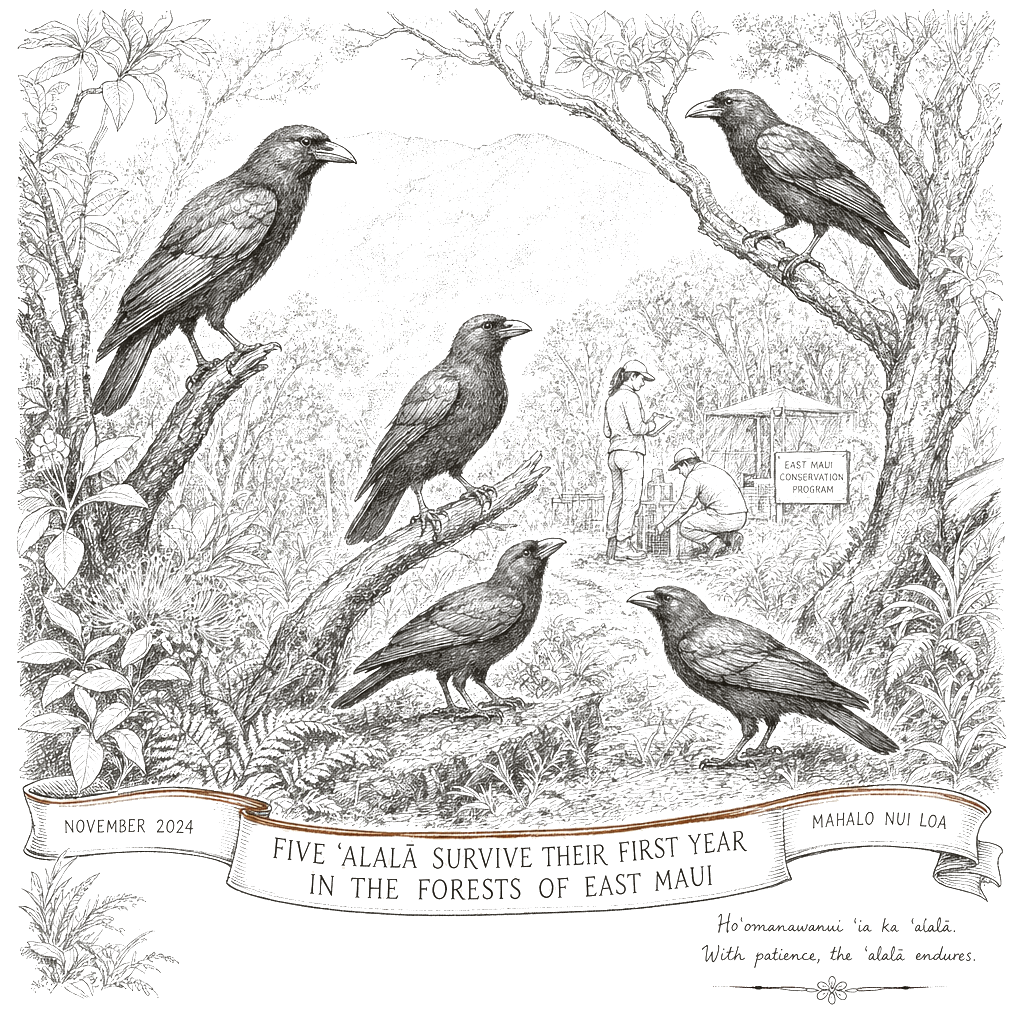
The five birds chosen for the Maui release were selected for their advanced social skills, breeding potential and predator-avoidance instincts. Before their November 2024 release into a remote section of Kīpahulu Forest Reserve, they spent several weeks in a field aviary acclimating to GPS trackers and supplemental feeders, according to the state Department of Land and Natural Resources.
A 2024 environmental assessment found that Kīpahulu Forest Reserve — on the leeward slopes of Haleakalā — contained native fruits the species forages for on its home island, and that the introduction was unlikely to pose a risk to other endangered species in the area.
Lessons from a previous failure
The Maui effort is the first ʻalalā reintroduction attempted outside of Hawaiʻi island. A previous program released 30 birds at sites inside the Puʻu Makaʻala Natural Area Reserve on the Big Island between 2016 and 2020. The effort faltered after the Hawaiian hawk, known as the ʻio, identified the crows as prey. Researchers estimate 25 birds died; 18 bodies were recovered, according to a study by the San Diego Zoo Wildlife Alliance.
“Once they were getting nailed by this hawk species, the managers made the difficult decision to just pull all the birds that they could get out of the forest, because it wouldn’t serve any purpose to let them be hunted down,” said Martin Frye, a research field supervisor for the Maui Forest Bird Recovery Project. “At that point, they’re too valuable to lose to a foregone conclusion like that.”
The ʻio is not present in the Kīpahulu Forest Reserve area, which researchers identified as a key factor in choosing the site.
An unexpected nest
One of the project’s most notable developments came in late 2025, when two of the released birds paired up and laid an egg — an unexpected occurrence given their young age.
“They went kind of from being just buddies to not buddies anymore, which was interesting to see,” Hebebrand said. “We don’t know the status of the egg, but she appeared to sit on it the whole 21 days that they sit on an egg. The first time around, it’s not typical that it would hatch… But it’s pretty incredible to see a nest.”
Cultural and ecological significance
The ʻalalā play an ecological role in Hawaiian forests by pruning trees and dispersing native plant seeds. Native Hawaiians have long regarded the birds as ʻaumākua, or family guardians, Frye said.
“In the deep past, people picked out that voice from all the voices of the forest,” Frye said. “We can’t lose that voice. That’s the push. We need that voice to be present in order for the forest to be whole, in order for our relationship to the forest be whole, in order to preserve a link to the past.”
Keanini Aarona, an avian recovery specialist at Maui Bird Conservation Center in Olinda who helped raise some of the young birds before their release, described the work in terms that extend beyond conservation biology.
“I feel almost like a parent to them, and sending them out is kind of nerve-wracking,” Aarona said. “But it’s also so exciting, because these birds are so young, and one day there will be a point when they will have spent more of their life out in the forest than they did in captivity.”
For Aarona, the stakes of the work are rooted in Hawaiian cultural tradition.
“In Hawaiian culture, everything is full circle. People can’t live without the forest, and the forest can’t live without the birds,” he said. “These birds, they are our ancestors.”