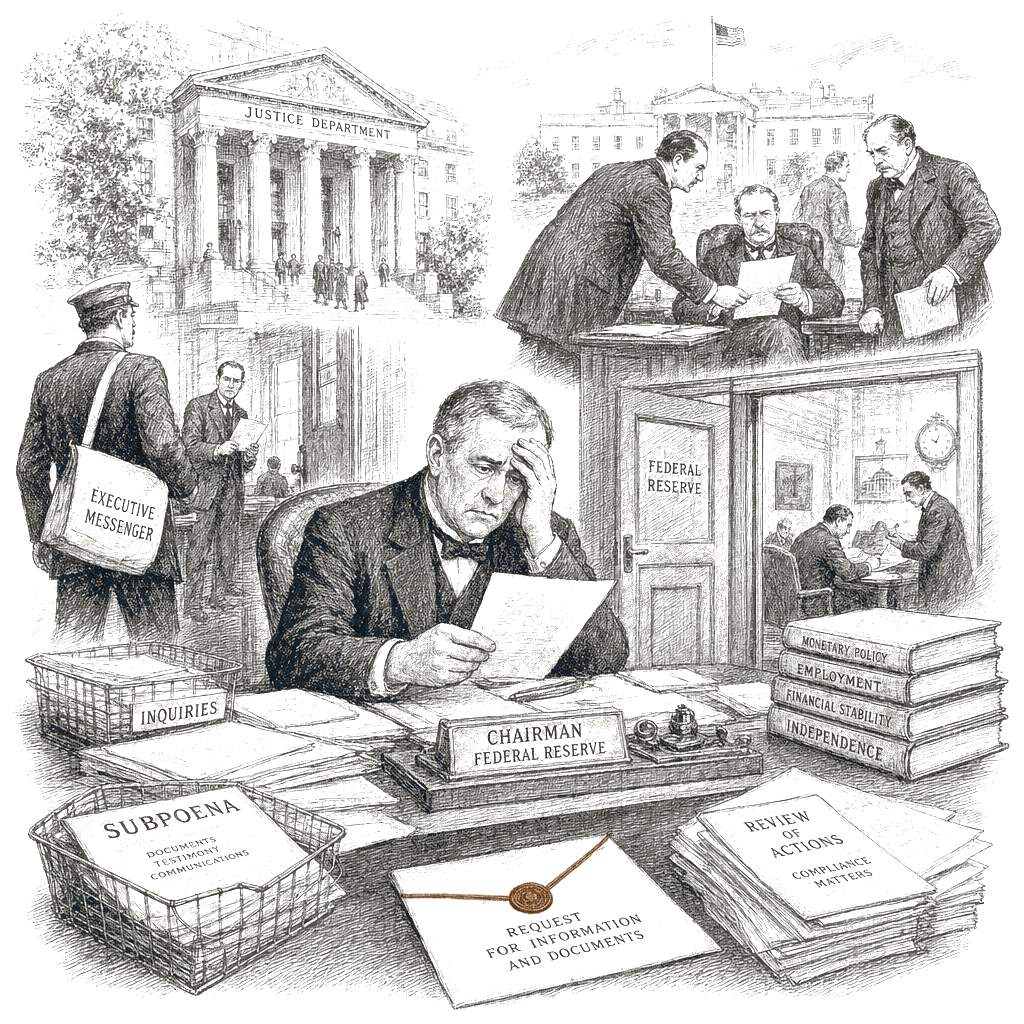
The move puts the Federal Reserve’s political independence under explicit legal pressure for the first time in decades, alarming investors and prompting at least one Republican senator to warn that White House advisers are working to end the Fed’s autonomy over interest-rate decisions.
The Justice Department threatened Federal Reserve Chair Jerome Powell with criminal indictment over his congressional testimony about the central bank’s building renovation project, Powell said Sunday — a move he characterized as a “pretext” to undermine the Fed’s independence in setting interest rates.
The threat, disclosed as U.S. financial markets opened broadly lower Monday, represents a departure from Powell’s previous measured responses to pressure from President Donald Trump. The yield on the 10-year Treasury note — the benchmark rate against which mortgage and corporate borrowing costs are set — stood at 4.18% on January 12, edging higher as investors assessed the development.
“If there were any remaining doubt whether advisers within the Trump Administration are actively pushing to end the independence of the Federal Reserve, there should now be none,” said Sen. Thom Tillis, a North Carolina Republican who sits on the Banking Committee, which oversees Federal Reserve nominations.
Trump’s escalating pressure on the Fed
Trump has repeatedly attacked Powell for declining to cut the Fed’s short-term interest rate more quickly, and has threatened to fire him. The Fed’s short-term rate stands at 3.6%, its lowest level in nearly three years, after the central bank cut rates in three of the final four months of 2025. Trump has demanded lower borrowing costs to stimulate economic growth and reduce the federal government’s interest payments on its debt.
The administration has focused on the Fed’s $2.5 billion renovation of its Washington headquarters as a potential avenue for forcing Powell out. Trump has accused Powell of mismanaging the project. The Supreme Court last year suggested, in a ruling on other independent agencies, that a president cannot remove the Fed chair solely for policy disagreements, but may do so for cause — typically interpreted to mean wrongdoing or negligence. Powell would likely contest any attempt to remove him before his term as chair expires in May, and such a challenge would probably reach the Supreme Court.
A separate front: Federal Reserve Governor Lisa Cook
Trump is also seeking to remove Federal Reserve Governor Lisa Cook over unproven allegations of mortgage fraud. The allegation was made by Bill Pulte, a Trump appointee to the Federal Housing Administration. Cook’s term runs to 2038; removing her would allow Trump to appoint a loyalist years ahead of schedule.
Why Fed independence matters
Economists have broadly favored independent central banks because they can take steps to control inflation that would be politically unpopular — including raising interest rates, which increases borrowing costs for households and businesses. The Fed’s preferred inflation gauge, the personal consumption expenditures price index, showed prices rising at a 2.8% annual rate as of January 2026, above the central bank’s 2% target and a key reason the Fed has proceeded cautiously on rate reductions.
The argument for insulating the Fed from political direction was reinforced by the inflation of the 1970s. Former Fed Chair Arthur Burns has been widely blamed for allowing that era’s inflation to accelerate after succumbing to pressure from President Richard Nixon to keep interest rates low before the 1972 election. Paul Volcker, appointed Fed chair by President Jimmy Carter in 1979, subsequently pushed the short-term rate to nearly 20%, triggering a sharp recession and unemployment approaching 11% — but restoring price stability by the mid-1980s.
A more recent case unfolded in Turkey. President Recep Tayyip Erdogan forced the central bank to hold rates low in the early 2020s even as inflation reached 85%. After Erdogan granted the bank greater independence in 2023, short-term rates rose to 50% to combat inflation, and have remained elevated.
Limits on presidential influence over the Fed
Even replacing Powell as chair — which Trump may do when the term expires in May — would not assure the rate-policy changes the president seeks. Twelve members of the Fed’s rate-setting committee vote on interest-rate decisions; the chair alone does not control the outcome.
Congress also shapes the Fed’s mandate through legislation. Since 1977, the Fed has operated under a dual mandate to seek both stable prices and maximum employment; it defines stable prices as 2% inflation. The 1977 law requires the Fed chair to testify before the House and Senate twice a year.
Most investors prefer an independent central bank in part because its decisions are more predictable. If the Fed were more swayed by political considerations, financial markets would find it harder to anticipate or understand its rate decisions — and investors concerned about sustained inflation would demand higher yields on government bonds, pushing borrowing costs higher across the economy.