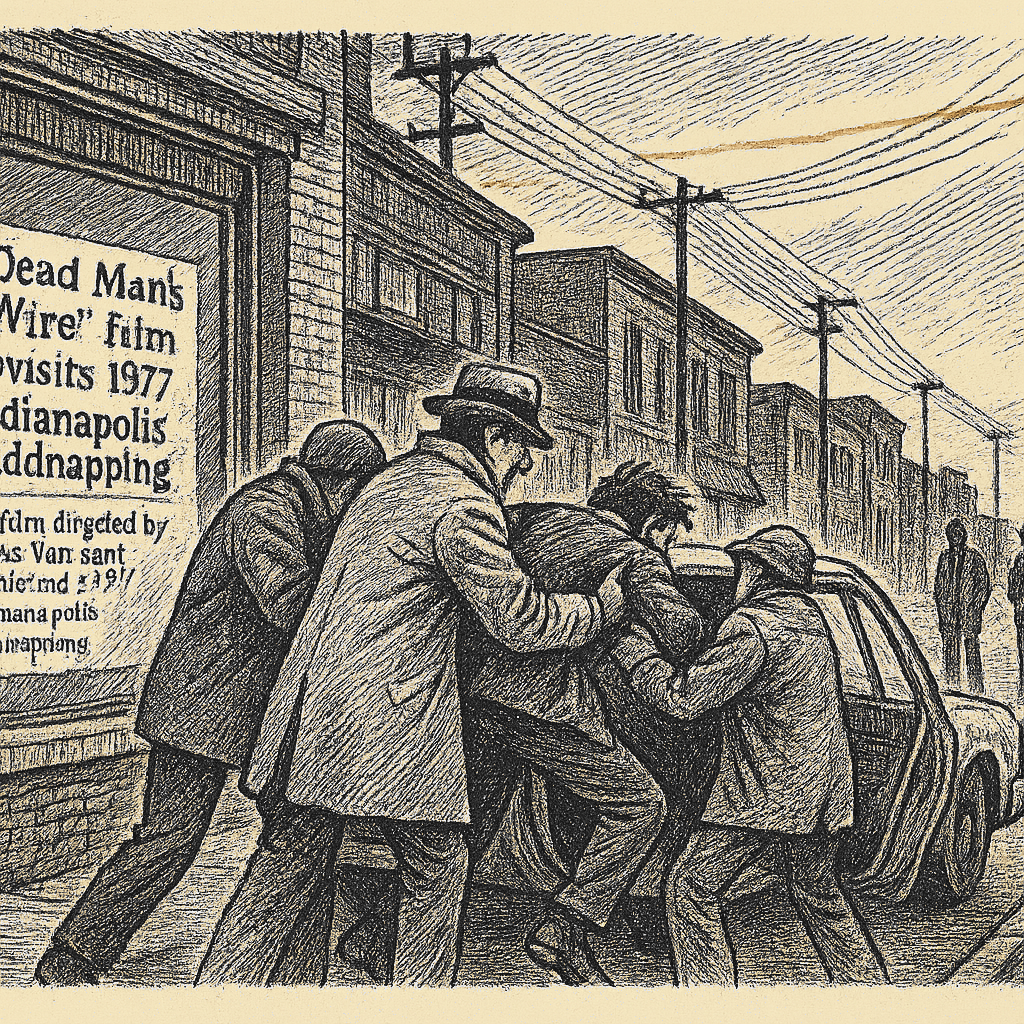
A film directed by Gus Van Sant depicting a 1977 Indianapolis kidnapping is set to premiere Jan. 16, drawing renewed attention to a case in which a failed real estate developer held a mortgage company executive at gunpoint for nearly 63 hours using a wire-triggered shotgun.
“Dead Man’s Wire,” starring Bill Skarsgård and Dacre Montgomery, focuses on the three days in February 1977 when Anthony “Tony” Kiritsis kidnapped Richard Hall, president of Meridian Mortgage, and took him hostage in his west-side apartment after a loan dispute turned violent.
The case — which ended with a live televised press conference and Kiritsis’s acquittal by reason of insanity — remains a defining episode in Indianapolis history. A location tour published by Mirror Indy traces the sites involved, most of which still stand under different names today.
A film brings the story back
“Dead Man’s Wire,” directed by Gus Van Sant and starring Bill Skarsgård and Dacre Montgomery, is set to premiere Jan. 16. The film centers on the three days in February 1977 when Tony Kiritsis, a west-side Indianapolis resident whose real estate plans had collapsed, kidnapped Richard Hall, president of Meridian Mortgage, and held him at gunpoint in a nearby apartment complex.
To prevent police from intervening, Kiritsis rigged a sawed-off shotgun to Hall’s head using a wire coathanger tied to the trigger — a device he called a “dead man’s line,” designed to discharge automatically if officers attempted to subdue him.
What the photographer saw
Jeff Atteberry was 25 years old and three years into a career at the Indianapolis Star when the standoff began. He missed the opening hours.
“I was taking an aunt and uncle to a doctor’s appointment,” Atteberry, now 73, told Mirror Indy. “So, you know, I was sort of like, ‘Man, I want to be a part of this,’ but I couldn’t go. I had to go take care of them.”
On the final day, Atteberry was assigned to photograph a press conference Kiritsis held in his apartment building’s common room, with Hall still at gunpoint nearby. Body heat from dozens of journalists packed into the small space kept fogging his lenses.
“I don’t remember having any sort of internal feelings,” he said. “I was trying to get pictures.”
While searching for a better angle, Atteberry moved to a spot no other photographer had taken — and quickly understood why.
“I was trying to find a better angle, and I ran around and I saw this one side where nobody was there. I remember thinking, ‘Well, this has got to be a good angle then,’” Atteberry said. “When I got there and took a shot or two, I realized I was looking at the shotgun barrel. And, I thought, ‘Oh, maybe this isn’t such a good place to be.’”
How the standoff unfolded
On the morning of Feb. 8, 1977, Kiritsis walked into the offices of Meridian Mortgage at 129 E. Market St. carrying a sawed-off shotgun and a wire coathanger concealed in boxes. He had gone to confront company chairman Millard Hall but was told Hall was on vacation in Florida. When Richard Hall arrived, Kiritsis asked if he had “a minute,” and the two entered Hall’s office. Moments later, Kiritsis had affixed the dead man’s line and called 911.
“Sir, this is a dire emergency, a real serious thing. I’ve just taken a prisoner,” Kiritsis told police, according to Mirror Indy.
He then commandeered a police vehicle near the Indiana Statehouse and forced Hall to drive to his apartment at 220 Welcome Way Blvd. — now the Pinnacle West Apartments — in the Chapel Hill/Ben Davis neighborhood. Claiming he had wired the building’s windows and doors with dynamite, Kiritsis triggered the evacuation of about 110 apartments, most of them occupied by senior citizens.
Over nearly 63 hours, Kiritsis called repeatedly into radio station WIBC-AM, where Fred Heckman, a member of the Indianapolis Broadcasters Association Hall of Fame, helped negotiate Hall’s release. The press conference on the final day ran nearly 30 minutes and was carried live. At its close, Kiritsis addressed the assembled journalists directly.
“I’m sorry about my language, and I’m sorry that this thing had to happen,” he said.
Shortly after, Atteberry and other reporters waiting outside heard a shotgun discharge.
“We were waiting on the other side of the building, and then we all heard a shotgun go off. We all thought, ‘This is not ending well,’” Atteberry said. “It turns out he was demonstrating that the shotgun really was loaded after all.”
Hall was released and taken to Wishard Memorial Hospital — now Sidney & Lois Eskenazi Hospital — for evaluation and treatment.
Background and legal aftermath
Kiritsis was born Aug. 13, 1938, to Greek immigrant parents who settled on Indianapolis’ west side, where his father operated a small ice cream manufacturing plant and later a mobile home park. After two years in the U.S. Army and a stint managing the family’s trailer park, Kiritsis worked as a car salesman before turning to real estate.
In 1973, he took out a $110,000 loan from Meridian Mortgage to purchase 17 acres at the northwest corner of Rockville Road and Lynhurst Drive, which he planned to develop into a shopping center. When the deals fell through, Kiritsis blamed the mortgage company, claiming it had steered prospective tenants to competing sites.
During the standoff, the Indianapolis Star confirmed that Richard Hall’s brother, Jack, had written to two supermarket companies and suggested alternative development sites — corroborating the core of Kiritsis’s complaint, though not the method he chose to address it.
Kiritsis was charged with kidnapping, armed extortion, and armed robbery. In October 1977, a jury found him not guilty by reason of insanity. He spent years in state psychiatric facilities, was released in 1988, and moved to Speedway. He died of natural causes in 2005 and is buried at Crown Hill Cemetery in Indianapolis.
The locations, then and now
Mirror Indy’s location tour, published ahead of the film’s Jan. 16 premiere, traces the sites connected to Kiritsis and the 1977 standoff across Indianapolis’ west side — from the block where his childhood home once stood to the renovated building that housed Meridian Mortgage’s offices and the apartment complex where Hall was held. Most of the locations remain standing today under different names or owners.