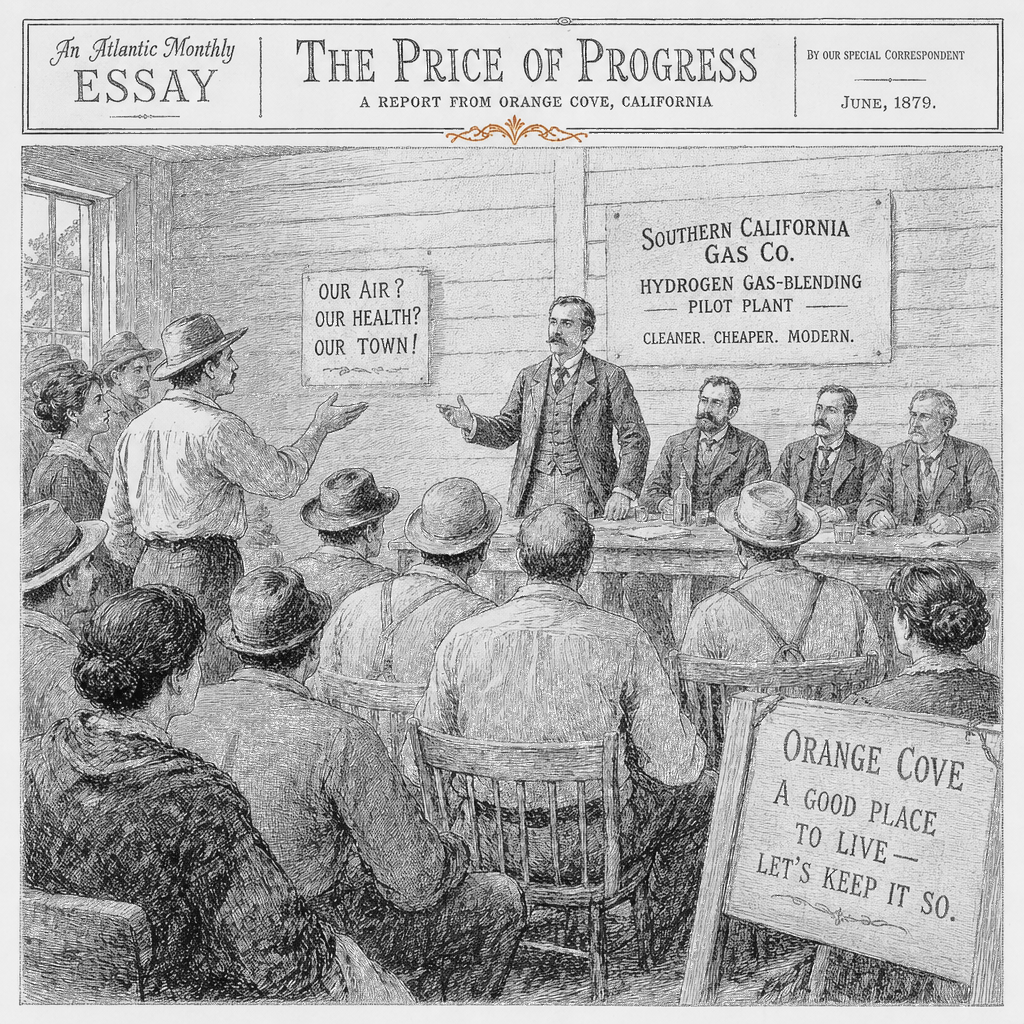
Southern California Gas Co. has proposed blending up to 5% hydrogen into the natural gas infrastructure of Orange Cove, a predominantly Latino farming town of roughly 10,000 in California’s Central Valley, as part of a state-directed program to test whether existing pipelines can carry cleaner fuel. Residents who oppose the plan say they face health risks they cannot easily avoid and were not given a meaningful role in the decision.
The proposed $64.3 million, 18-month project — to be funded by ratepayers — is one of five California pilot projects awaiting a decision this year from the California Public Utilities Commission. Orange Cove, which has the highest rate of asthma in Fresno County and a 39% poverty rate, has become a focal point in a broader dispute over environmental justice, public health, and the role of hydrogen blending in California’s decarbonization strategy.
“I don’t want to be anyone’s experiment,” said Alma Figueroa, 60, an Orange Cove resident who has asthma and said her lung cancer has returned.
Health and safety concerns
Research shows that burning hydrogen-blended gas in older appliances not designed for it can increase emissions of nitrogen oxides — pollutants linked to asthma and other respiratory problems. Hydrogen is also more flammable than natural gas and can deteriorate certain pipeline materials, increasing the risk of leaks and explosions.
Ryan Sinclair, an environmental microbiologist at Loma Linda University, said a 5% hydrogen blend can increase nitrogen oxide emissions by an average of 8% in older infrastructure. Residents cannot opt out of the blend unless they replace gas appliances with electric ones, Sinclair said, and he expressed concern that Orange Cove’s low-income residents lack the means to replace older equipment. He said more health risk assessments are needed before the project begins.
Alejandra Hormaza, who teaches renewable energy at California State Polytechnic University, Pomona, said the scientific consensus holds that hydrogen blends of up to 20% by volume are safe. But she said “we need more experimental work that uses real natural gas infrastructure to fully understand the impacts of hydrogen.” Hormaza has researched hydrogen leakage from gas systems for a decade and said there is insufficient research on whether hydrogen can increase leaks.
Research also shows hydrogen can indirectly warm the planet by interacting with other atmospheric gases.
Francisco Gonzalez, an Orange Cove resident whose friends and siblings have respiratory conditions, said his community is not opposed to clean energy, “but we are against being left out of the conversation.”
How Orange Cove was selected
SoCalGas originally proposed testing hydrogen blending at facilities at the University of California, Irvine, in an affluent community, but scaled back and revised its proposal following protests. When Orange Cove leaders expressed interest, SoCalGas identified the city as a suitable site because it has varied pipeline materials — including steel and plastic — and only one gas feed coming in, allowing tighter control of the blend, according to the Associated Press.
Orange Cove city leaders voted unanimously in support of the project. City officials did not respond to requests for comment. At an August public hearing, Mayor Diana Guerra Silva said the project would provide workforce opportunities for youth and draw business from visitors, according to a hearing transcript.
Residents who oppose the project said they have asked city officials to hold a town hall, but none has been scheduled. The town has launched a petition against the project and residents have voiced concerns at public meetings.
Michael Claiborne, directing attorney with Leadership Counsel for Justice and Accountability, which represents residents, said: “To me, it’s just an absurd project. It’s (a) boondoggle” that exposes residents to unnecessary risks.
What proponents say
Supporters of hydrogen blending see pilot projects as a step toward reducing reliance on fossil fuels while using the existing gas pipeline network, which spans about 3 million miles nationwide, according to the Department of Energy.
Janice Lin of the Green Hydrogen Coalition said testing blending is important. “The way to move us away and really clean our air and minimize our reliance on fossil fuels is by having a viable alternative,” Lin said.
California Gov. Gavin Newsom has described hydrogen as “an essential aspect of how we’ll power our future and cut pollution.” A Minneapolis utility estimated that a 5% green hydrogen blend would reduce carbon pollution by about 1,200 tons annually — the equivalent of removing 254 gas-powered vehicles.
Broader context
Interest in hydrogen technology grew during the Biden administration, but the Trump administration has canceled billions of dollars for hydrogen and other clean energy projects, including $1.2 billion designated for a hydrogen hub in California.
Environmental groups have said hydrogen should be reserved for industries such as aviation, cement, and steel-making that cannot easily be electrified, rather than deployed in residential gas systems. Others have said electrifying appliances is a more efficient path to emissions reductions.
If the California pilot projects are approved, SoCalGas said it will employ safety measures including leak surveys, detection technology, backflow prevention, and emergency response plans. Hawaii has blended hydrogen into its gas supply for decades.