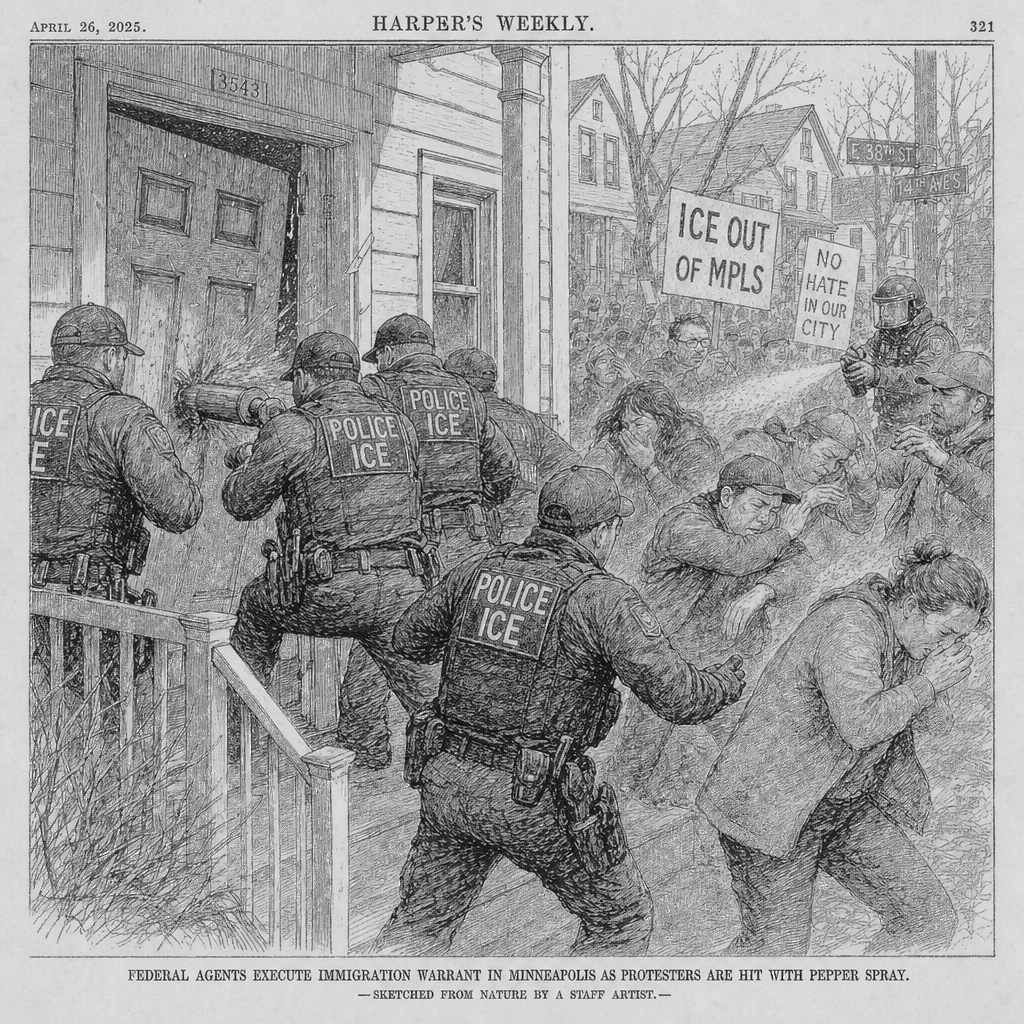
MINNEAPOLIS — Federal immigration agents rammed the door of a Minneapolis home Sunday and forced their way inside after pepper-spraying protesters who had confronted the heavily armed agents outside, according to video recorded by The Associated Press. A man was handcuffed and led away within minutes, arrested using a document signed by an immigration officer — not a court-issued warrant — which does not authorize forced entry into a private residence under federal law.
The incident unfolded as the Department of Homeland Security pressed what it has called its largest immigration enforcement operation ever in the Twin Cities, four days after an ICE officer fatally shot 37-year-old Renee Good, deepening tensions between federal authorities and Minneapolis residents and drawing protests in cities across the country.
The arrest and the warrant question
Along the residential street where Sunday’s arrest took place, protesters honked car horns, banged on drums and blew whistles in attempts to disrupt the operation. Some agents pushed back against the crowd before using pepper spray, AP video showed. A distraught woman later emerged from the home carrying the document federal agents had presented to make the arrest.
The document was signed by an immigration officer rather than a judge. A warrant signed by an immigration officer authorizes arrest only in a public area and does not permit forced entry into a private residence, the AP reported. Immigrant advocacy groups have conducted extensive “know-your-rights” campaigns urging people not to open their doors unless agents present a court order signed by a judge.
More than 2,000 immigration arrests have been made in Minnesota since the enforcement operation began at the beginning of December, Homeland Security spokesperson Tricia McLaughlin said. Homeland Security Secretary Kristi Noem told Fox News on Sunday that the administration would send additional federal agents to Minnesota to protect immigration officers and continue enforcement.
Schools, observers and community response
“We’re seeing a lot of immigration enforcement across Minneapolis and across the state, federal agents just swarming around our neighborhoods,” said Jason Chavez, a Minneapolis city councilmember who represents an area with a growing immigrant population. “They’ve definitely been out here.”
On Monday, Minneapolis public schools will start offering remote learning for the next month in response to concerns that children might feel unsafe venturing out while tensions remain high. Many schools had closed the previous week following Good’s shooting and the upheaval that followed.
More than 20,000 people have taken part in trainings to become observers of enforcement activities in Minnesota since the 2024 election, said Luis Argueta, a spokesperson for Unidos MN, a local human rights organization. People holding whistles positioned themselves in freezing temperatures on street corners Sunday in the neighborhood where Good was killed, watching for any signs of federal agents.
“It’s a role that people choose to take on voluntarily, because they choose to look out for their neighbors,” Argueta said.
Investigation dispute
Minneapolis Mayor Jacob Frey and U.S. Sen. Tina Smith said Sunday that the investigation into Good’s killing should not be overseen solely by the federal government. Both said in separate interviews that state authorities should be included.
“How can we trust the federal government to do an objective, unbiased investigation, without prejudice, when at the beginning of that investigation they have already announced exactly what they saw — what they think happened,” Smith said on ABC’s “This Week.”
The Trump administration has defended the ICE officer who shot Good, saying he was protecting himself and fellow agents and that Good had “weaponized” her vehicle. Todd Lyons, acting director of U.S. Immigration and Customs Enforcement, defended the officer on Fox News on Sunday.
“That law enforcement officer had milliseconds, if not short time to make a decision to save his life and his other fellow agents,” Lyons said.
Protests spread nationally
Good’s killing and the shooting of two people by federal agents in Portland, Oregon, led to protests across the country over the weekend, including demonstrations in New York, Los Angeles, Washington, D.C., and Oakland, California.
Lyons said the administration’s enforcement operations in Minnesota would not be necessary “if local jurisdictions worked with us to turn over these criminally illegal aliens once they are already considered a public safety threat by the locals.”