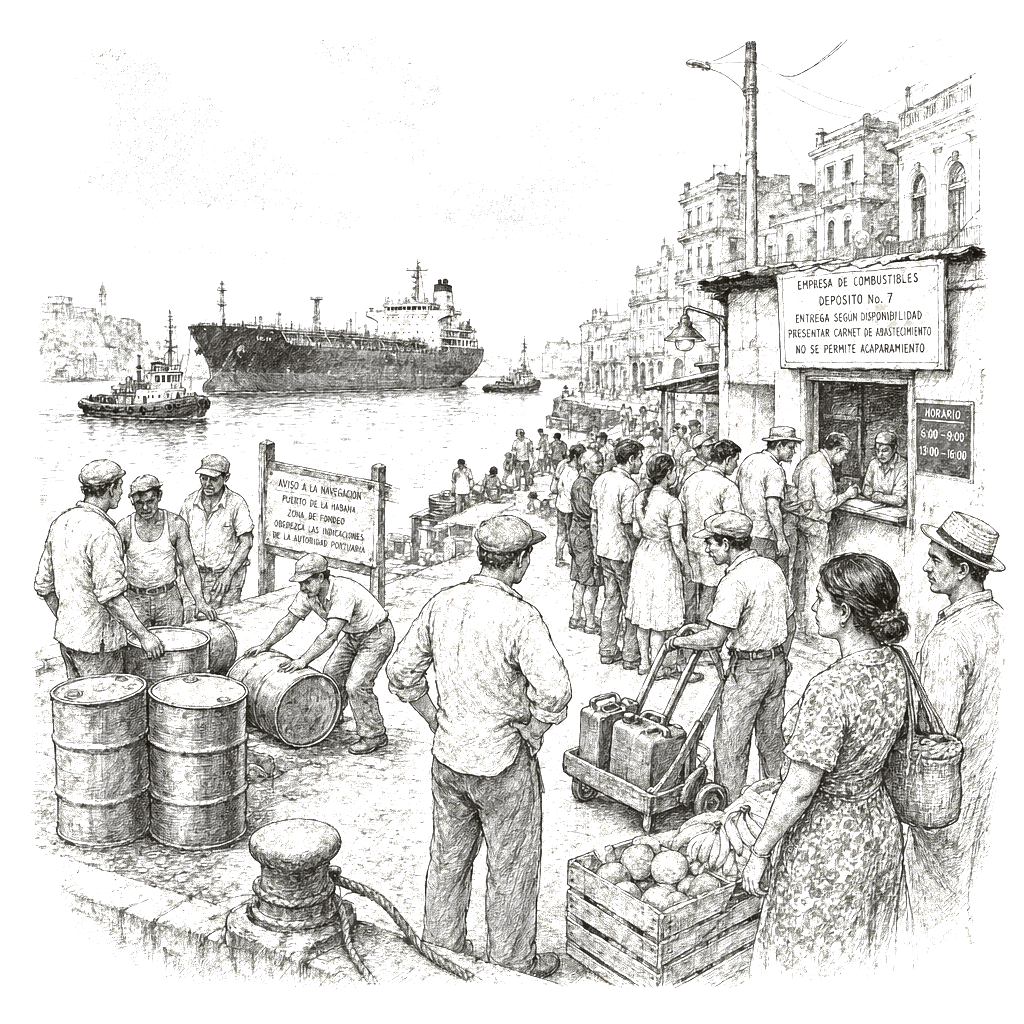
Cuba is bracing for new strains on its government and economy as the United States increases seizures of Venezuela-linked oil tankers, according to reporting by the Associated Press.
The AP said concerns in Cuba have sharpened amid fears that a sudden halt in Venezuelan oil shipments could intensify the hardships already driving outages, shortages, unrest worries, and migration plans. The report tied the current alarm to a Jan. 3 incident in which former President Nicolás Maduro was captured, setting off fresh uncertainty about what could follow in the oil supply chain.
Long before that Jan. 3 attack, the AP said, Cuba was already facing severe blackouts. Residents described long lines at gas stations and supermarkets as the island’s economic crisis deepened, with electricity supply failures sidelining day-to-day life.
Michael Galant, a senior research and outreach associate at the Center for Economic and Policy Research in Washington, D.C., told AP that a lack of Venezuelan oil would take an already dire situation “to new extremes.” He also described such a breakdown as “what a collapsing economy looks like.”
Galant told AP he believes the Trump administration’s goal is to induce suffering in the civilian population “as to instigate some sort of uprising, regime change.” He also said this “sort of besiegement of Cuba is very intentional,” while adding that it is difficult to predict what would spark “actual regime instability.” Galant said that, in his view, the approach amounts to “wait them out” from the perspective of U.S. Secretary of State Marco Rubio, with “There’s always a breaking point.”
The AP reported that from 2020 to 2024 Cuba’s population fell by 1.4 million, with experts largely attributing the decline to migration spurred by the worsening crisis. Juan Carlos Albizu-Campos, a Cuban economist and demographics expert, said those with means had already left but that migration would continue, arguing that “Fuel is a factor that affects everything” and that people who had not previously considered leaving would start to feel they need to do so.
On the ground in Havana, 16-year-old student Amanda Gómez told AP, “I’d be lying if I told you that I don’t want to leave the country.” She said, “We’re all thinking about leaving, from the youngest to the oldest,” framing the uncertainty as affecting families across age groups. The AP also described Ernesto Macías, 53, standing in line at the Spanish embassy in Havana to request a visa for a daughter he said he already had Spanish citizenship for. Macías told AP he wouldn’t want Cuba to be invaded, and said, “I hope it doesn’t happen,” but added that he expects “people will continue to emigrate because there is no other way.”
The AP said Cuba’s gross domestic product has fallen 15% in the last six years and that President Miguel Díaz-Canel pointed to a 4% decrease in 2025. The report said Cuba had relative prosperity between 2000 and 2019 driven by tourism and services exports, as well as nickel, rum and tobacco. It said the crisis accelerated after the COVID-19 pandemic, alongside what the AP described as a radical increase in U.S. sanctions during Trump’s second administration.
Even with other sources, the AP said, Cuba’s system has remained vulnerable because the island depends on Venezuela for oil. It cited Jorge Piñón of the Energy Institute at the University of Texas at Austin, who AP said tracks shipments using oil tracking services and satellite technology, and reported estimated deliveries of 35,000 barrels a day from Venezuela before the U.S. attack, along with about 5,500 barrels daily from Mexico and roughly 7,500 from Russia. The AP said blackouts persisted even with those shipments.
Jorge Duany, with the Cuban Research Institute at Florida International University, told AP that an “indefinite shutdown of the electrical system” could be envisioned under a total suspension of Venezuelan oil shipments, which he said “seems to be the current strategy of the American government.” Duany said it would lead people to imagine the possibility of mass protests.
Andy S. Gómez, a retired dean of the School of International Studies and senior fellow in Cuban Studies at the University of Miami, told AP he does not foresee the downfall of Cuba while Raúl Castro is still alive and running the military. Gómez said there is concern, adding that “They’re not well armed; their equipment is outdated.” He also said civilians aren’t armed and that it’s unlikely one of the army’s three factions would break with the ruling elite.
Gómez told AP that “someone is going to have to take the big pill,” and he framed it as either Díaz-Canel or Prime Minister Manuel Marrero Cruz, saying the problems could force a political change that would follow the leadership line rather than end the system. He said even if unrest leads to the ouster of a top official, the replacement would likely be a well-known figure and would amount to “a continuation of the government.”