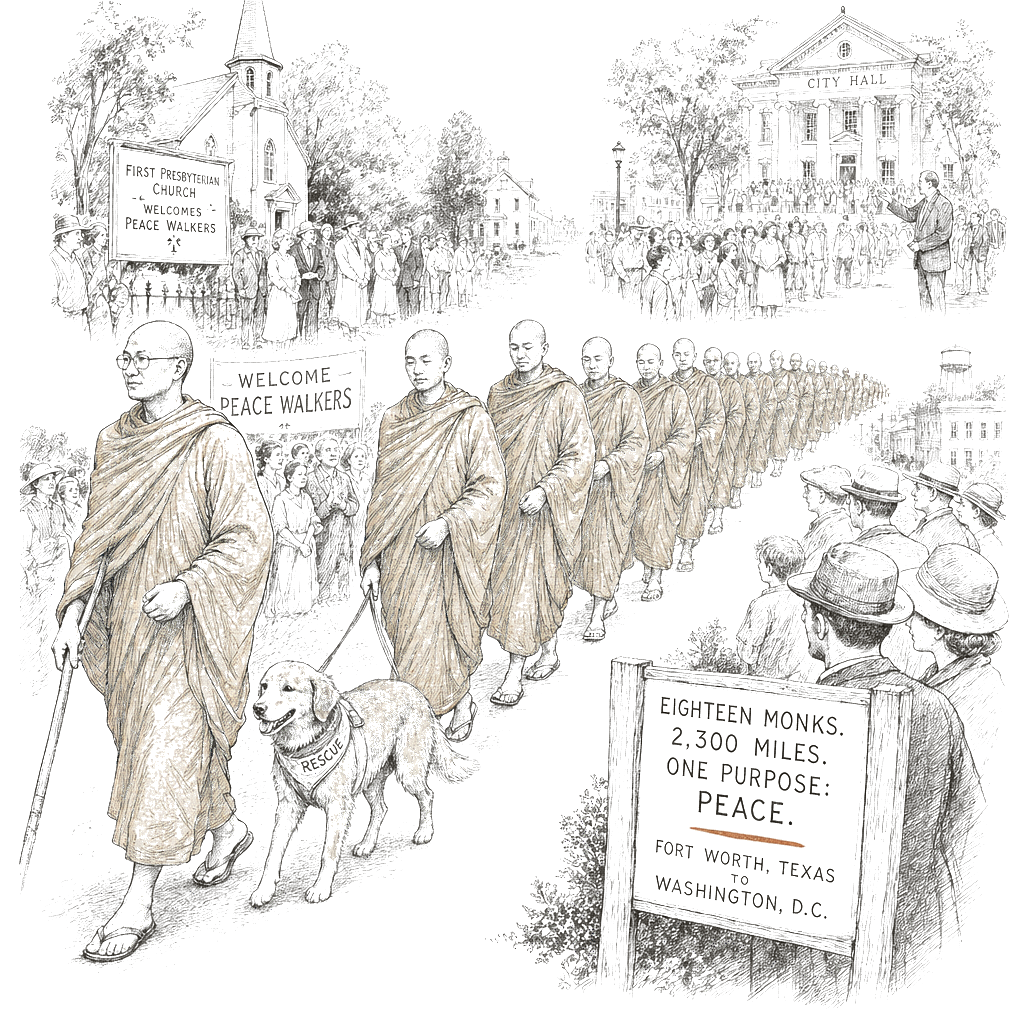
The walk, rooted in a Theravada Buddhist tradition of meditative pilgrimage, has transcended religious and political lines in a divided country, drawing Christians, spiritual seekers and the grief-stricken alike. The group plans to reach Washington in mid-February to ask Congress to recognize Vesak — marking the birth and enlightenment of the Buddha — as a federal holiday.
Eighteen Buddhist monks in saffron and ocher robes are walking single file across the American South, drawing thousands of onlookers to churchyards, city halls and town squares along a 2,300-mile (3,700-kilometer) route from Fort Worth, Texas, to Washington, D.C.
Led by the Venerable Bhikkhu Pannakara, who makes the trek barefoot and teaches mindfulness and forgiveness at every stop, the group has attracted large crowds across six states since setting out on Oct. 26, 2025, from the Huong Dao Vipassana Bhavana Center in Fort Worth. Accompanying the monks is Aloka, a rescue dog whose name means “divine light” in Sanskrit. On Saturday, thousands gathered at the South Carolina State House in Columbia, where the monks chanted on the steps and Mayor Daniel Rickenmann issued the group a formal proclamation.
“My hope is, when this walk ends, the people we met will continue practicing mindfulness and find peace,” Pannakara said.
The journey, scheduled to end in mid-February 2026, carries a legislative aim: when the monks arrive in Washington, they plan to ask Congress to recognize Vesak — marking the birth and enlightenment of the Buddha — as a federal holiday. Long Si Dong, a spokesperson for the Fort Worth temple, described the potential recognition as “a day of reflection, compassion and unity for all people regardless of faith.”
Crossing religious and political lines
The walk has drawn people well beyond Buddhist circles. In Opelika, Alabama, on Christmas night, the Rev. Patrick Hitchman-Craig hosted the monks at his United Methodist congregation expecting a small turnout. About 1,000 people arrived.
“Anyone who is working for peace in the world in a way that is public and sacrificial is standing close to the heart of Jesus, whether or not they share our tradition,” Hitchman-Craig said. “I was blown away by the number of people and the diversity of who showed up.”
At a stop Thursday in Saluda, South Carolina, Audrie Pearce drove four hours from her village of Little River to join the crowd lining Main Street. She described herself as spiritual but not religious. She teared up when Pannakara handed her a flower.
“There’s something traumatic and heart-wrenching happening in our country every day,” Pearce said. “I looked into their eyes and I saw peace. They’re putting their bodies through such physical torture and yet they radiate peace.”
Becki Gable of Cullman, Alabama, drove nearly 400 miles (about 640 kilometers) to catch up with the monks in Saluda. Raised Methodist, Gable said she sought relief from the grief of losing her daughter and parents.
“I just felt in my heart that this would help me have peace,” she said. “Maybe I could move a little bit forward in my life.”
The physical cost of the walk
The journey has exacted a heavy toll. On Nov. 19, 2025, as the group made its way along U.S. Highway 90 near Dayton, Texas, an escort vehicle was struck by a distracted truck driver. Two monks were injured; one lost his leg, reducing the group from 19 to 18. Pannakara’s own feet are heavily bandaged from stepping on rocks, nails and glass along the route.
The American landscape has presented logistical challenges that South Asia does not. “In India, we can do shortcuts through paddy fields and farms, but we can’t do that here because there are a lot of private properties,” Pannakara said. “But what’s made it beautiful is how people have welcomed and hosted us in spite of not knowing who we are and what we believe.”
Aloka and the tradition behind the walk
Pannakara first encountered Aloka during a 112-day walk across India in 2022. Then a stray, the dog followed the monks from Kolkata in eastern India all the way to the Nepal border. When Aloka fell critically ill, Pannakara carried him and nursed him back to health.
“I named him light because I want him to find the light of wisdom,” Pannakara said.
Hailing from Theravada Buddhist monasteries across the globe, the monks practice Vipassana meditation — an ancient technique focused on the mind-body connection, observing breath and physical sensations to understand impermanence and suffering. Pannakara has told gathered crowds that the walk is not a conversion effort.
Brooke Schedneck, professor of religion at Rhodes College in Memphis, Tennessee, said the peace walk tradition in Theravada Buddhism dates to the 1990s, when the Venerable Maha Ghosananda, a Cambodian monk, led marches across areas riddled with landmines to foster national healing after civil war and genocide.
“These walks really inspire people and inspire faith,” Schedneck said. “The core intention is to have others watch and be inspired, not so much through words, but through how they are willing to make this sacrifice by walking and being visible.”
The monks’ trek is a separate endeavor from a $200 million campaign by the Fort Worth temple to build monuments on its 14-acre property to house the Buddha’s teachings engraved in stone, according to Dong.