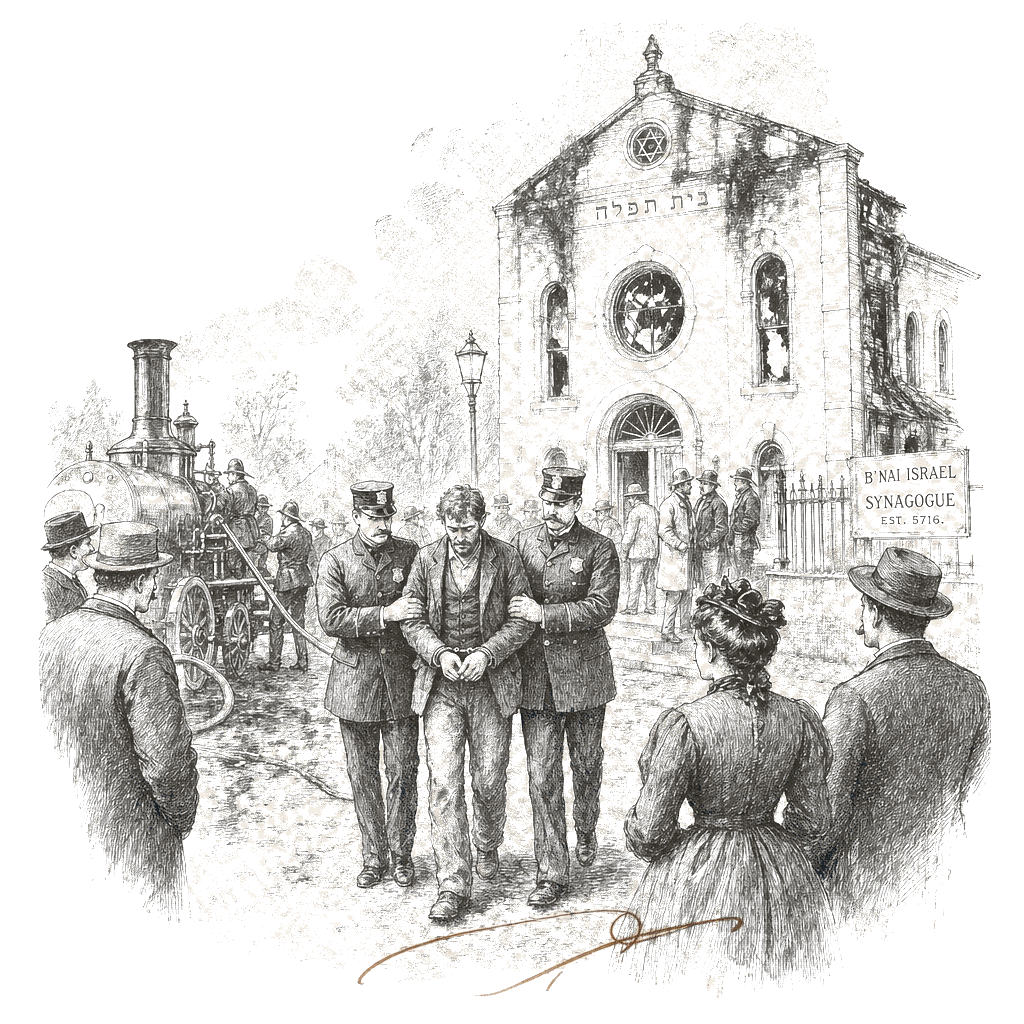
Religious leaders, civil rights activists, and national Jewish organizations condemned the fire as an attack on both Jewish heritage and a shared legacy of Black-Jewish solidarity in the American South, even as the identity of the suspect and any motive remained under investigation.
A person was arrested on suspicion of arson Sunday after a fire heavily damaged Beth Israel Congregation in Jackson, Mississippi — the state’s largest synagogue and the only one in Jackson — which the Ku Klux Klan bombed in 1967 for the congregation’s role in the civil rights movement. The fire broke out shortly after 3 a.m. Saturday; no congregants or firefighters were injured, authorities said.
Firefighters arrived to find flames billowing out of windows and all doors to the synagogue locked, said Charles D. Felton Jr., chief of investigations for the Jackson Fire Department. Local and federal authorities, including agents from the FBI and the Bureau of Alcohol, Tobacco, Firearms and Explosives, arrested one person for investigation of arson at a hospital, where that person had non-life-threatening burns, Felton said. The suspect’s name was not being immediately released.
A spokesperson for the Jackson FBI said the agency was “working with law enforcement partners on this investigation.”
A synagogue with deep roots in civil rights history
Founded approximately 160 years ago, Beth Israel is Mississippi’s largest synagogue. The Institute of Southern Jewish Life, which also houses its offices in the building, noted the congregation was targeted by the Ku Klux Klan in 1967 — a response to its active support of the civil rights movement. The home of the synagogue’s rabbi, an outspoken critic of racial segregation, was bombed two months later by the same group.
The fire caused its worst damage in the synagogue’s administrative office and library, where two Torahs were destroyed, according to a synagogue representative. Five Torahs inside the sanctuary are being assessed for smoke damage; floors, walls, and ceiling there were covered in soot. One Torah that survived the Holocaust was protected behind glass and was not damaged, said Michele Schipper, CEO of the Institute of Southern Jewish Life and a past president of the congregation.
Condemnations
Religious leaders and national organizations condemned the attack on a building whose history is bound up with interfaith partnership.
“That history reminds us that attacks on houses of worship, whatever their cause, strike at the heart of our shared moral life,” said CJ Rhodes, a prominent Black Baptist pastor in Jackson, in a statement posted to Facebook.
Jim Berk, CEO of the Simon Wiesenthal Center, a Los Angeles-based organization focused on combating antisemitism, framed the fire as an assault on a shared legacy.
“It was an assault on the heart of Jewish life in the South, and on a legacy shaped in partnership with the Black community through the long, unfinished struggle for civil rights,” Berk said in a statement. “This attack is not only an act of antisemitism, it is an assault on that legacy, testing whether the lessons of that era still hold.”
Jonathan Greenblatt, CEO of the Anti-Defamation League, placed the fire in a national context.
“That it has been attacked again, amid a surge of antisemitic incidents across the US, is a stark reminder: antisemitic violence is escalating, and it demands total condemnation and swift action from everyone,” Greenblatt said in a statement.
Congregation plans to continue services
The Beth Israel congregation said it would continue its regular worship programs and Shabbat services, likely at one of the local churches that reached out to offer space, Schipper said. The congregation is still assessing the full extent of the damage.
“We are a resilient people,” said Zach Shemper, president of Beth Israel Congregation. “With support from our community, we will rebuild.”