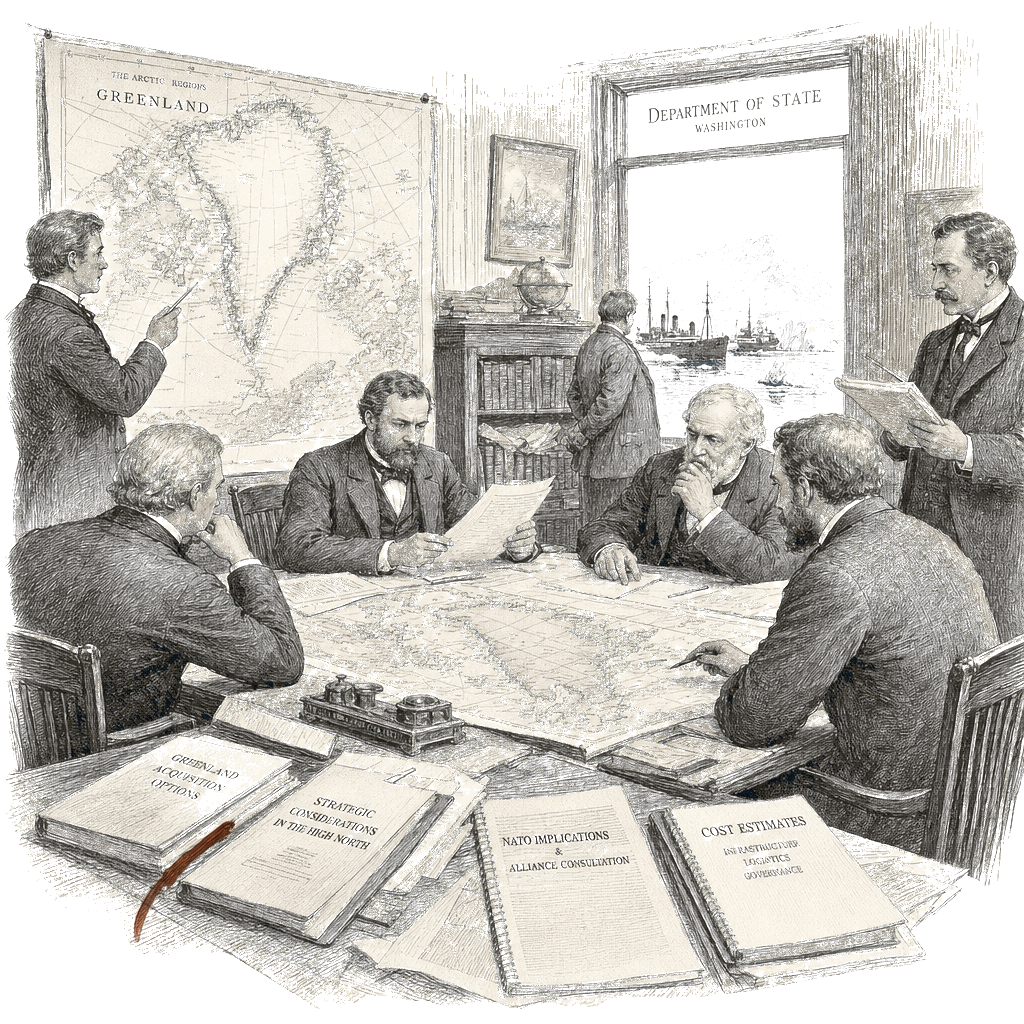
The White House is considering a range of options to acquire Greenland, including military force, after U.S. officials met Thursday in Washington with counterparts from Denmark and Greenland and agreed to meet again the following week. President Donald Trump said Friday the United States would act on Greenland “whether they like it or not,” adding that if a deal was not reached “the easy way, we’re going to do it the hard way.” Danish Prime Minister Mette Frederiksen has warned that an American takeover of Greenland would mark the end of NATO. Greenlanders have said they do not want to become part of the United States.
Analysts say each pathway open to the Trump administration — from military seizure to purchase to a Pacific-style compact arrangement — carries significant costs or risks, and that the U.S. already holds broad strategic access to Greenland under a 1951 defense agreement that Denmark and Greenland have not sought to revoke.
The White House is weighing a range of options to take control of Greenland — including military force, outright purchase, or a Pacific-style security compact — but analysts say each carries substantial risks or costs that may outweigh what the U.S. stands to gain beyond what it already holds under a 1951 defense agreement with Denmark.
Officials from Denmark, Greenland, and the United States met Thursday in Washington to discuss the renewed push by the Trump administration. The parties agreed to meet again the following week. President Donald Trump said Friday the United States would act on Greenland “whether they like it or not,” adding, “If it’s not done ‘the easy way, we’re going to do it the hard way.’”
In an interview Thursday with The New York Times, Trump said he wants to own Greenland because “ownership gives you things and elements that you can’t get from just signing a document.”
Military force: a NATO-ending move
Analysts said a military takeover of Greenland — the world’s largest island, with a population of around 57,000 and no military of its own — would risk shattering the transatlantic alliance.
“If the United States chooses to attack another NATO country militarily, then everything stops,” Danish Prime Minister Mette Frederiksen said.
Imran Bayoumi, an associate director at the Atlantic Council’s Scowcroft Center for Strategy and Security, said he doubted Trump would pursue a military seizure. He described the option as unpopular with both Democratic and Republican lawmakers and said it would likely “fundamentally alter” U.S. relationships with allies worldwide.
Ulrik Pram Gad, an expert on Greenland at the Danish Institute for International Studies (DIIS), said “blowing up the NATO alliance” for something the U.S. already effectively possesses does not make strategic sense. The existing 1951 agreement grants Washington the right to operate military bases and to bring as many troops as it wants to Greenland, Gad and other analysts noted.
Trump has cited the threat from Russian and Chinese ships in the region as a rationale for seeking control. Lin Mortensgaard, an expert on Arctic international politics at DIIS, said that justification is “not true.” While Russian submarines likely operate across the Arctic, there are no Russian surface vessels in the area near Greenland, Mortensgaard said. China has research vessels in the Central Arctic Ocean, and Russo-Chinese military exercises in the Arctic have taken place closer to Alaska, she said.
Bayoumi said the sudden fixation on Greenland reflects decades of U.S. neglect of Arctic strategy. “The realization we need to increase our presence in the Arctic, and we don’t yet have the right strategy or vision to do so,” he said.
Purchase: possible intent, uncertain price
Secretary of State Marco Rubio told a select group of U.S. lawmakers this week that the administration’s intention is to eventually purchase Greenland rather than take it by force, according to the AP report. Danish and Greenlandic officials have previously said the island is not for sale.
It is not clear how much a purchase would cost or whether the U.S. would be negotiating with Denmark, Greenland, or both.
A Pacific compact: precedent exists, improvement unclear
One option Gad raised would involve the U.S. obtaining a veto over Greenlandic security decisions in exchange for economic support — modeled on the Compact of Free Association (COFA) the United States holds with Palau, Micronesia, and the Marshall Islands. Under that arrangement, according to the Congressional Research Service, Washington gains the right to operate military bases and make security decisions in exchange for U.S. security guarantees and around $7 billion in yearly economic assistance.
Analysts said it is unclear how much a COFA-style arrangement would improve Washington’s current position. The U.S. already operates the remote Pituffik Space Base in northwestern Greenland, which supports missile warning, missile defense, and space surveillance operations for the U.S. and NATO.
Influence operations: language and welfare as barriers
Aaja Chemnitz, a Greenlandic politician, told the AP that Greenlanders want more rights, including independence, but do not want to become part of the United States.
Gad said influence operations aimed at persuading Greenlanders to join the U.S. would likely fail. The island’s community is small and its language is “inaccessible,” he said. Danish Foreign Minister Lars Løkke Rasmussen summoned the top U.S. official in Denmark in August to complain that “foreign actors” were seeking to influence the country’s future. Danish media reported that at least three people with connections to Trump carried out covert influence operations in Greenland.
Even if the U.S. managed to take control of the island, it would face a substantial financial obligation. Greenlanders currently hold Danish citizenship and access to the Danish welfare system, including free health care and schooling. “Trump would have to build a welfare state for Greenlanders that he doesn’t want for his own citizens,” Gad said.
The diplomatic floor: an updated defense agreement
Gad said the best achievable outcome for Denmark would be an updated defense agreement signed by Trump with a “gold-plated signature.” But he said he doubted that would happen, because Greenland remains useful to the president as a political lever.
When Trump wants to shift the news agenda, Gad said, “he can just say the word ‘Greenland’ and this starts all over again.”
The U.S. military presence in Greenland has decreased from thousands of soldiers across 17 bases and installations since 1945 to roughly 200 personnel at Pituffik Space Base in the northwest of the island, Rasmussen said last year. The base supports early warning systems for both the U.S. and NATO.