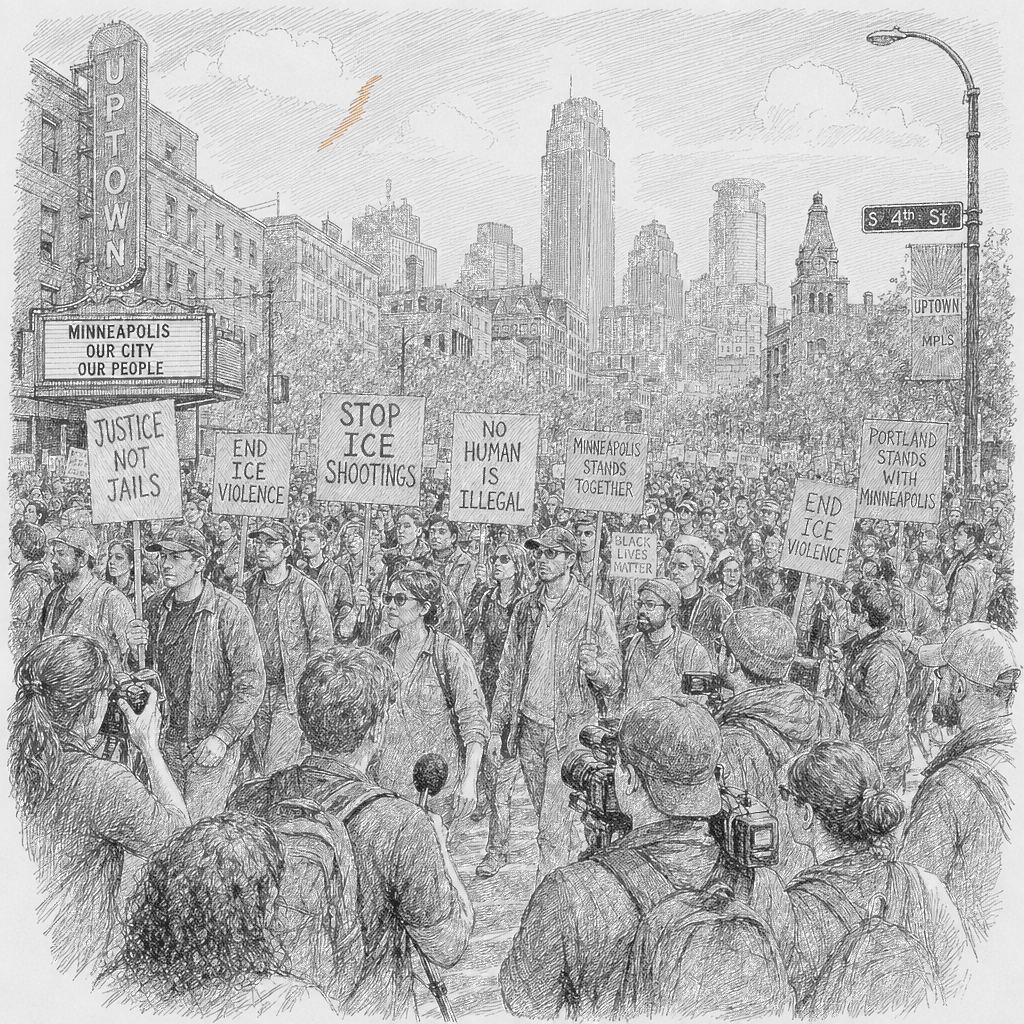
The demonstrations unfolded as the U.S. Department of Homeland Security said its deployment of immigration officers in the Twin Cities represents its largest immigration enforcement operation ever, with more than 2,000 federal officers taking part in a crackdown the Trump administration tied in part to allegations of fraud involving Somali residents.
MINNEAPOLIS — Thousands of people marched in Minneapolis on Saturday to protest the fatal shooting of a woman by a federal immigration officer, as hundreds of demonstrations took place in cities and towns across the country, from Texas and Florida to North Carolina. Minnesota’s governor and the city’s mayor urged participants to remain peaceful amid a city on edge.
“We’re all living in fear right now,” said Meghan Moore, a mother of two from Minneapolis who joined the march. “ICE is creating an environment where nobody feels safe and that’s unacceptable.”
The protest was one of hundreds organized nationally over the weekend following the killing of Renee Good, 37, by an Immigration and Customs Enforcement officer in Minneapolis on Wednesday and the shooting of two people — who were not protesters — in Portland, Oregon.
Violence marred Friday night protest
Saturday’s demonstration came a day after a protest outside a Minneapolis hotel attracted about 1,000 people and turned violent. Demonstrators threw ice, snow and rocks at officers, Minneapolis Police Chief Brian O’Hara said. One officer suffered minor injuries after being struck with a piece of ice, and 29 people were cited and released, O’Hara said.
Minneapolis Mayor Jacob Frey said those who damage property or endanger others will be arrested, attributing the violence to “agitators that are trying to rile up large crowds.”
“This is what Donald Trump wants,” Frey said. “He wants us to take the bait.”
Minnesota Gov. Tim Walz issued calls for restraint on social media.
“Trump sent thousands of armed federal officers into our state, and it took just one day for them to kill someone,” Walz said. “Now he wants nothing more than to see chaos distract from that horrific action. Don’t give him what he wants.”
“We will fight with peaceful expression, in court, through public debate, and at the ballot box. Keep the peace. And keep the faith,” Walz said in a subsequent post.
Marchers brave subfreezing temperatures
Saturday’s march began in a park about half a mile from the residential neighborhood where Good was killed. Protesters braved subfreezing temperatures and light snow, carrying handmade signs declaring “De-ICE Minnesota!” and “ICE melts in Minnesota.” They marched down a street lined with restaurants and stores where various nationalities and cultures are celebrated in colorful murals.
Connor Maloney said he attended because of his frustration with the immigration crackdown. “Almost daily I see them harassing people,” he said. “It’s just sickening that it’s happening in our community around us.”
In Durham, North Carolina, Steven Eubanks, 51, said he felt compelled to attend a local protest because of what he described as the “horrifying” killing in Minneapolis.
“We can’t allow it,” Eubanks said. “We have to stand up.”
Indivisible, a social movement organization, said hundreds of protests were scheduled in Texas, Kansas, New Mexico, Ohio, Florida and other states.
ICE operations continued during the march
The large protest did not appear to deter federal officers from operating elsewhere in Minneapolis. An Associated Press photographer witnessed heavily armed officers — at least one in Border Patrol uniform — approach a person who had been following them during the demonstration. Two of the agents had long guns out when they ordered the person to stop, telling him it was his “first and final warning.” The agents eventually drove onto the interstate without detaining the driver.
In Richfield, a suburb of Minneapolis, federal agents with their faces covered pointed their fingers at journalists and warned them to stay away as they detained a man outside a home improvement store.
O’Hara said city police have been responding to calls about cars abandoned after their drivers were apprehended by immigration enforcement. In one case a car was left in park; in another, a dog was left inside a vehicle.
O’Hara said immigration enforcement activities are happening “all over the city” and that 911 callers have been alerting authorities to ICE activity, arrests and abandoned vehicles.
The U.S. Department of Homeland Security said its deployment of immigration officers in the Twin Cities is its biggest-ever immigration enforcement operation, with more than 2,000 officers taking part. The Trump administration said both the Minneapolis and Portland shootings were acts of self-defense against drivers who “weaponized” their vehicles to attack officers.
Neighborhood protests near the site of Good’s death have been largely peaceful, with minimal law enforcement presence. Near the airport, some confrontations between smaller groups of protesters and officers guarding the federal building used as a base for the Twin Cities operation erupted on Thursday and Friday.
Congress denied facility access
Three Minnesota congresswomen attempted to tour the ICE facility inside the Minneapolis federal building on Saturday morning. Reps. Ilhan Omar, Kelly Morrison and Angie Craig were initially allowed to enter but were told to leave roughly 10 minutes later. The three accused ICE agents of obstructing members of Congress from fulfilling their oversight duties.
A federal judge last month temporarily blocked the Trump administration from enforcing policies that limit congressional visits to immigration facilities. The ruling stems from a lawsuit filed by 12 members of Congress who sued after they were denied entry to detention facilities.