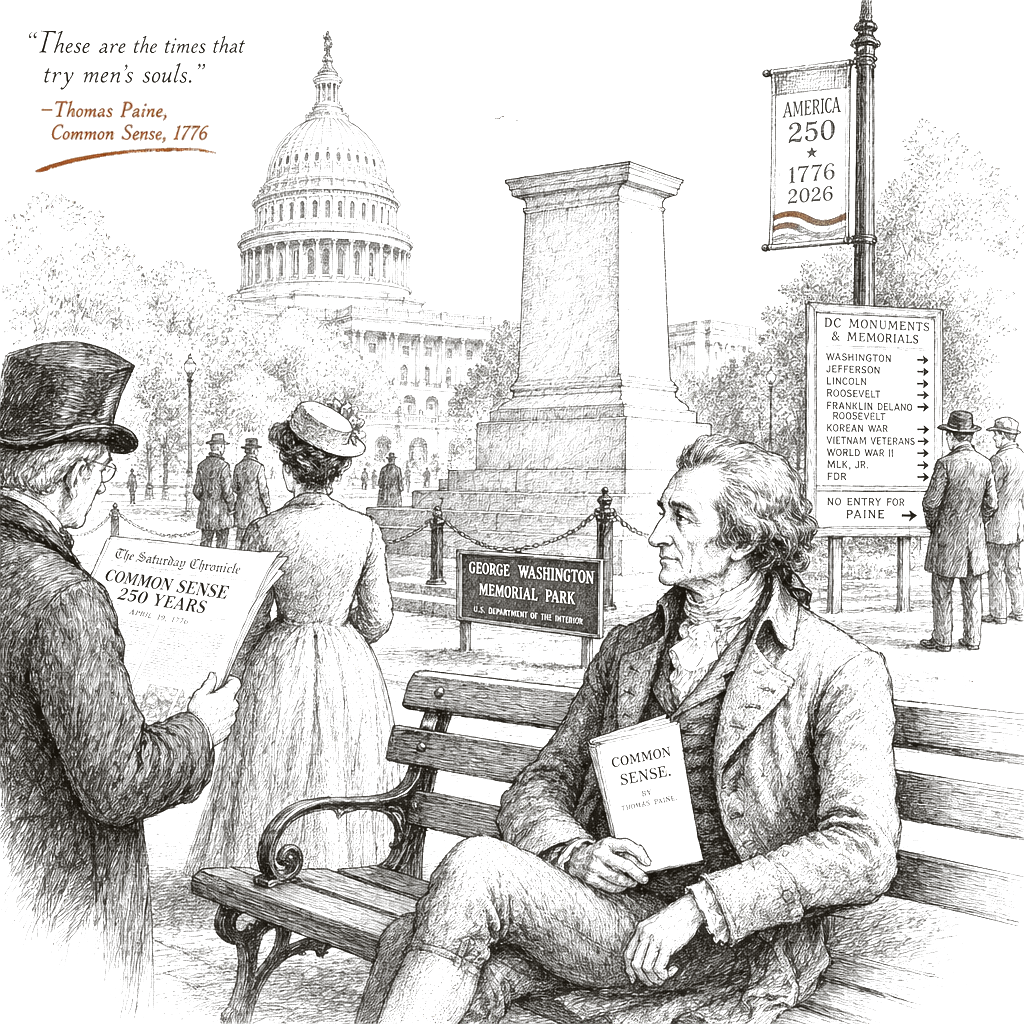
A long wait, and a failed precedent
The current effort is not the first. In 1992, President George H.W. Bush signed bipartisan legislation authorizing a DC memorial for Paine — supported by lawmakers as ideologically distant as Democratic Sen. Ted Kennedy of Massachusetts and Republican Sen. Jesse Helms of North Carolina. The project failed to attract adequate funding and was essentially forgotten by the mid-2000s.
Federal memorials are authorized by Congress but typically built through private donations, a structure that has left the current effort dependent on both political support and fundraising. Success is not assured.
A contested legacy
Paine was born Thomas Pain in Thetford, England, in 1737, some 90 miles outside of London, and emigrated to the colonies in 1774. He added the “e” to his last name after arriving in America. By the time he sailed for the New World, he had struggled with debt, married twice, and failed in virtually every profession he had entered — from teaching to working as a government excise officer. A letter of introduction from Benjamin Franklin helped him find work in Philadelphia as a contributor to The Pennsylvania Magazine.
“Common Sense” was released on Jan. 10, 1776, credited to “an Englishman.” Later expanded to 47 pages, it was widely shared, read aloud, and discussed. Paine’s accessible prose was credited with helping shift public opinion from opposing British aggression to calling for a full break with Britain. He did not merely attack the actions of King George III; he denounced the very concept of hereditary monarchy as “evil” and “exceedingly ridiculous.”
“Of more worth is one honest man to society and in the sight of God, than all the crowned ruffians that ever lived,” he wrote.
John Adams called Paine a “star of disaster.” Benjamin Franklin worried about his “rude way of writing.” George Washington valued “Common Sense” for its “sound doctrine” and “unanswerable reasoning,” and Thomas Jefferson later befriended Paine and invited him to the White House.
Later in life, Paine published “The Age of Reason” in installments beginning in 1794 — a fierce attack on organized religion. Paine believed in God but rejected all organized faiths. He described the Bible’s “paltry stories” and said Christianity was “too absurd for belief.” By the time of his death in New York in 1809, he had been estranged from friends and many of the surviving founders; only a handful of mourners attended his funeral.
Scholars note that federal recognition for Paine would have been nearly impossible well into the 20th century. Theodore Roosevelt referred to him as a “filthy little atheist.”
Reagan opened a door
Harvey J. Kaye, author of “Thomas Paine and the Promise of America,” said the election of Ronald Reagan in 1980 marked an unexpected turning point. During his acceptance speech at the Republican National Convention, Reagan quoted Paine’s famous call to action: “We have it in our power to begin the world over again.”
“Reagan opened the door,” Kaye said. Reagan’s embrace helped make Paine acceptable across party lines, Kaye said, contributing to the bipartisan 1992 memorial legislation.
Still invoked across the political divide
Historian Eric Foner wrote that Paine’s appeal lasted through “his impatience with the past, his critical stance toward existing institutions, his belief that men can shape their own destiny.”
Today, Paine’s words appear on both sides of American political arguments. Supreme Court Chief Justice John Roberts opened his 2025 year-end report on the federal judiciary by citing the anniversary of “Common Sense,” praising Paine for “shunning legalese” as he articulated that “government’s purpose is to serve the people.”
In 2025, passages from “Common Sense” also appeared at nationwide “No Kings” rallies held against Trump administration policies. One demonstrator’s sign in Boston read: “No King! No Tyranny! It’s Common Sense.”