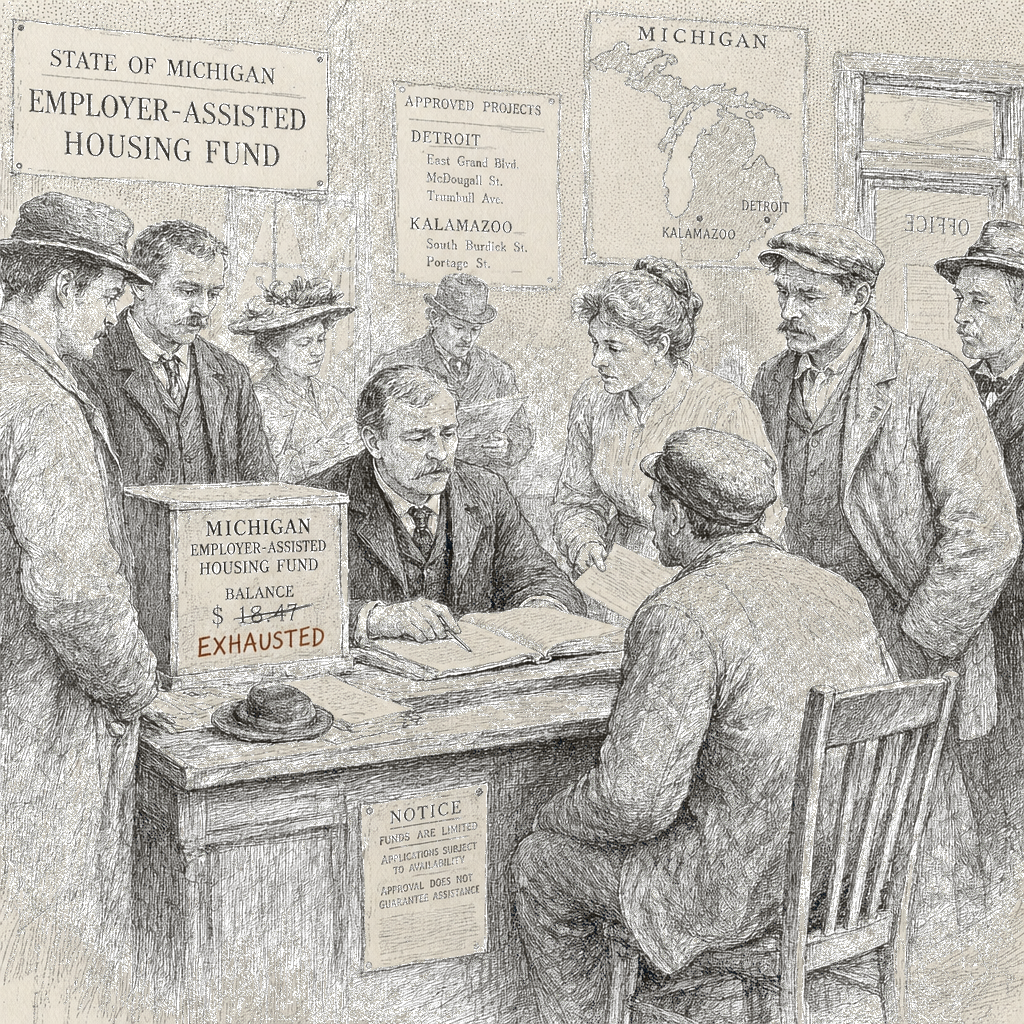
Michigan’s Employer-Assisted Housing Fund has been exhausted after the state housing authority approved $3.2 million in December for new worker housing projects in Detroit and Kalamazoo, draining a $10 million pool that Gov. Gretchen Whitmer launched in January 2025. The Michigan State Housing Development Authority signed off on both projects at its December board meeting. Whether the program — which has helped produce 619 rental units or homes across the state — will continue depends on a legislature that omitted new funding from its October budget.
The Employer-Assisted Housing Fund pairs state grants with employer contributions of equal value in cash or land, then requires participating projects to hold to affordability standards for at least five to ten years. The Whitmer administration supports continuing the program, but the state housing authority’s executive director said she does not yet know whether lawmakers share that appetite.
Michigan’s state housing authority has exhausted a $10 million employer-assisted housing fund after approving $3.2 million in December for new worker housing projects in Detroit and Kalamazoo, leaving the program’s future uncertain as state lawmakers have not committed to additional funding.
The Michigan State Housing Development Authority approved both projects at its December board meeting, draining the remaining balance of a fund Gov. Gretchen Whitmer launched in January 2025. The Whitmer administration supports continuing the program, but the housing authority’s executive director said she cannot gauge legislative appetite for it.
“I don’t know what their appetite is, to be honest,” Amy Hovey, executive director of the Michigan State Housing Development Authority, told Bridge Michigan.
The two new projects
The larger of the two December approvals — $2.5 million — will go to Bogan Asset Management, a Michigan-based real estate development firm, to build a five-story residential and commercial building in Kalamazoo blocks from downtown and adjacent to Bronson Methodist Hospital, one of the city’s largest employers. The project is expected to include approximately 84 residential units, at least 20 of which will be earmarked as employer-assisted housing. All units will be restricted to households earning at or below 120% of area median income — a maximum rent of $2,874 per month for a family of four in Kalamazoo County, according to state documents. Bogan will match the state’s grant with a land donation on behalf of the hospital.
In Detroit, the state approved $1.21 million on Dec. 18 for Detroit Affordable Homes 1, LLC, to build 12 for-sale homes on vacant residential lots within the city. State housing officials said multiple Detroit-area employers will contribute matching funds, though the firms were not identified by name in board documents. The project will use 3D concrete printing technology from Colorado-based Alquist, which previously partnered with Habitat for Humanity on what the company says was the first owner-occupied 3D-printed home in the country, completed in Virginia in December 2021. Units will be restricted to households earning at or below 120% of area median income — a maximum of $121,200 annually for a family of four in Wayne County.
A program that outpaced its seed funding
The Employer-Assisted Housing Fund was structured to multiply the state’s investment: each dollar in state grants required an equal employer match in cash or land, with the resulting housing required to remain affordable for at least five years (for-sale) or ten years (rental). According to state data, employers exceeded the match target, contributing an estimated $11.7 million in cash or land against the state’s $10 million — a combined investment of more than $21 million.
The fund has produced 619 rental units or homes statewide since its launch, 232 of which are classified specifically as employer-assisted housing units. Whitmer introduced the program by noting that Michigan had added only about one housing unit for every 14 jobs created between 2014 and 2023.
With the national median sales price of homes at $410,800 as of early 2026, according to Federal Reserve data, working households face mounting pressure to find housing at wages that don’t keep pace with ownership costs — the gap the employer-assisted model is designed to narrow.
Katie Bach, a spokesperson for the Michigan State Housing Development Authority, said in an email that the results demonstrate unmet demand. “The demand is there, and the need is real,” Bach said. ”… Now the question is identifying the resources to scale it.”
Legislative uncertainty
Michigan lawmakers did not include additional money for the Employer-Assisted Housing Fund in the state budget approved in October. Hovey described the omission as potentially “a bump in the road” for the larger effort but said the administration does not yet have assurances of a legislative commitment.
Before the December approvals exhausted the fund, the state had allocated roughly $5.4 million in May 2025 for housing in Traverse City, Flint, Petoskey, Grand Rapids, Wyoming and Royal Oak. An additional $1.4 million was approved in October for projects in Battle Creek and Newberry.
The Battle Creek project takes a different approach than others funded under the program. The Local Initiatives Support Corporation, working on behalf of the Battle Creek community, its economic development corporation and the W.K. Kellogg Foundation, received $1 million in state matching funds to create a city-specific housing development fund. Rather than matching a single employer’s contribution, the fund will pool contributions from multiple employers. The project is expected to yield 40 total units, all at or below 120% of area median income.
In Newberry, $400,000 in state funds matched a $466,500 combined cash-and-land donation from Pine Stump Property Holdings, LLC, to build four rental units reserved for employees of Pine Stump Junction, a full-service bar and restaurant, as well as employees of the holding company. All four units target households at or below 120% of area median income, which for a family of four in Luce County means a maximum rent of $2,457 per month.