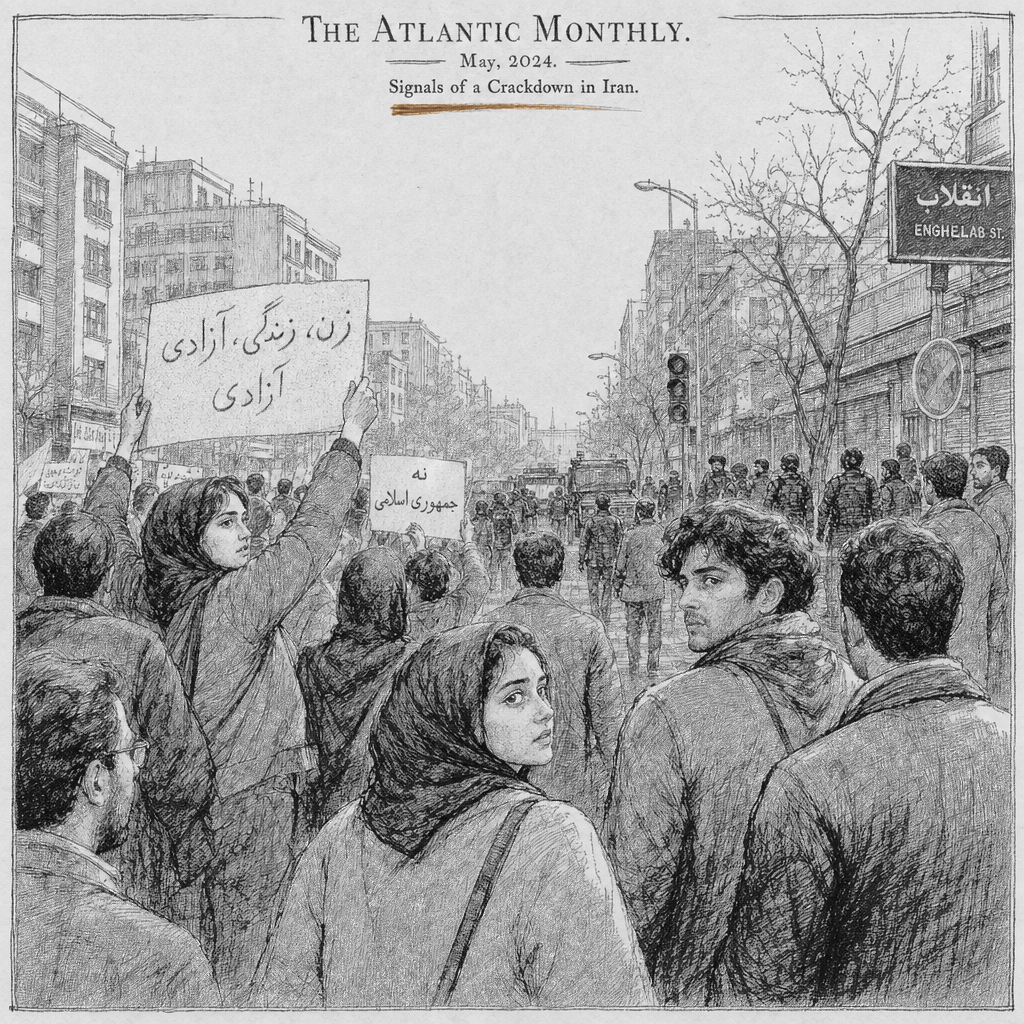
DUBAI — Iran’s supreme leader signaled an imminent crackdown on demonstrators Friday as protests across the Islamic Republic persisted into a third week, despite the government cutting internet access and severing international telephone lines. At least 65 people have been killed and more than 2,300 detained since demonstrations began in late December over the country’s ailing economy, according to the U.S.-based Human Rights Activists News Agency.
The government’s escalating response — labeling protesters “terrorists,” vowing maximum punishment, and silencing communications — came as U.S. President Donald Trump repeated threats to strike Iran militarily if demonstrators were killed, adding an international dimension to an uprising the Associated Press described as the most significant challenge to the Islamic Republic in years.
Khamenei’s warning
Speaking to a crowd at his compound in Tehran, Supreme Leader Ayatollah Ali Khamenei, 86, dismissed Trump and accused demonstrators of acting on his behalf. Supporters shouted “Death to America!” in footage aired by Iranian state television.
“Protesters are ruining their own streets … in order to please the president of the United States,” Khamenei said. “Because he said that he would come to their aid. He should pay attention to the state of his own country instead.”
Iran’s judiciary chief Gholamhossein Mohseni-Ejei separately vowed that punishment for protesters “will be decisive, maximum and without any legal leniency.” Iranian state media labeled the demonstrators “terrorists” — a designation that has preceded violent crackdowns in past rounds of unrest.
Communications blackout
Despite the internet and telephone blackout, short videos shared by activists purported to show demonstrators chanting against Iran’s government around bonfires in Tehran and other cities, the Associated Press reported. The demonstrations restarted Friday night, though it was not immediately possible to assess whether they continued at the same strength.
One video purported to show a fire in the street in the Saadat Abad area of northern Tehran with what appeared to be thousands of people gathered. A man could be heard chanting “Death to Khamenei!”
Iran’s state TV reported that violence overnight killed six people in Hamedan, about 280 kilometers (175 miles) southwest of Tehran, and two security force members in Qom, about 125 kilometers (75 miles) south of the capital. State TV had claimed the protests were violent and caused casualties but did not offer nationwide totals. Protests were also reported Friday in Zahedan in Iran’s restive southwestern Sistan and Baluchestan province.
European condemnation
Late Friday, German Chancellor Friedrich Merz, British Prime Minister Keir Starmer and French President Emmanuel Macron issued a joint statement condemning reported deadly violence against the protesters and urged Iran to allow its citizens to express themselves without fear of reprisal.
Iranian Nobel Peace Prize laureate Shirin Ebadi called on more Western governments to denounce Iran’s government, saying it “has made cruelty a governing method.”
“Some still insist on romantic myths about this regime, treating it as a defender of the oppressed abroad,” Ebadi said in a statement. “But a government that shoots peaceful protesters … at home cannot claim moral authority anywhere.”
Trump’s threats
Trump repeated threats to strike Iran if protesters were killed. Speaking Friday, he said any possible American strike would not “mean boots on the ground but that means hitting them very, very hard where it hurts.”
“Iran’s in big trouble,” Trump said. “It looks to me that the people are taking over certain cities that nobody thought were really possible just a few weeks ago.”
He added: “I tell the Iranian leaders you better not start shooting because we’ll start shooting too.”
Trump had cited his administration’s recent seizure of Venezuelan former President Nicolás Maduro as context for the credibility of his warnings.
Pahlavi’s role
The protests have also served as an early test of the influence of Crown Prince Reza Pahlavi, whose father fled Iran just before the 1979 Islamic Revolution. Pahlavi, who called for protests Thursday night, similarly called for demonstrations at 8 p.m. Friday.
On Friday, Pahlavi called on Trump to help the protesters, saying Khamenei “wants to use this blackout to murder these young heroes.”
“You have proven and I know you are a man of peace and a man of your word,” Pahlavi said in a statement. “Please be prepared to intervene to help the people of Iran.”
Holly Dagres, a senior fellow at the Washington Institute for Near East Policy, said Pahlavi’s calls proved to be a turning point.
“What turned the tide of the protests was former Crown Prince Reza Pahlavi’s calls for Iranians to take to the streets at 8 p.m. on Thursday and Friday,” Dagres said. “Per social media posts, it became clear that Iranians had delivered and were taking the call seriously to protest in order to oust the Islamic Republic.”
Dagres said the communications blackout served a dual purpose. “This is exactly why the internet was shut down: to prevent the world from seeing the protests. Unfortunately, it also likely provided cover for security forces to kill protesters.”
Demonstrations in Tehran and other cities have included chants in support of the shah — something that would have brought a death sentence in earlier years but now underlines the anger fueling the protests, the Associated Press reported.