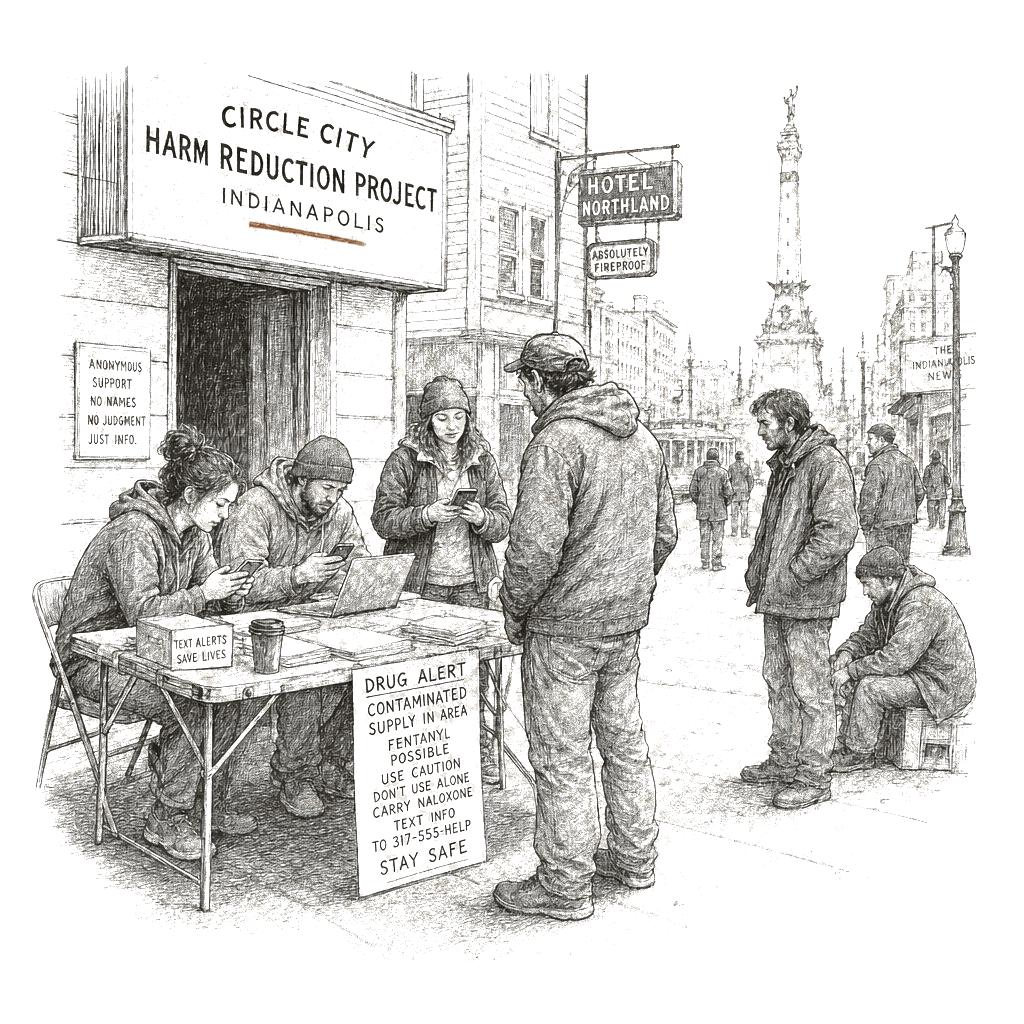
An Indianapolis nonprofit sends anonymous text alerts to drug users when the local supply is disrupted — warning of bad batches, law enforcement seizures, and newly detected contaminants — in a real-time effort to prevent fatal overdoses.
The CHARIOT program, run by Overdose Lifeline, had nearly 500 subscribers in Indianapolis as of early January 2026, the organization said. Marion County recorded 562 drug overdose deaths in 2025 and about 1,300 emergency room visits for overdose, according to the Indiana Department of Health.
The program reflects a harm-reduction approach that public health workers say keeps people alive and opens a pathway to treatment, even as overdose deaths remain a persistent toll in Indiana.
How the alerts work
Overdose Lifeline sends CHARIOT texts when it receives word of disruptions to the local drug supply chain. That can mean “bad batches” — such as methamphetamine laced with opioids — or news of drug seizures by law enforcement.
A week before Christmas, the service sent a message warning subscribers about a large seizure of meth, pressed pills, and fentanyl in the 46203 ZIP code on Indianapolis’s east side, advising them to test their drugs and carry naloxone.
Research shows overdoses spike in the weeks following police action, according to Overdose Lifeline. People may experience withdrawal or decreased tolerance and so take more risks while using.
“We’ve got to address the unintended consequences,” said Justin Phillips, the founder of Overdose Lifeline. “Otherwise we are going to lose a bunch of lives.”
A two-way system
The texts flow in both directions. Subscribers can also send information back to Overdose Lifeline. In early December, someone reported a federal raid in the 46225 ZIP code on the city’s south side, writing that a supplier of fentanyl, carfentanil, and pressed pills had been arrested.
In other cases, Phillips said, people text in warnings after testing their drugs and finding traces of fentanyl or xylazine, a tranquilizer. All messages are anonymous.
“Shame and stigma are huge,” Phillips said. “The text alerts are another way to address barriers that prevent people from getting help.”
Breanna Hicks, a director at Overdose Lifeline who runs the CHARIOT program, said the anonymity is deliberate.
“Harm reduction meets people where they are,” Hicks said. “It’s a way to keep people safe and a segue into treatment.”
Personal loss behind the work
Phillips founded Overdose Lifeline after losing her son Aaron to a heroin overdose in 2013. She subsequently worked to pass Aaron’s Law, signed in Indiana in 2015, which expanded community access to naloxone — a medication that reverses the effects of an opioid overdose.
The nonprofit distributes naloxone and fentanyl test strips at pop-up events across Indianapolis. On Jan. 7, it tabled at Presidential Place Park downtown, handing out hygiene kits, naloxone, test strips, and brochures for recovery centers.
P’lare Sanders, 45, who stays at Wheeler Mission, approached the table and picked up a naloxone package. She told Mirror Indy that her best friend died after a drug dealer began cutting meth with fentanyl.
“Her drug dealer started cutting meth with fentanyl. Just to make a dollar,” Sanders said.
Sanders said she was not carrying naloxone at the time. “I wish I would’ve had that training,” she said. “Because maybe my friend would still be here.”
Phillips said she believes her son would have benefited from tools like CHARIOT and naloxone had they been widely available a decade ago.
“Had I known about drug testing, naloxone and trying to meet him where he was,” Phillips said, “we could’ve had a different outcome.”
How to access the service
People can sign up for CHARIOT alerts by texting “CHARIOT” to 888-450-3598. Those who are using can call the Never Use Alone Hotline at 800-484-3731 to connect with a peer. Free naloxone and fentanyl test strips are available through Overdose Lifeline.