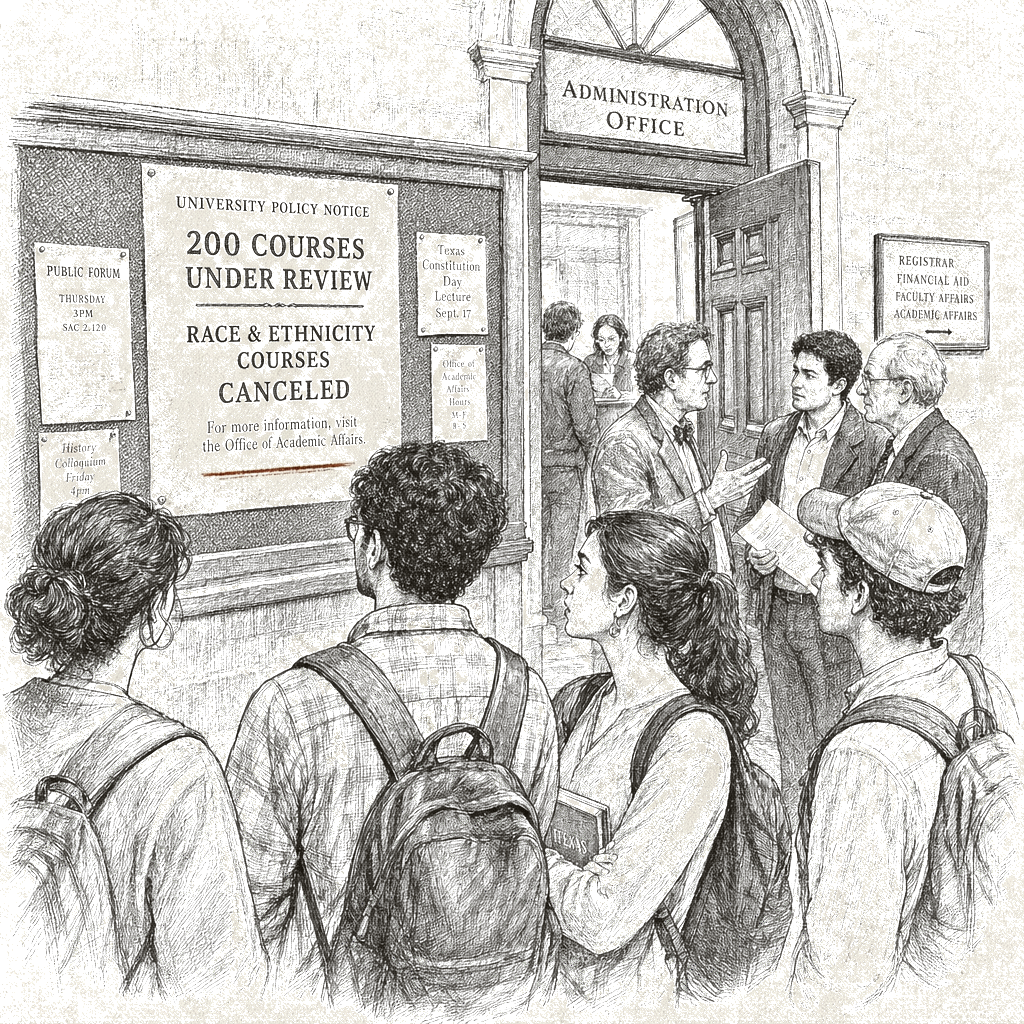
A Texas A&M University System policy restricting classroom discussion of race and gender has put roughly 200 courses in the College of Arts and Sciences under review, administrators told faculty this week, with one introductory course already canceled and a philosophy professor directed to remove Plato readings days before the spring semester begins Jan. 12.
The abrupt implementation — affecting courses some students had already registered to attend — shows how a board-level policy adopted in November is reshaping individual syllabi across one of the nation’s largest public university systems, drawing sharp criticism from faculty and academic freedom advocates.
Policy background
The Texas A&M System Board of Regents approved the policy in November, requiring campus presidents to sign off on courses that could be seen as advocating “race and gender ideology” or topics related to sexual orientation or gender identity. The action followed a student’s secret recording of a professor discussing gender identity in a children’s literature class that spread widely on social media, prompting criticism from conservative commentators.
Regents revised the policy in December, barring most discussion of those topics in introductory or core curriculum courses unless administrators determine the material serves a “necessary educational purpose” and approve it in writing. That change set off a rapid review of courses across the system ahead of the Jan. 12 semester start.
Cancellations and revisions
Emails sent by college administrators Tuesday, obtained by the Texas Tribune, showed that three courses faced immediate consequences.
SOCI 217, Introduction to Race and Ethnicity, was canceled outright. In an email to enrolled students, administrators said they “carefully considered” whether the course could comply with the revised policy and “concluded that we cannot teach this course in its present form.” Students with a “demonstrable need” to complete the course for a degree or career goal could pursue it through an independent study arrangement, the email said.
The canceled course had drawn scrutiny before the policy change. Texas Scorecard, a conservative website widely read by elected Texas Republicans and A&M regents, published stories in September and October criticizing the course’s content and identifying its instructor.
A communications course on religion and the arts was renumbered and stripped of core curriculum credit. A philosophy professor faced a starker choice.
The Plato directive
Martin Peterson, who teaches PHIL 111, Contemporary Moral Issues, submitted his syllabus for review Dec. 22. His department head told him Tuesday he had two options: remove modules on race ideology and gender ideology — including Plato readings — or be reassigned to teach a noncore philosophy course. The email gave Peterson until the close of business Wednesday to decide.
Peterson said he would revise his syllabus, replacing the Plato readings with lectures on free speech and academic freedom.
Texas A&M said in a statement that the directive did not amount to a ban on teaching Plato, noting that other sections of the same course that include Plato but do not include modules on race and gender ideology had been approved.
Peterson told the Texas Tribune the distinction missed the point. “Plato founded the Academy, the very first university,” he said. “If we cannot freely discuss Plato, we no longer have a university.”
Faculty uncertainty
College of Arts and Sciences Interim Dean Simon North told a faculty meeting Monday that the college had identified roughly 200 courses as potentially affected, according to three faculty members in attendance. Faculty member Andrew Klein, who also attended, said he understood the number to be preliminary because departments across the college were working under different deadlines to submit syllabi for review.
Faculty can seek an exemption by demonstrating that race and gender topics are central to their curricula. North estimated the college would request about 30 exemptions, which the university would need to accept or deny in coming weeks, according to professor Sally Robinson, who attended the meeting and is seeking exemptions for two of her own courses.
“Everyone is worried about students and about what’s going to happen next week,” Robinson said. “It’s unclear to us, and I think it’s unclear to the college as well, how those decisions are going to get made and who actually is going to make them.”
The dean’s office did not respond to questions from the Tribune.
Critics respond
The Texas A&M chapter of the American Association of University Professors and the Foundation for Individual Rights and Expression both criticized the policy’s effects.
“This is what happens when the board of regents gives university bureaucrats veto power over academic content,” said Lindsie Rank, director of campus rights advocacy at the Foundation for Individual Rights and Expression. “The board didn’t just invite censorship, they unleashed it with immediate and predictable consequences.”
Broader context
The College of Arts and Sciences is one of 17 colleges and schools at Texas A&M’s College Station campus, the flagship of a system that includes 11 other universities subject to the same policy.
Other Texas university systems are taking similar steps. The Texas Tech University System now prohibits certain race- or sex-related course content except when required for licensing, certification, or patient care. Texas State University administrators have urged faculty to revise course descriptions and titles they consider ideological.