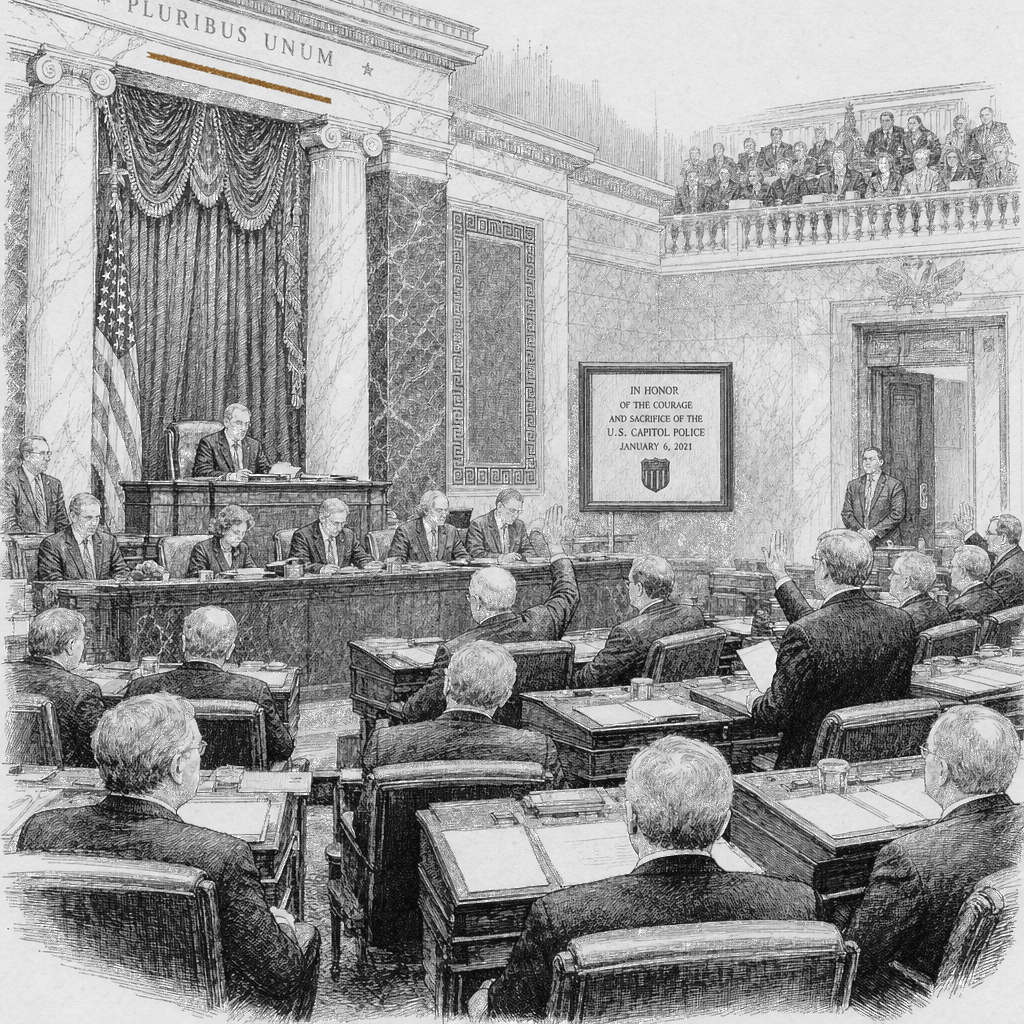
The Senate resolution directs the Architect of the Capitol to prominently display the plaque in a publicly accessible location in the Senate wing until it can be moved to its intended permanent site at the West front of the building — a placement that would require agreement from the House, whose speaker has said the plaque as constructed does not comply with the law.
The Senate voted Thursday without objection to display a plaque honoring police officers who defended the U.S. Capitol during the Jan. 6, 2021 attack, acting during the fifth-anniversary week of the siege and amid a White House campaign to reshape the historical record of that day.
The bipartisan floor action came after senators learned that the plaque — mandated by Congress more than three years ago and required by law to be installed in 2023 — had never been displayed at the Capitol, with many House lawmakers instead hanging replicas outside their office doors.
Republican Sen. Thom Tillis of North Carolina announced the effort earlier this week, partnering with Democratic Sen. Jeff Merkley of Oregon and Democratic Sen. Alex Padilla of California. No senators objected.
‘We Owe Them Eternal Gratitude’
Tillis described the thousands of rioters who stormed the Capitol as “thugs” and said the officers who responded had transformed a day that could have broken democratic institutions into one that affirmed them.
“We came back and completed our constitutional duty to certify the election,” Tillis said. “We owe them eternal gratitude and this nation is stronger because of them.”
The Senate passed the resolution swiftly, with brief debate. The new measure directs the Architect of the Capitol to “prominently display” the plaque in a “publicly accessible” location in the Senate wing until it can be placed at its permanent site — the West front of the Capitol, where some of the fiercest fighting took place on Jan. 6. Moving it there would require agreement from the House.
White House History Dispute as Backdrop
Senators said the Senate was also motivated by an effort from President Donald Trump’s White House to rewrite the history of the attack. The Trump administration released a report this week shifting blame for the riot onto Democrats, former President Joe Biden’s 2020 election victory, and the police response itself. Trump said in a speech this week that he had intended only for his supporters to march peacefully to the Capitol.
“It’s so important we be honest with the American people about what happened,” Merkley said as he called the resolution up for passage. “It’s so important we recognize those who defended our democratic republic on that day.”
Padilla described the White House’s new website as an “attempt to rewrite history” that “dishonors” the officers. “The Senate bipartisan commitment to real history is strong,” he said.
Why the Plaque Was Never Installed
Tillis acknowledged a “technical implementation problem” that contributed to the years-long delay: the plaque as constructed lists the law enforcement agencies that responded to assist the Capitol Police, rather than naming individual officers. The number of officers who responded runs into the thousands.
To address that, Tillis said a digital component — he described it as presumably a website — will list all the names. “You’ll see how many people came here,” he said.
The office of House Speaker Mike Johnson said this week that the plaque, as constructed, does not comply with the law. Johnson, who led efforts to object to the 2020 election results before becoming speaker, has not agreed to place the plaque in its intended permanent location.
Capitol Police officers filed a lawsuit seeking to compel the plaque’s installation as the law requires. Trump’s Justice Department is seeking to dismiss that lawsuit.