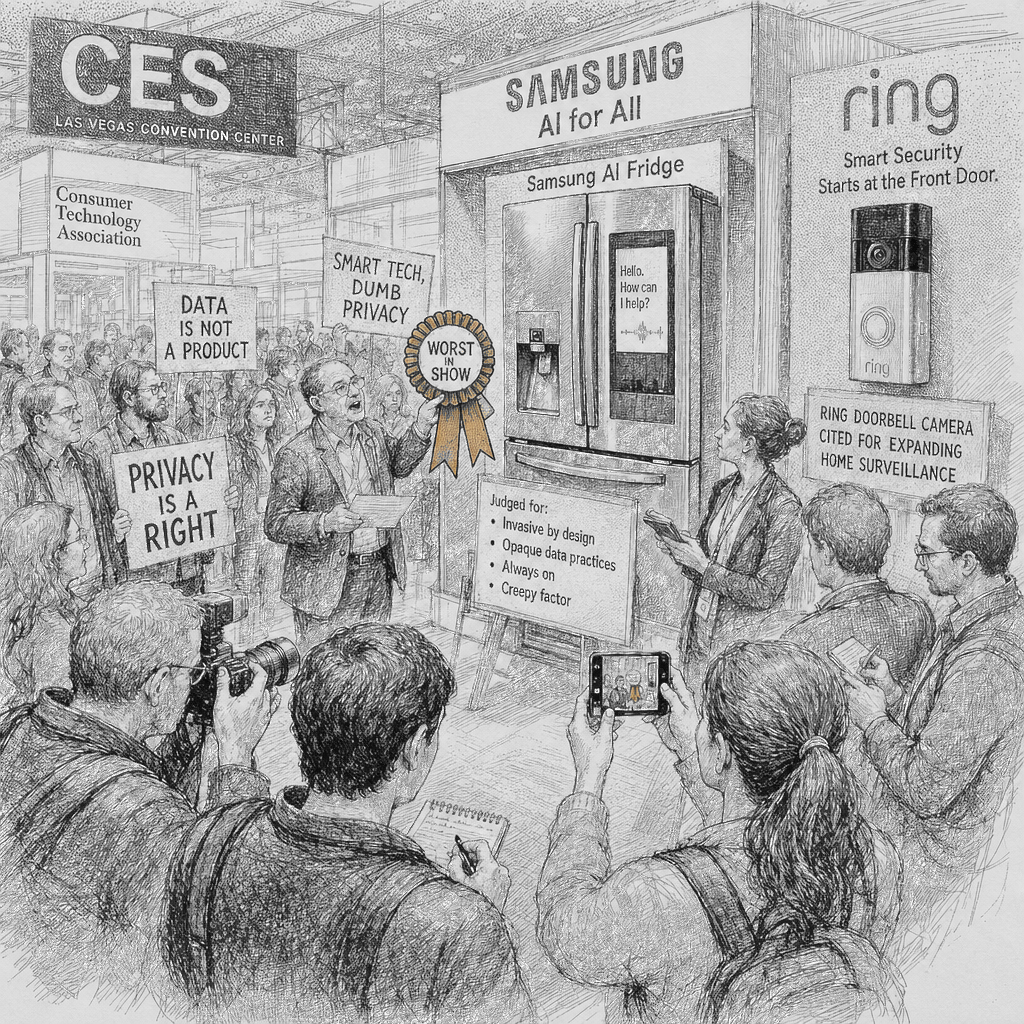
Consumer and privacy advocates announced the annual “Worst in Show” anti-awards at the CES gadget expo in Las Vegas on Thursday, naming Samsung’s voice-activated AI refrigerator the overall worst product of the show and citing Amazon’s Ring doorbell camera system for what judges called a significant and troubling expansion of home surveillance. The contest, run independently of CES and the Consumer Technology Association that organizes the show, singles out products judges consider invasive, wasteful or unnecessarily fragile.
The awards reflect a widening concern among consumer advocates that manufacturers are embedding artificial intelligence into everyday devices in ways that introduce new privacy and security risks, raise costs and reduce repairability without meaningfully improving a product’s core function.
Samsung’s AI fridge takes the overall award
Samsung’s “Bespoke AI Family Hub” refrigerator received the overall “Worst in Show” recognition from a panel whose members represent Consumer Reports, the Electronic Frontier Foundation, the Digital Right to Repair Coalition and right-to-repair advocates iFixit, among other consumer groups.
The refrigerator allows users to issue voice commands to open or close its door, but a demonstration on the Las Vegas convention floor showed the device did not reliably detect speech when ambient noise was present. Beyond voice control, the appliance uses computer vision to monitor food levels and can advertise grocery replacements to users.
“Everything is an order of magnitude more difficult,” said Gay Gordon-Byrne, of the Digital Right to Repair Coalition, in a recorded ceremony announcing the anti-awards.
Samsung said in response that “a trade show floor is naturally very different from a consumer’s home environment” and that its Bespoke AI features “are designed to simplify decisions around the home, making life more convenient and enjoyable.” The company also said “security and privacy are foundational” to the AI experiences in the refrigerator.
Amazon Ring flagged for surveillance expansion
New features for Amazon’s Ring doorbell camera system received the worst-in-show designation for privacy. Cindy Cohn, executive director of the Electronic Frontier Foundation, said the additions amounted to “doubling down on privacy invasion and supporting the misconception that more surveillance always makes us safer.”
The new features include an “AI Unusual Event Alert” designed to detect unexpected people or occurrences such as the arrival of “a pack of coyotes,” along with facial recognition, mobile surveillance towers deployable at parking lots and similar locations, and an app store that would let third-party developers build additional applications for the doorbell system. Amazon did not immediately respond to a request for comment.
AI ‘soulmate’ companion wins People’s Choice
An AI companion called Ami, made by Chinese company Lepro, won the People’s Choice designation for worst product. Marketed as “your always-on 3D soulmate,” Ami displays a female avatar on a curved screen and targets remote workers seeking what the company describes as private and empathetic interactions during workdays. The device tracks eye movements and emotional signals including tone of voice.
Judges said they were calling out Lepro “for having the audacity to suggest that an AI video surveillance device on a desk could be anyone’s soulmate.” They acknowledged the device includes a physical camera shutter but said its “always-on” marketing raised concerns. Lepro did not immediately respond to a request for comment.
Treadmill’s privacy disclaimer draws security criticism
Merach’s internet-connected treadmill received the worst-in-show designation for security. The China-based company’s device features what it describes as the industry’s first AI fitness coach powered by a large language model, capable of conversing with users and adjusting speed and incline based on heart-rate data.
Judges flagged the breadth of biometric data and behavioral information the device collects, as well as language in the treadmill’s own privacy policy stating: “We cannot guarantee the security of your personal information.” Merach did not immediately respond to a request for comment.
Bosch earns two awards; music lollipop cited for waste
German company Bosch received two “Worst in Show” awards — one for adding subscription features and Amazon’s Alexa voice assistance to its “Personal AI Barista” espresso machine, and one for a parts-pairing feature in its e-bike app that digitally links a bike to its components and flags any part appearing in a database of stolen goods.
Cory Doctorow, author of Enshittification: Why Everything Suddenly Got Worse and What to Do About It and a contest judge, said the e-bike feature could allow Bosch to restrict owners from making routine repairs, even if the company does not currently intend to exercise that control. Bosch said in a statement that judges were misleadingly suggesting it forces consumers to use features that are optional, and that its products protect consumers “against unauthorized tampering or control through a comprehensive security concept, using encryption and authentication.”
Lollipop Star, a candy that plays music through bone induction technology as users chew it, received the worst-in-show designation for the environment. Its sticks cannot be recharged or reused after the candy is consumed.
“We need to stop making so many disposable electronics, which are full of toxic chemicals, require critical minerals to produce and can burn down waste facilities,” said Nathan Proctor, who directs the Public Interest Research Group’s right-to-repair campaign. A spokesperson for Lollipop Star’s maker, Lava Brand, did not immediately respond to a request for comment.
Purpose of the awards
The Worst in Show judges, who have no affiliation with CES or the Consumer Technology Association, said they select products based on how uniquely problematic a product is, the potential impact if widely adopted and whether it represents a significant regression from previous versions of similar technology.
“We definitely intend some shame,” said Elizabeth Chamberlain, iFixit’s director of sustainability. “We do hope that manufacturers see this as a poke, as an impetus to do better next time. But our goal isn’t to really shame any particular manufacturer as such. We’re hoping that they’ll make changes as a result of it. We’re pointing to trends that we see in the industry as a whole.”
Chamberlain added that in most cases judges identified a single product to illustrate a pattern that spans an entire category — meaning any one of several similar devices could have received the designation.