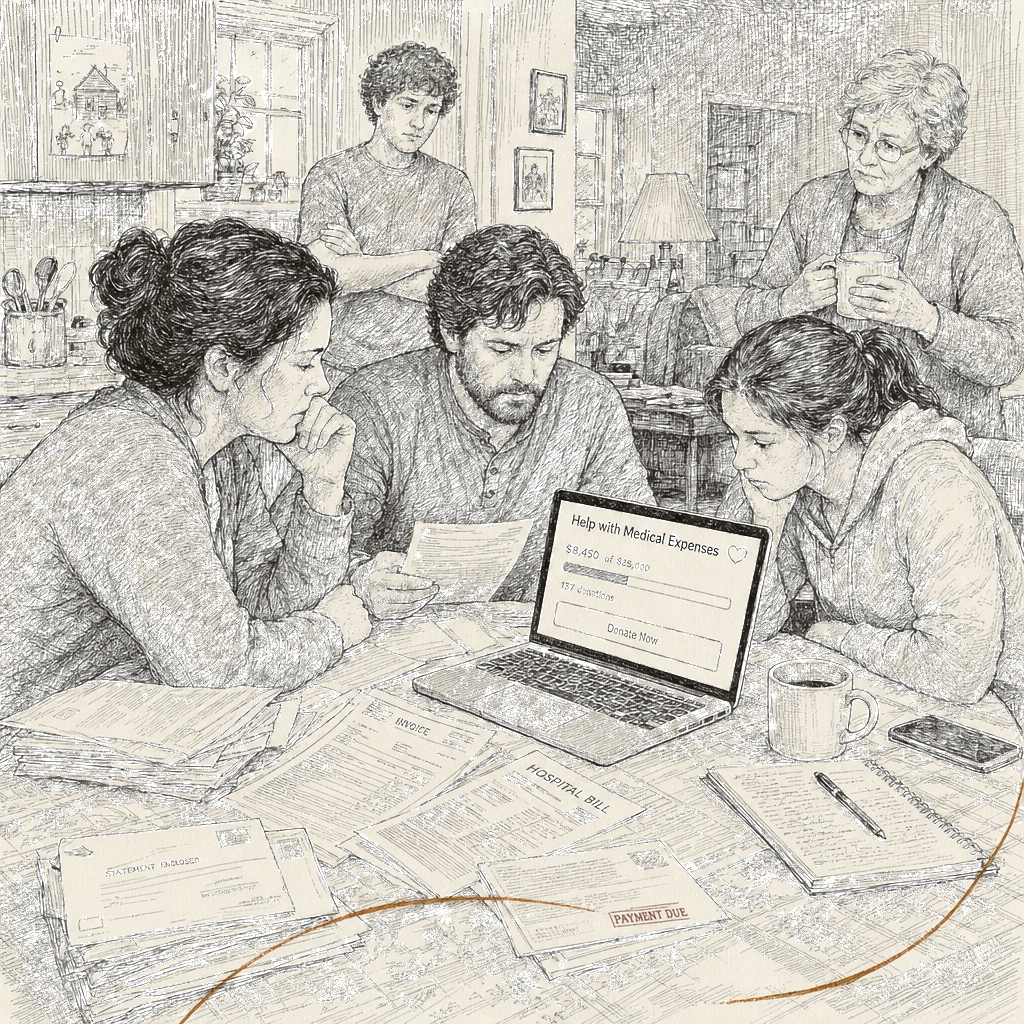
About 1 in 5 U.S. adults donated to an online crowdfunding campaign in 2025, with medical expenses ranking as the most commonly supported cause, according to an AP-NORC poll released Thursday. The survey of 1,146 adults also found that most donors gave $50 or less, and that Americans harbor broad doubts about whether crowdfunding platforms charge reasonable fees and whether campaign beneficiaries truly need the money.
The findings come as enhanced Affordable Care Act tax credits that reduced health insurance costs for most ACA enrollees have expired — a development that a bioethicist who studies medical crowdfunding said could drive more Americans toward campaign fundraising to cover bills they cannot otherwise afford.
Medical expenses lead all crowdfunding categories
About 4 in 10 crowdfunding donors said their most recent donation went toward medical expenses or health care, the AP-NORC poll found — the top cause category. Memorials and funerals ranked second. Groceries and other daily necessities, veterinary expenses and animal causes, and natural disaster relief followed.
Jeremy Snyder, a bioethicist who researches medical crowdfunding, said the prevalence of health care campaigns reflects a persistent gap between what insurance covers and what treatment costs. People may also find it easier to seek help for medical bills — which can be framed as unavoidable, one-time emergencies — than for other financial shortfalls.
“Costs keep going up,” Snyder said. “Coverage is still a struggle and probably getting worse.”
Snyder said the expiration of enhanced ACA subsidies could send more patients to crowdfunding to cover health care costs they cannot meet through insurance.
Most donors give small amounts
Participation in crowdfunding remained well below more traditional charitable giving. About 7 in 10 U.S. adults said they made a charitable contribution in 2025; roughly 2 in 10 said they donated to a crowdfunding campaign.
Of those who gave to a campaign, about 6 in 10 said their most recent donation was $50 or less, the poll found. The prevalence of small-dollar gifts underscores the importance of strong personal networks: campaigns without offline connections or large social media reach can struggle to generate the volume of small contributions needed to meet their goals.
Karla Galdamez, a former teacher from California, said she gave to her first crowdfunding campaign after a fellow educator died by suicide. A group of teachers started a GoFundMe to raise money for his family.
“The word spreads pretty fast like that,” Galdamez said. “Then people start sending each other links. And it works.”
Doubts about fees and how funds are used
Most Americans expressed limited confidence in crowdfunding platforms, the poll found.
Only 44% of U.S. adults said they were at least “somewhat” confident that the sites charge reasonable service fees. Major for-profit platforms say their charges cover payment processing costs only. GoFundMe takes 2.9% plus 30 cents off individuals’ U.S. donations and solicits optional tips; GiveSendGo, a Christian-focused alternative, takes 2.7% plus 30 cents. GoFundMe eliminated a 5% fee on personal campaigns in 2017.
“GoFundMe’s model is intentionally designed to ensure the maximum amount of help goes directly to the people and nonprofits who need help, while giving donors the choice of whether to contribute anything additional for our services,” Sarah Peck, GoFundMe’s vice president of communications, said in a statement.
Snyder said there is a “pervasive sense” among the public that platforms charge “mandatory fees” beyond processing costs, when they largely do not. He said consumers may associate companies with the larger platform fees previously charged before platforms restructured their fee models.
Confidence in how funds are used was similarly limited. More than half of U.S. adults said they were at least “somewhat” confident that crowdfunding recipients genuinely need the money, and about half said they were at least “somewhat” confident that recipients use it responsibly. Only about 1 in 10 said they were “very” or “extremely” confident on either measure.
Maria Barrett, 68, a New Jersey resident, said she donates when she knows the organizers or has researched the campaign. She recently gave to a woman with brain cancer — her son knew the patient’s partner — and to a house fire survivor she could verify because the fire occurred in her town.
“I just wish it wasn’t so difficult for people to get help in this country without having to crowdsource and stuff,” Barrett said. “One illness can wipe out a family. One death can wipe out a family.”
About the poll
The AP-NORC poll of 1,146 adults was conducted Dec. 4-8, 2025, using a sample drawn from NORC’s probability-based AmeriSpeak Panel, which is designed to be representative of the U.S. population. The margin of sampling error for adults overall is plus or minus 4 percentage points.