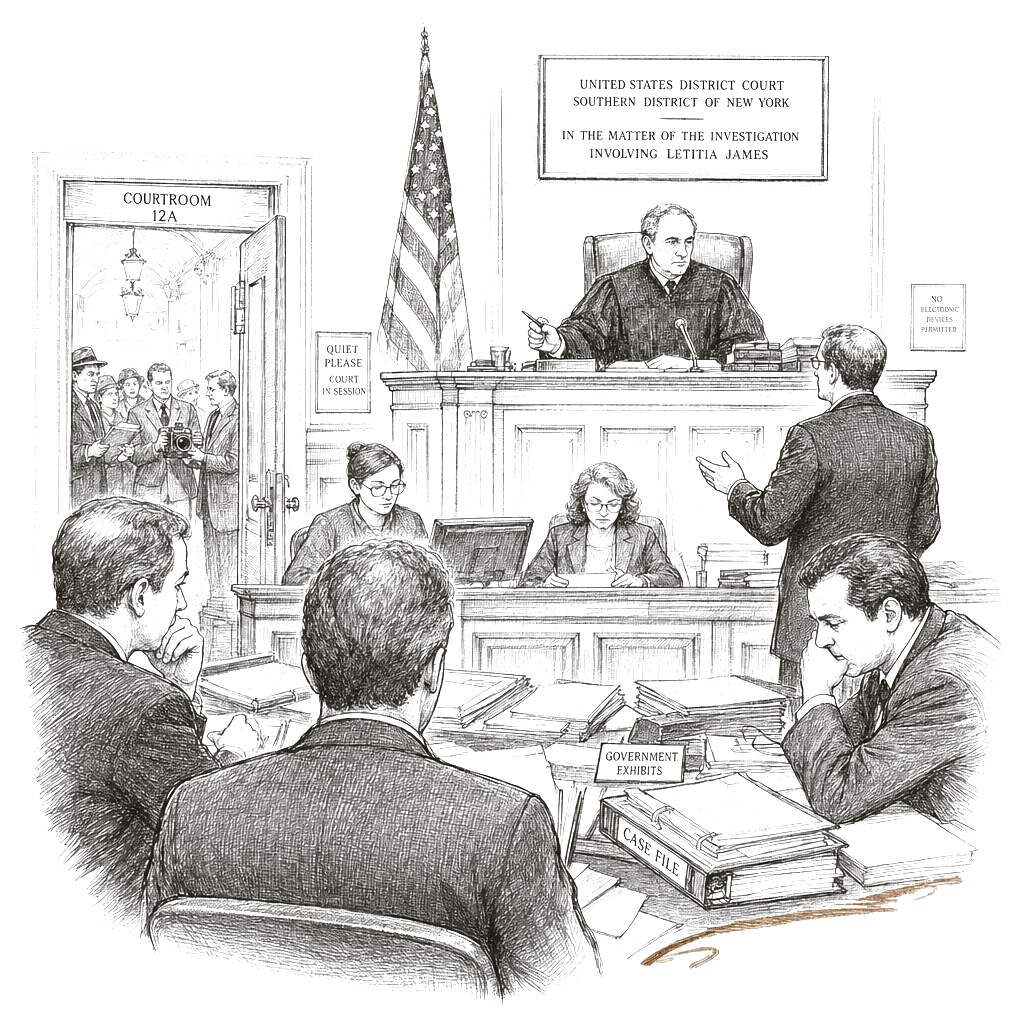
The ruling joined a growing line of federal court decisions against Trump administration officials who assumed acting U.S. attorney positions without Senate confirmation, a pattern that has now produced adverse rulings in New York, New Jersey, Virginia, Nevada, and Southern California.
A federal judge on Thursday disqualified the Trump administration’s acting U.S. attorney for the Northern District of New York from overseeing investigations into state Attorney General Letitia James, ruling that he had no lawful authority to hold the position.
U.S. District Judge Lorna G. Schofield blocked subpoenas that John Sarcone had sought seeking information about James’ lawsuits against President Donald Trump and the National Rifle Association. Schofield said the Justice Department failed to follow statutory procedure after a panel of district judges declined to extend Sarcone’s tenure.
“When the Executive branch of government skirts restraints put in place by Congress and then uses that power to subject political adversaries to criminal investigations, it acts without lawful authority,” Schofield wrote. “Subpoenas issued under that authority are invalid. The subpoenas are quashed, and Mr. Sarcone is disqualified from further participation in the underlying investigations.”
The workaround the judge rejected
Attorney General Pam Bondi appointed Sarcone to serve as interim U.S. attorney for the Northern District in March. When his 120-day term elapsed and district judges declined to keep him, Bondi appointed him as a special attorney and designated him first assistant U.S. attorney — a set of personnel moves that federal officials said authorized him to continue serving as acting U.S. attorney.
Schofield rejected that reasoning. “On the same day that the judges declined to extend Mr. Sarcone’s appointment, the Department took coordinated steps — through personnel moves and shifting titles — to install Mr. Sarcone as Acting U.S. Attorney,” she wrote. “Federal law does not permit such a workaround.”
Sarcone was part of Trump’s legal team during the 2016 presidential campaign and worked for the U.S. General Services Administration during Trump’s first term.
James’ challenge
James, a Democrat, challenged Sarcone’s authority after he issued subpoenas seeking information about two lawsuits her office had filed — one against Trump, alleging fraud in his business dealings, and one against the NRA and some of its former leaders.
James said the subpoenas were part of a campaign of baseless investigations against Trump’s perceived adversaries. Her office called Thursday’s ruling “an important win for the rule of law” and said it would “continue to defend our office’s successful litigation from this administration’s political attacks.”
The Justice Department said in a statement Thursday that it “will continue to fight and defend the President and the Attorney General’s authority to appoint their U.S. Attorneys.”
A pattern of adverse rulings
The decision joined a series of federal court rulings against Trump administration officials installed as acting U.S. attorneys without Senate confirmation.
In November, a federal judge dismissed criminal cases against former FBI Director James Comey and James herself after concluding that Lindsey Halligan was unlawfully appointed as interim U.S. attorney for the Eastern District of Virginia. In December, a panel from the 3rd U.S. Circuit Court of Appeals affirmed a lower-court ruling disqualifying Alina Habba from serving as New Jersey’s top federal prosecutor. Federal judges in Nevada and Southern California issued similar rulings in their districts.
Senate Democratic leader Chuck Schumer said in a statement that “the people of the Northern District of New York deserve a qualified, independent prosecutor, not a political loyalist.”
Joshua Naftalis, a Manhattan federal prosecutor for 11 years before entering private practice in 2023, said it is “always a big deal when judges say that the U.S. attorney doesn’t have the authority.” He added that because subpoenas are not typically issued by a single prosecutor, the ruling might not directly affect other investigations brought through the office.
Schofield said the federal government could reissue the subpoenas at the direction of a lawfully authorized attorney.