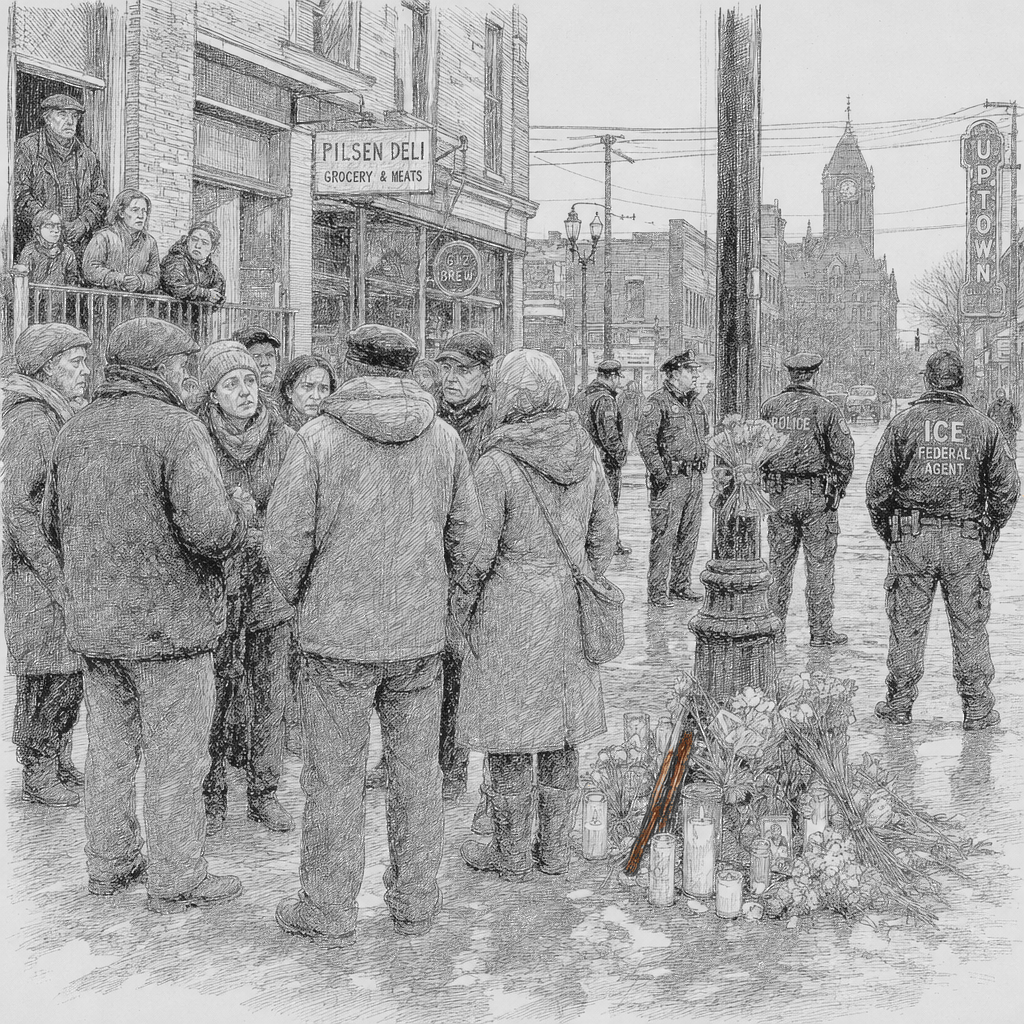
Good’s death intensified a conflict that spans immigration enforcement, unproven accusations of government fraud tied to Minnesota’s Somali community, and a White House strategy of pressuring Democratic-led states into compliance with federal demands — one that has made Minnesota a recurring focal point of Trump’s second term.
An Immigration and Customs Enforcement officer shot and killed Renee Good, 37, during a protest against immigration raids in Minneapolis on Wednesday, the latest and most violent confrontation in a mounting conflict between the Trump administration and Minnesota.
Good was killed just blocks from where a Minneapolis police officer killed George Floyd in 2020 — a proximity that drew painful comparisons to the disorder that followed Floyd’s death. The Trump administration had announced the previous day that it was sending more than 2,000 federal officers to the Twin Cities of Minneapolis and St. Paul in what it claimed would be the largest immigration enforcement operation in U.S. history.
Good is at least the fifth person killed during ICE enforcement efforts, according to the Associated Press. ICE operations that began last summer in Chicago, Los Angeles and Portland also generated large protests.
Vance defends ICE, announces new position
Speaking at the White House on Thursday, Vice President JD Vance said Good’s death was “a tragedy of her own making,” blamed “leftist ideology,” and said the media had encouraged protests against the administration’s crackdown. Vance also announced a new assistant attorney general position to prosecute the abuse of government assistance programs, with a focus on Minnesota.
Minneapolis schools remained closed Thursday after immigration agents clashed with high school students at one campus the day before. Minnesota’s National Guard remained on standby at the direction of Gov. Tim Walz, who announced this week that he will not seek reelection.
Stephanie Abel, a 56-year-old Minneapolis nurse, said she is keeping her gas tank full and cash available in memory of the upheaval that followed Floyd’s death. “I thought the federal government would realize that now is not the time to be toying with people,” Abel said. “What are they going to try to do to get Minneapolis to ignite?”
A state in sustained conflict
Minnesota has become a recurring target of the Trump administration, which has focused on several Democratic-led states in what the president has used as a divide-and-conquer strategy characterizing his second term.
The state’s political profile invites that attention. Under Walz, Minnesota expanded its public safety net even as much of the country moved rightward — funding increases for education, universal free school meals, and strengthened abortion protections. Trump lost the state by only 4 percentage points in 2024, making it less reliably Democratic than California or New York while remaining a Democratic stronghold throughout his years in office.
In June, a Democratic state lawmaker and her husband were killed in what the AP described as an assassination carried out by a man with ties to Trump. Conservative figures have disputed that account, insisting the gunman was a leftist acting at Walz’s behest — a characterization the victims’ family called a conspiracy theory. On Sunday, the family asked Trump to remove a social media post they said echoed those disputed claims.
David Schultz, a political scientist at Hamline University in St. Paul, said the state reflects the country’s broader divisions. “Minnesota is a microcosm of a lot of the tensions we have in our society,” Schultz said. “We’re a country that’s hugely polarized, Democrats-Republicans, urban-rural.”
Somali community at the center of fraud allegations
The Twin Cities operation is also intertwined with a conservative effort to make Minnesota the center of a government fraud narrative.
In November, Trump called Minnesota “a hub of fraudulent money laundering activity” after a report by a conservative outlet, City Journal, claimed federal money was fraudulently flowing to the militant group al-Shabab. According to the AP, there has been little, if any, evidence proving such a link. The president subsequently said he would end Temporary Protected Status for Somalis in Minnesota.
Last month, Trump called the state’s Somali population “garbage” following a large federal investigation into fraudulent use of COVID-19 and medical aid funds by social service organizations, among others. Prosecutions in that fraud case began during the Biden administration. In late December, conservative influencer Nick Shirley posted an unconfirmed video claiming that day care centers in Minneapolis run by Somalis had fraudulently collected more than $100 million in government aid.
On Tuesday, the Trump administration said it was withholding funding for programs that support needy families with children, including day care funding, in five Democratic-led states — Minnesota, California, Colorado, Illinois and New York — citing concerns about fraud.
Jamal Osman, a Somali immigrant and Minneapolis city councilman who lives near the site of the ICE shooting, said the anger directed at his community largely originates outside the state. “We have whole groups of people who’ve never been to Minnesota,” Osman said. “Minnesota is probably one of the nicest places to live. It’s a beautiful area with very nice people and we blended in, it’s all very nice. We don’t really see bad things happening here normally.”
Walz: ‘Leave our state alone’
At a news conference Thursday, Walz said Minnesota’s residents are “exhausted” by what he called the president’s “relentless assault on Minnesota.” The governor said he had called on Trump to ease up.
“So please, just give us a break,” Walz said. “And if it’s me, you’re already getting what you want, but leave my people alone. Leave our state alone.”