The vote came days after enhanced ACA subsidies expired on Jan. 1, triggering premium increases that health care analysts estimated would average 114% for previously subsidized enrollees, according to a KFF analysis. The Congressional Budget Office projected the bill would add $80.6 billion to the federal deficit over a decade while extending coverage to an additional 4 million Americans at its peak.
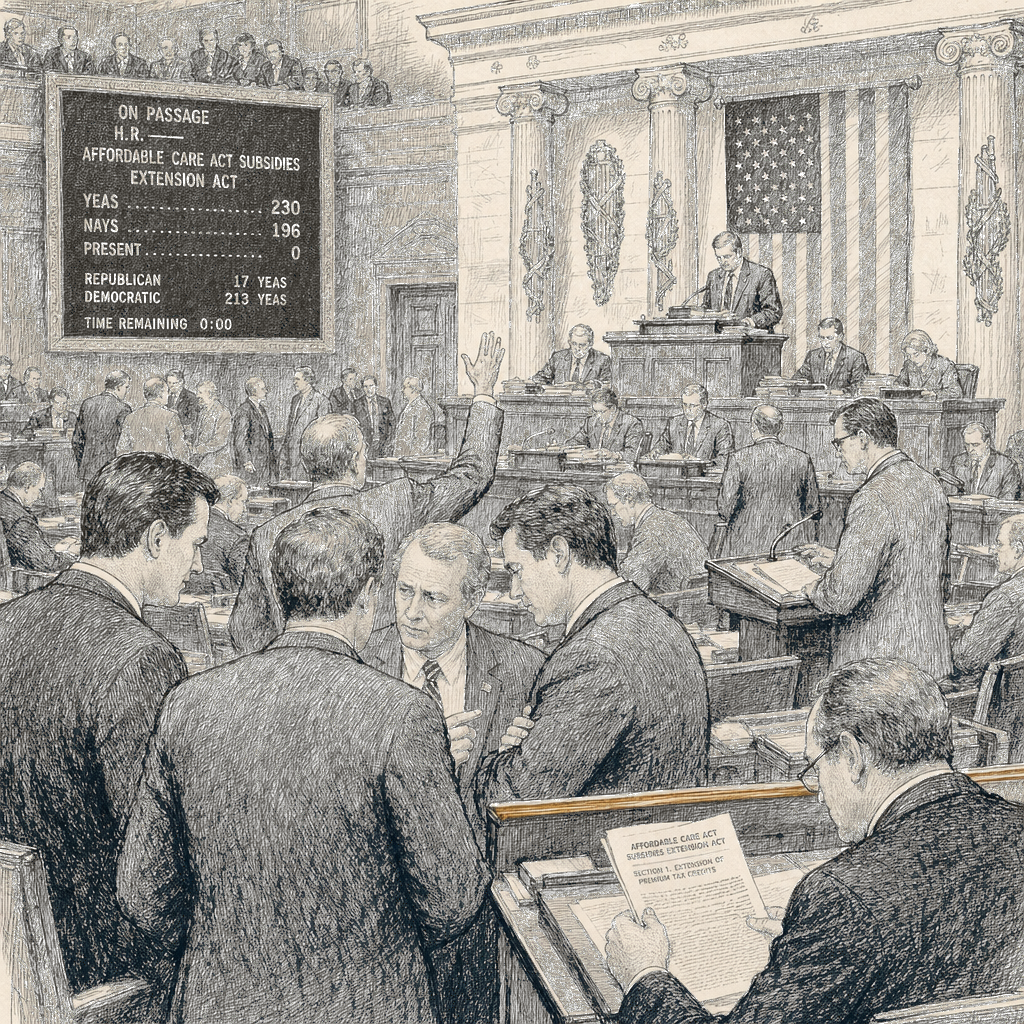
WASHINGTON — The House passed legislation Thursday to extend expired Affordable Care Act health insurance subsidies by a 230-196 vote, with 17 Republican lawmakers joining every Democrat in a cross-party coalition that defied Speaker Mike Johnson and forced a floor vote through a procedural maneuver Johnson had spent months trying to prevent.
The three-year subsidy extension moves to the Senate, where the House bill faces an uncertain path. Senate Majority Leader John Thune, R-S.D., has said any bipartisan compromise must include income limits for subsidy recipients, a nominal cost-sharing requirement for beneficiaries, and expanded health savings accounts — conditions the House bill does not meet.
The nonpartisan Congressional Budget Office estimated the bill would add $80.6 billion to the federal deficit over a decade. The CBO also projected it would extend coverage to an additional 100,000 Americans in 2026, 3 million in 2027, 4 million in 2028, and 1.1 million in 2029.
The vote came days after enhanced ACA subsidies expired on Jan. 1, triggering sharp premium increases. Approximately 24 million Americans enrolled in ACA marketplace plans in 2025, with 92% of total enrollees receiving enhanced subsidies before they lapsed, according to Centers for Medicare and Medicaid Services data. A KFF analysis found that previously subsidized enrollees face an average 114% increase in annual health insurance fees. In one case documented by the Associated Press, a monthly premium rose from $85 to nearly $750.
“The affordability crisis is not a ‘hoax,’ it is very real — despite what Donald Trump has had to say,” said House Democratic Leader Hakeem Jeffries, D-N.Y. “Democrats made clear before the government was shut down that we were in this affordability fight until we win this affordability fight. Today we have an opportunity to take a meaningful step forward.”
How the vote was forced
The vote hinged on a discharge petition — a procedural tool that allows a majority of House members to bring a bill to the floor without the speaker’s consent, bypassing leadership. Four Republicans from competitive swing districts pushed the petition to the required 218 signatures: Reps. Brian Fitzpatrick, Robert Bresnahan, and Ryan Mackenzie, all of Pennsylvania, and Rep. Mike Lawler of New York. All four represent districts whose outcomes will help determine which party controls the House after the fall elections, the AP reported.
After the petition succeeded, 17 Republicans ultimately voted with Democrats to pass the bill — a larger group than the four who had signed on to force the vote.
Johnson, R-La., had spent months working to prevent such an outcome. His office said Thursday that ACA subsidies from the COVID-19 era are rife with fraud and urged members to vote no. On the floor, some Republicans said the bill benefited too narrow a portion of the population.
“Only 7% of the population relies on Obamacare marketplace plans. This chamber should be about helping 100% of Americans,” said Rep. Jason Smith, R-Mo., chairman of the House Ways and Means Committee.
Background: shutdown and subsidy expiration
The ACA subsidy standoff has been unfolding since a 43-day government shutdown last fall, during which Democrats attempted to force action on the subsidies without success. After the shutdown ended, Johnson discussed allowing politically vulnerable Republicans a vote on a temporary extension, but ultimately sided with the more conservative wing of his conference, which regards the ACA as a failed government program.
Rank-and-file Republicans then moved independently as constituents began receiving notices of sharply higher premiums in January.
Senate path
A bipartisan group of roughly a dozen senators has been negotiating an alternative to the House bill. Sen. Bernie Moreno, R-Ohio, a leader in that group, said the senators hoped to deliver a framework the following week. He and other members of the group met with House colleagues on options.
Sen. Jeanne Shaheen, D-N.H., who is part of the negotiations, said there is agreement on addressing fraud in health care.
“We recognize that we have millions of people in this country who are going to lose — are losing, have lost — their health insurance because they can’t afford the premiums,” Shaheen said. “And so we’re trying to see if we can’t get to some agreement that’s going to help, and the sooner we can do that, the better.”
President Trump has pushed Republicans to direct money to Americans’ health savings accounts so that people can bypass the federal government and manage their own insurance. Democrats have largely rejected that approach as insufficient for covering high health care costs.
Jeffries said after Thursday’s vote that Thune should bring the House Democratic bill to the Senate floor for an immediate vote. Thune has not committed to doing so, and the Senate has previously rejected the House bill.