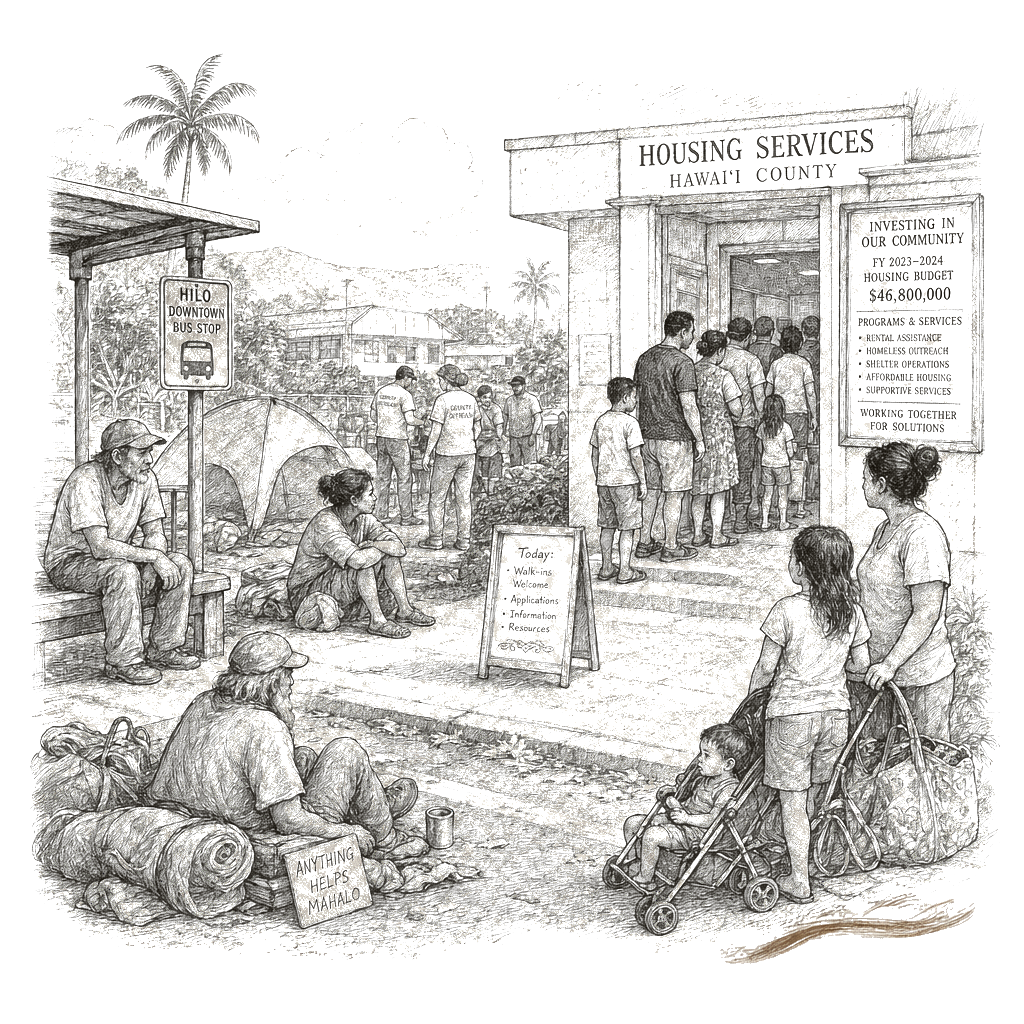
The vote leaves the future of the county’s Homelessness and Housing Fund — set to expire in 2027 without council action — increasingly uncertain, with a consultant’s recommendation that the fund continue as a long-term flexible mechanism facing a council that is visibly fracturing over whether to sustain the investment.
Hawaii County’s homeless population has continued to grow despite nearly $33 million in county spending on homeless programs over four years, according to reporting by Honolulu Civil Beat distributed through the Associated Press. The Hawaii County Council approved a new $6 million allocation for outreach and housing nonprofits last month on a narrow 5-4 vote, as several council members questioned whether the spending has produced measurable results on the ground.
The vote leaves the future of the county’s Homelessness and Housing Fund in question. The fund is set to expire in 2027 without a council vote to extend it — and a consultant’s recommendation that it continue faces an increasingly divided council.
Council members question results
Council member Ashley Kierkiewicz, who represents Puna and voted against the latest allocation, said she has struggled to see evidence of improvement in her district.
“When I’m outside and I’m walking through communities of downtown Pāhoa and downtown Hilo, it doesn’t look like we’re better off,” Kierkiewicz said.
Council member Matt Kaneali’i-Kleinfelder, also of Puna and also a no vote, said the scale of the investment demands visible results.
“My expectation is, when the county puts up $30 million in three years toward addressing homelessness and housing, that the results are evident,” he said. “I don’t think that they are.”
Council member Heather Kimball, who represents the Hāmākua Coast and voted in favor, said she nonetheless wants an audit of both the spending details and program effectiveness. She said she expects the audit proposal to come before the council this month.
“If the public views the program as unsuccessful, if it doesn’t look like on the ground any impacts have been made spending these tens of millions of tax dollars, it is going to be harder for the council politically to free up the program,” Kimball said.
Kimball said the audit is not meant to be punitive: “It is really just that we need the data to determine whether or not to continue this program.”
Kona council member Rebecca Villegas also raised concerns, saying the same nonprofits appear to receive grants each cycle with limited demonstrated impact.
What the money has produced
County funds flow from the Homelessness and Housing Fund to local nonprofits, covering outreach, short-term and long-term housing, shelters, and support programs. The $6 million approved last month targets those services. A separate $5.14 million package — covering the largest shelters in East and West Hawaiʻi, overnight sleeping programs, and a permanent supportive housing project in Kona — still awaits council approval.
Brandee Menino, CEO of HOPE Services Hawaiʻi, said the programs have produced real outcomes even as overall homelessness has grown. She cited figures from Bridging the Gap Hawaiʻi showing that HOPE Services and other social service agencies helped 552 people transition from homelessness to permanent housing on the Big Island last fiscal year. HOPE Services data, she said, shows 74% of people the organization works with go into housing.
“While we’re doing a rock-star job at exiting people [from homelessness] and securing housing, acquiring housing, leasing housing — we’re doing amazing — what the data also shows is more people are falling into homelessness,” Menino said.
Menino has worked in social services on the island for 24 years. She said the situation is getting worse and predicted it will worsen further as federal threats to Medicaid, food subsidies, and federal housing subsidies mount.
The structural bottleneck
Menino cited county data showing 80% of homeless individuals say they would come indoors if housing or shelter were available. Almost half of people who move from homelessness into housing can do so only because they receive housing subsidies, she said.
“You need the subsidies, you need the housing inventory,” Menino said. “That’s the bottleneck.”
A county consultant, SAS Services, hired in 2024 to evaluate the Homelessness and Housing Fund, cited the lack of “truly affordable housing” on the Big Island and described the fund as one piece of a larger, countywide strategy. The consultant proposed creating a new Office of Homelessness to coordinate services and recommended the fund continue after 2027 as a “flexible funding mechanism to address the growing needs in the areas of homelessness and housing instability.”
Kēhaulani Costa, the county’s community development administrator, told council members she has seen nonprofits struggle when their funding is cut. The county reduced or eliminated some grants this year to fund others, and when awardees lost funding, she said, “we’ve seen emergency shelter beds reduced, we’re going to see outreach programs reduced because funding was not available.”
Fund’s future uncertain
Kaneali’i-Kleinfelder cited reports that California spent $24 billion over five years on homelessness — with homelessness increasing there as well.
“I am concerned about throwing money at an issue that we’re not able to fix,” he said. “There has to be an outcome to spending $30 million in taxpayer funds, or we’re in a bad spot.”
Kierkiewicz said she views the fund as temporary by design: “We never designed this to be a permanent entitlement. It was always temporary in nature.”
Council member Dennis “Fresh” Onishi, who represents Hilo and part of Puna and voted in favor of the $6 million allocation, said he will support social service programs only if they have a defined endpoint for county funding and a plan to find independent resources.
Menino said the county should continue the fund regardless. “It’s getting worse, for sure,” she said of the homelessness situation. “It’s going to get worse.”