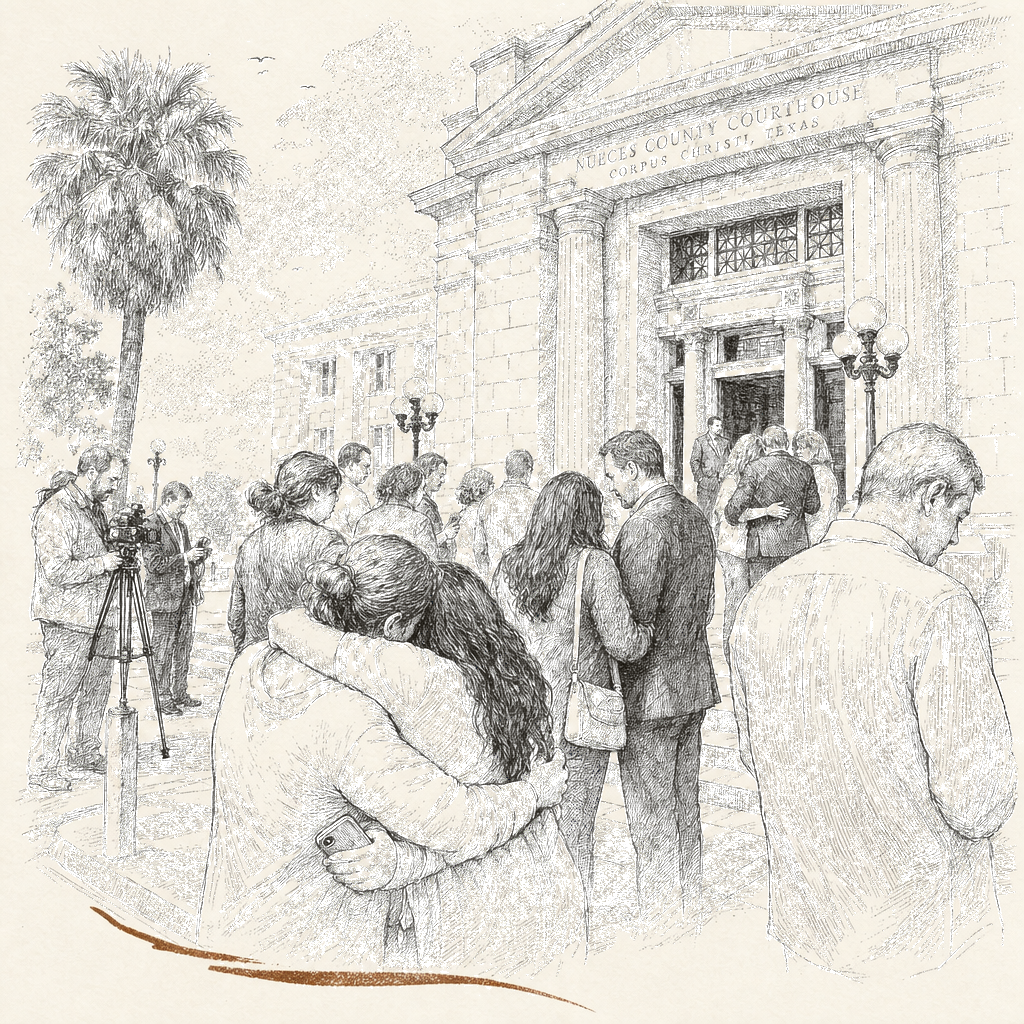
A former Uvalde schools police officer went on trial Tuesday in Corpus Christi, Texas, on child endangerment charges stemming from the 2022 Robb Elementary School massacre, as relatives of victims wept in court while listening to frantic 911 recordings from the attack that killed 19 students and two teachers.
Special prosecutor Bill Turner told jurors that former school officer Adrian Gonzales arrived outside the school just before the teenage gunman entered but did not move to stop him, even after a teacher pointed to where the gunman was firing in a parking lot. Gonzales went inside only “after the damage had been done,” Turner said during opening statements.
The prosecution marks one of the rarest categories of criminal charge in American law enforcement — an officer held to account not for excessive force but for alleged failure to act during a mass shooting, a legal standard that has proven extremely difficult to meet in court.
CORPUS CHRISTI, Texas — A former Uvalde schools police officer went on trial Tuesday on child endangerment charges over his response to the 2022 Robb Elementary School massacre, as families of the 21 victims wept in court while listening to 911 recordings from the attack that killed 19 students and two teachers.
Special prosecutor Bill Turner told jurors that former school officer Adrian Gonzales arrived outside the school just before the teenage gunman entered but did not move to stop him, even after a teacher pointed to where the gunman was firing in a parking lot. Gonzales entered the building only “after the damage had been done,” Turner said during opening statements.
Gonzales has pleaded not guilty to child abandonment or endangerment. If convicted, he faces a maximum of two years in prison.
Prosecution details Gonzales’ movements in the attack’s opening minutes
Tissue boxes were brought to the victims’ families as testimony began. Some shook their heads while listening to audio from the first calls for help, and their cries grew louder as the recordings unfolded, according to the Associated Press.
Turner told jurors that Gonzales, a 10-year veteran of the police force who had extensive active shooter training, stood outside as children and teachers hid in darkened classrooms and grabbed scissors “to confront a gunman.”
“When a child calls 911, we have a right to expect a response,” Turner said, his voice trembling.
Defense says Gonzales acted under uncertainty
Defense attorneys disputed the prosecution’s characterization. Attorney Nico LaHood said Gonzales radioed for more help and evacuated children as other officers arrived.
“The government makes it want to seem like he just sat there,” LaHood said. “He did what he could, with what he knew at the time.”
Defense attorney Jason Goss told jurors that Gonzales was focused on locating the gunman while also believing he lacked protection against a high-powered rifle.
“This isn’t a man waiting around. This isn’t a man failing to act,” Goss said.
Defense attorneys also told jurors that blame extended beyond Gonzales — from the lack of security at the school to police policy overall. “The monster who hurt these children is dead,” Goss said.
Families question why more officers were not charged
Some families have voiced anger that Gonzales and former Uvalde schools Police Chief Pete Arredondo are the only two officers to face criminal charges over the response. Arredondo’s trial has not been scheduled.
Nearly 400 federal, state and local officers converged on the school after the attack, according to the Associated Press. An investigation found 77 minutes passed from the time authorities arrived until officers breached the classroom and killed the gunman, Salvador Ramos. State and federal reviews cited cascading failures in law enforcement training, communication, leadership and technology, and questioned why officers waited so long.
Velma Lisa Duran, the sister of teacher Irma Garcia — one of the two teachers killed — said of Gonzales: “He could have stopped him, but he didn’t want to be the target.”
Prosecutors focused their opening statements sharply on Gonzales’ movements in the minutes after the shooting began. They did not address the hundreds of other officers who remained at the scene before the classroom was breached.
Prosecutors face a demanding legal standard
Criminal prosecution of an officer for failing to act to save lives during a shooting is rare in U.S. legal history. A Florida sheriff’s deputy was acquitted by a jury after being charged with failing to confront the shooter in the 2018 Parkland, Florida, school massacre — the first such prosecution in the United States for an on-campus shooting.
The judge overseeing the case and attorneys warned jurors before testimony began that the evidence would be emotional and difficult to process. Among those expected to testify are some of the victims’ families.
Witness testimony is scheduled to resume Thursday morning.