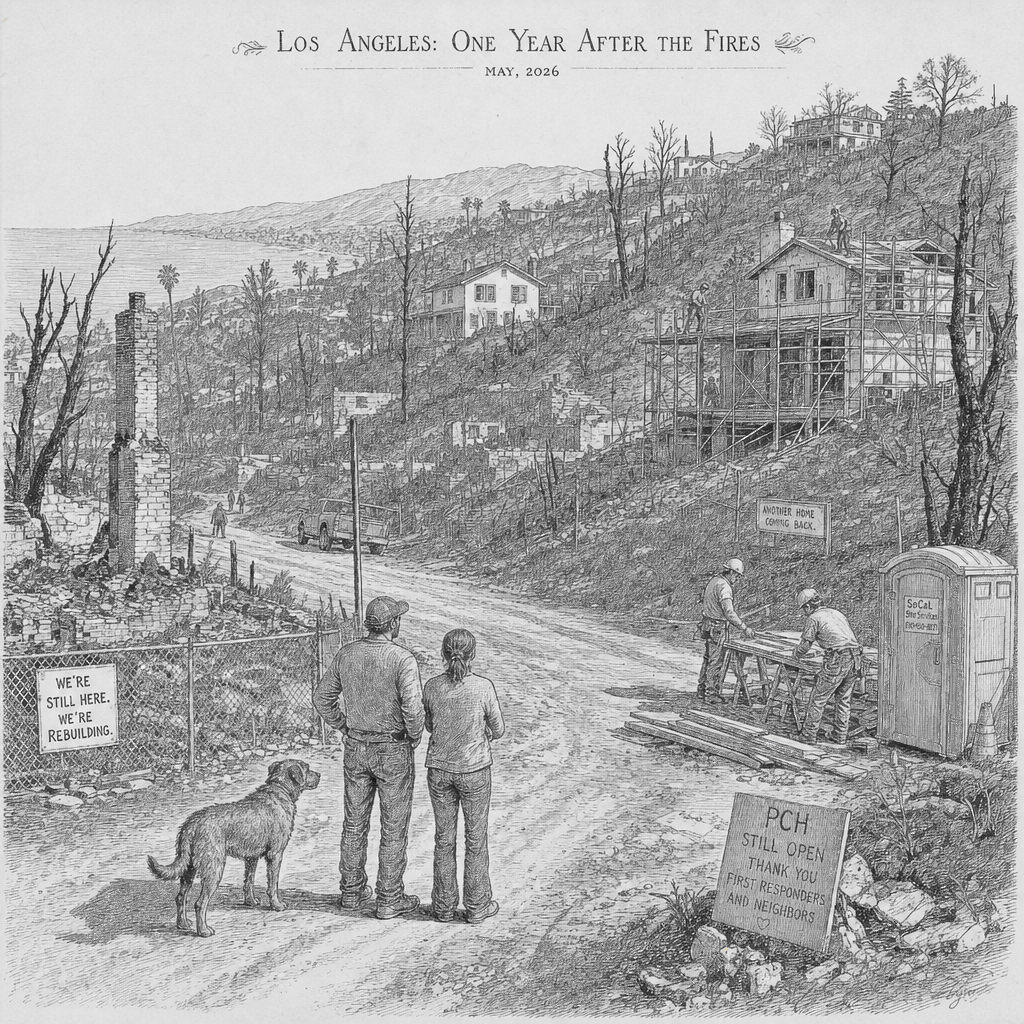
LOS ANGELES — One year after the Palisades and Eaton fires killed 31 people and destroyed roughly 13,000 homes and residential properties across Los Angeles County, fewer than a dozen homes have been rebuilt, the Associated Press reported. About 900 homes are under construction, but more than 600 properties where single-family homes were destroyed have already been sold as survivors unable to afford rebuilding leave their communities behind.
Insurance payouts falling far short of construction costs — which can easily exceed $1 million — have left most survivors unable to commit to rebuilding projects. Less than 20% of people who experienced total home loss had closed out their insurance claims by December, according to a survey by the Department of Angels, a nonprofit formed after the disaster to advocate for recovery efforts.
The sluggish pace of rebuilding reflects documented insurance shortfalls, a racial disparity in inaction rates identified by UCLA researchers, and a disaster-recovery pattern that experts say typically does not produce significant construction momentum until the 18-month mark — raising urgent questions about who will be able to return and who will not.
Insurance gap stalls most rebuilds
About one-third of insured survey respondents held policies with State Farm, the state’s largest private insurer, or the California FAIR Plan, the insurer of last resort, according to the Department of Angels survey. Both drew high rates of dissatisfaction, with respondents citing burdensome requirements, lowball estimates, and repeated adjuster changes.
“We’re seeing huge gaps between the money insurance is paying out, to the extent we have insurance, and what it will actually cost to rebuild and/or remediate our homes,” said Joy Chen, executive director of the Eaton Fire Survivors Network, which represents about 10,000 fire survivors mostly from Altadena.
In November 2025, Los Angeles County opened a civil investigation into State Farm’s practices and potential violations of the state’s Unfair Competition law. Chen said the group has seen a flurry of substantial payouts since then.
State Farm spokesperson Tom Hartman said in a statement to the Associated Press that the company has addressed more than 13,500 claims and issued over $5 billion in payments. He called the county investigation a “distraction” and said the company is committed to helping survivors.
Without certainty on insurance proceeds, households cannot commit to projects that can easily exceed $1 million to complete.
“They’re worried about getting started and running out of money,” Chen said.
Some rebuild; most cannot
The streets of Pacific Palisades and Altadena remain lined with dirt lots. In Malibu, foundations and concrete piles rising from the sand are all that remains of beachfront homes. Many neighborhoods are dark at night, with few streetlamps replaced. Even homes that survived the fires are often uninhabited as families work to clear them of toxic contamination.
Ted Koerner, 67, was among the first to complete a rebuild after his Altadena home was reduced to ash. With his insurance payout tied up, Koerner liquidated about 80% of his retirement holdings, secured contractors quickly, and finished construction in just over four months. Shortly before Thanksgiving, he moved back in.
Most do not have options like Koerner.
Jessica Rogers, a mother of two and now executive director of the Pacific Palisades Long Term Recovery Group, discovered after the Palisades fire destroyed her home that her coverage had been canceled. Her fallback was a low-interest loan from the Small Business Administration, but the application was complicated by a job loss and identity theft. A $550,000 approval came through last month. She said she is still weighing how to cover the remaining costs.
“Do I empty out my 401(k) and start counting every penny in a penny jar around the apartment?” Rogers said.
She estimated there are hundreds of survivors in Pacific Palisades who are “stuck dealing with FEMA and SBA and figuring out if we could piecemeal something together to build our homes.”
Al and Charlotte Bailey, who lived in their Altadena home for 41 years, have been living in an RV parked on the empty lot where their house once stood. They are funding their rebuild through insurance proceeds and a loan, and also hope to receive money from Southern California Edison. Several lawsuits allege that Edison’s equipment sparked the Altadena fire.
“We had been here for 41 years and raised our family here, and in one night it was all gone,” said Al Bailey, 77. “We decided that, whatever it’s going to cost, this is our community.”
Racial disparities emerge in Altadena
Altadena drew aspiring Black homeowners for decades as redlining and other forms of racial discrimination blocked access to homes in other Los Angeles-area communities. In 2024, 81% of Black households in Altadena owned their homes, nearly twice the national Black homeownership rate, according to the Associated Press.
As of August 2025, 7 in 10 Altadena homeowners whose property was severely damaged had not begun taking steps to rebuild or sell, according to research by UCLA’s Latino Policy & Politics Institute. Among those homeowners, Black homeowners were 73% more likely than others to have taken no action.
Andrew Rumbach, co-lead of the Climate and Communities Program at the Urban Institute, said the pattern echoes the recovery from a December 2021 fire near Boulder, Colorado, which destroyed more than 1,000 homes. At the one-year mark, he said, most lots had been cleared and permits filed, but significant construction typically doesn’t accelerate until around 18 months.
“You’re going to start to see some real inequality start to emerge where certain neighborhoods, certain types of people, certain types of properties are just lagging way far behind, and that becomes the really important question in the second year of a recovery: Who’s doing well and who is really struggling and why?” Rumbach said.