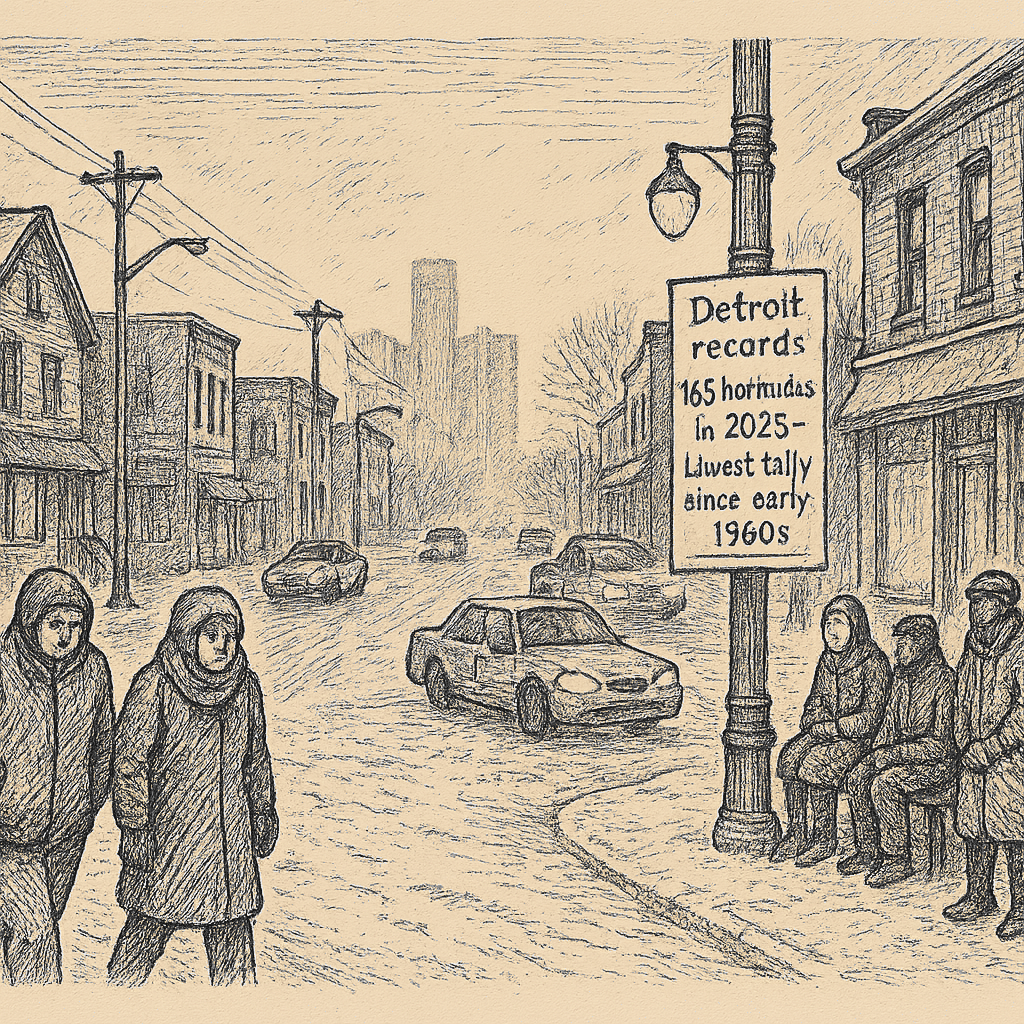
Detroit’s homicide count has fallen nearly in half since 2021, reflecting a pattern seen across many U.S. cities as prevention programs, enforcement technology, and community partnerships have narrowed the pandemic-era spike in violence.
DETROIT — Detroit ended 2025 with 165 criminal homicides, its lowest count since at least the early to mid-1960s and 38 fewer than the 203 recorded in 2024, Police Chief Todd Bettison announced Wednesday.
“What we’re doing in the city of Detroit is working,” Bettison said. “We will continue investing in prevention, enforcement, technology — everything.”
The 2024 tally of 203 had itself been the city’s lowest since 1965, when 188 homicides were committed. The count has declined steeply in recent years: 252 in 2023, 309 in 2022, and 308 in 2021.
The drop in killings was accompanied by declines across other violent crime categories. Nonfatal shootings fell from 603 in 2024 to 447 in 2025. Carjackings dropped from 142 to 77, and robberies declined from 1,209 to 953. Sexual assaults and auto vehicle thefts also fell, Bettison said.
More than 6,200 guns were recovered in Detroit during 2025.
Detroit’s homicide rate fell as well. The city’s rate stood at approximately 32 per 100,000 residents in 2024, according to a study by the Center for Public Safety Initiatives at the Rochester Institute of Technology. Based on Detroit’s population of roughly 645,000, the 2025 count translates to approximately 25 per 100,000.
A national pattern
Detroit’s decline fits within a broader national trend. The FBI reported that violent crime in the United States fell 4.5% in 2024, while property crime dropped 8% from the year before. Murder and nonnegligent manslaughter nationwide fell nearly 15% in 2024, continuing a reversal from the pandemic-era crime spike. Homicides nationally had risen nearly 30% in 2020 from the prior year.
New Orleans officials reported this week that violent crime in the city fell for a third consecutive year in 2025.
Alaina De Biasi, professor of criminology and criminal justice at Wayne State University in Detroit, described the national reductions as “kind of a return to pre-pandemic levels.”
“We have multiple violence reduction initiatives happening at any one time,” De Biasi said of Detroit.
Among the strategies Bettison outlined: using crime intelligence to identify individuals who use firearms and to target the times and locations where violence is most concentrated. A dedicated unit responds to illegal street parties, while metal detectors and scanners were deployed at large gatherings including the 2024 NFL Draft, held downtown. Bettison attributed the results to partnerships with federal, state, and local law enforcement agencies and the community.
Political context
Detroit’s results come as President Donald Trump has deployed National Guard members to several cities on crime-fighting missions, accusing a number of large, mostly Democratic-run cities of having runaway crime. New Orleans became the latest city to receive troops, with armed forces arriving there less than a week after officials released its annual crime figures.
Bettison declined to engage with Trump’s claims directly. “I’m just focused on local, what I’m doing,” he said. “My job as police chief is to continue that we have a safe environment … pushing down crime.”