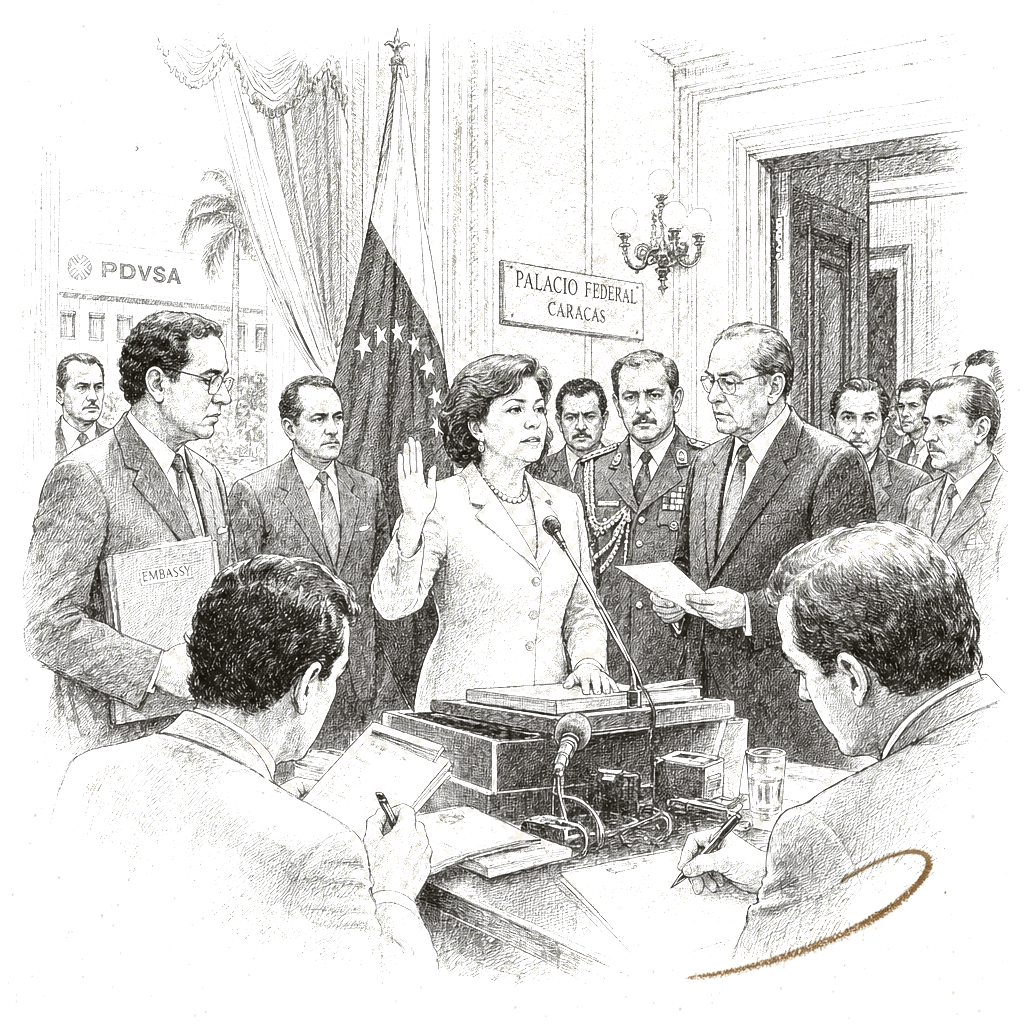
Delcy Rodríguez, sworn in Monday as Venezuela’s interim president after the capture of Nicolás Maduro, built part of her political prominence through a 2017 effort to court the incoming Trump administration — including directing Citgo, a subsidiary of Venezuela’s state oil company, to donate $500,000 to Trump’s inauguration, according to an Associated Press investigation drawing on interviews with 10 former U.S. and Venezuelan officials.
The charm offensive failed to shift U.S. policy toward Venezuela, but it raised Rodríguez’s profile in American business and political circles and helped pave the way for her current role as Washington’s primary interlocutor in Caracas.
With Rodríguez now holding Venezuela’s top office, former U.S. officials and analysts say the central unresolved question is whether the arrangement between her government and the Trump administration will include elections — mandated by Venezuela’s constitution within 30 days of the presidency being permanently vacated — a subject neither side has publicly raised.
A failed gamble that opened doors
In 2017, then serving as Venezuela’s foreign minister, Rodríguez directed Citgo to make the inauguration donation. She also arranged for Trump’s former campaign manager to be hired as a lobbyist for the company, courted Republicans in Congress and sought a meeting with the head of Exxon, according to the AP.
The effort did not succeed. Within weeks of taking office, Trump — pressed by then-Sen. Marco Rubio of Florida — made restoring Venezuela’s democracy his administration’s primary focus in the region, in response to Maduro’s crackdown on political opponents.
Lee McClenny, a retired U.S. foreign service officer who served as the top American diplomat in Caracas during the period of Rodríguez’s outreach, said he met with her repeatedly and watched her approach Washington as a practical problem to be solved.
“She’s an ideologue, but a practical one,” McClenny said. “She knew that Venezuela needed to find a way to resuscitate a moribund oil economy and seemed willing to work with the Trump administration to do that.”
Childhood loss and a slow political rise
Rodríguez entered politics on the coattails of her older brother, Jorge Rodríguez, who became a senior official under Hugo Chávez. Her political outlook was hardened by a childhood loss: in 1976, during a period of significant U.S. commercial and political influence in Venezuela, her father — a socialist leader — was detained for questioning and died in custody, leaving her fatherless at the age of 7. McClenny said she raised the murder in their meetings and blamed the United States for it.
Her rise under Chávez was not without setbacks. In 2006, on an international trip, Chávez removed her from the presidential delegation and ordered her home from Moscow after the delegation’s schedule of meetings fell apart. She was fired shortly afterward, according to two former officials who were present on the trip, and held no high-profile role under Chávez again.
“It was painful to watch how Chávez talked about her,” one of the former officials said. “He would never say a bad thing about women but the whole flight home he kept saying she was conceited, arrogant, incompetent.”
Maduro revives her career
After Chávez died of cancer in 2013 and Maduro assumed the presidency, Rodríguez’s fortunes reversed. A lawyer educated in Britain and France who speaks English, she proved valuable to a government increasingly isolated from Western financial markets.
Maduro promoted Rodríguez to vice president in 2018, where she gained control over large portions of Venezuela’s oil economy. She brought in foreign financial advisers and moved against internal rivals: former Oil Minister Tareck El Aissami was jailed in 2024 as part of an anti-corruption crackdown that she spearheaded, according to the AP.
Rodríguez’s back-channel outreach to Washington drew on allies who later faced their own legal difficulties. Media tycoon Raul Gorrín helped organize a secret April 2018 visit by Rep. Pete Sessions, a Texas Republican, to Caracas for a meeting with Maduro. U.S. federal prosecutors unsealed money laundering indictments against Gorrín in the months that followed.
Hans Humes, chief executive of Greylock Capital Management, who said he met with both Maduro and Rodríguez on multiple occasions, said her years managing Venezuela’s economy position her to stabilize the country under a new arrangement — and that importing exiled opposition figures could carry serious risks.
“We’ve seen how expats who have been outside of the country for too long think things should be the way it was before they left,” Humes said. “You need people who know how to work with how things are not how they were.”
Democracy questions without answers
Since Maduro’s capture Saturday, Trump has alternately praised Rodríguez as a “gracious” American partner and warned that she faces a fate similar to Maduro’s if she does not keep the ruling party in check and grant the United States “total access” to Venezuela’s oil reserves.
Venezuela’s constitution mandates elections within 30 days of the presidency being permanently vacated. Neither Trump nor Rodríguez has mentioned elections, according to the AP.
Trump also said that Nobel Peace Prize winner María Corina Machado lacks the “respect” to govern Venezuela, despite her handpicked candidate being recognized by the U.S. and other governments as the winner of the country’s 2024 presidential election, which Maduro’s government was widely accused of stealing.
Elliott Abrams, who served as Trump’s special envoy to Venezuela during the first administration, said the current arrangement raises fundamental questions about what, precisely, is being built.
“Nothing that Trump has said suggests his administration is contemplating a quick transition away from Delcy. No one is talking about elections,” Abrams said. “If they think Delcy is running things, they are completely wrong.”