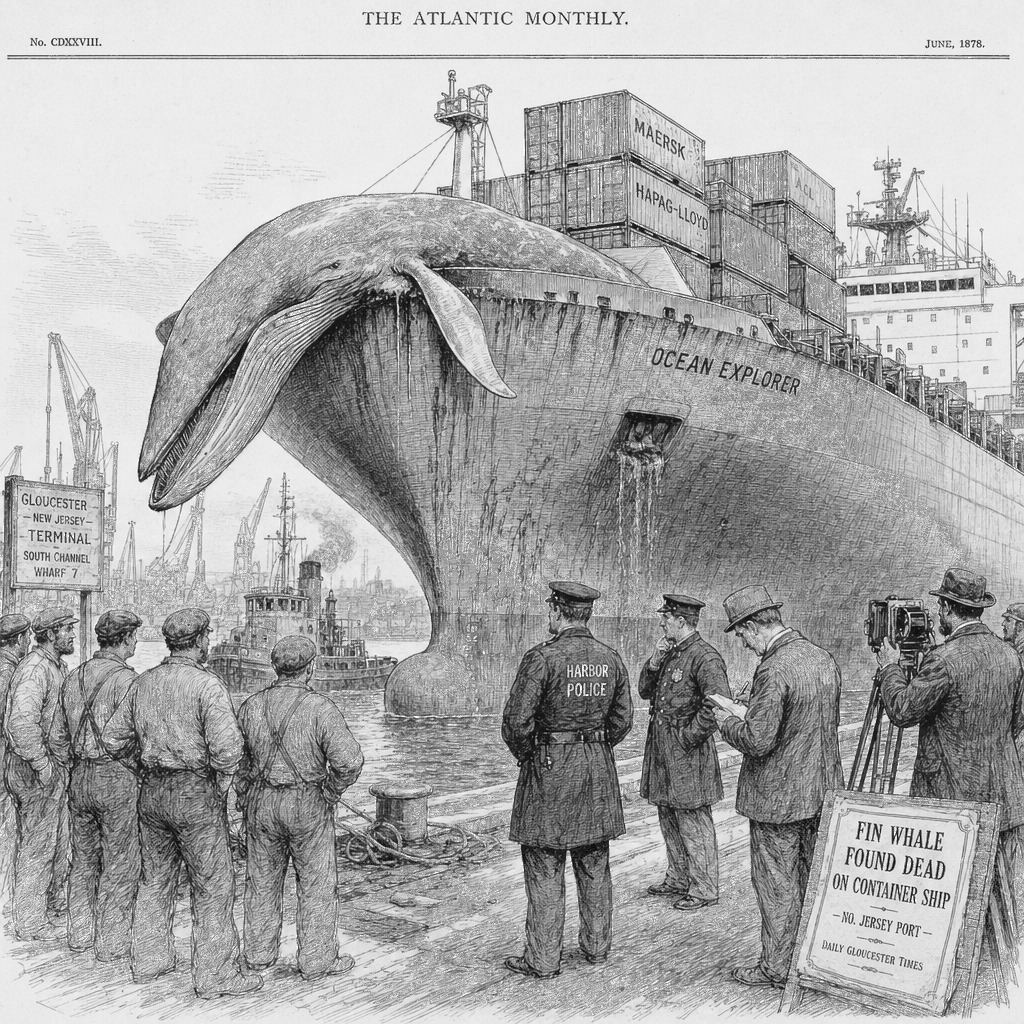
The discovery underscores the persistent dangers facing fin whales along the Eastern Seaboard, where the second-largest animals on earth have staged a gradual recovery from near-extinction driven by commercial hunting — only to face ongoing threats from ship strikes, fishing gear entanglement, and climate change.
GLOUCESTER CITY, N.J. — A dead fin whale was found on the bow of a container ship docked at the Gloucester Marine Terminal in New Jersey, the U.S. Coast Guard reported Sunday, prompting federal wildlife investigators to open a case and rescue workers to begin efforts to remove the carcass.
The Marine Mammal Stranding Center, a New Jersey-based animal rescue organization, said in a social media post that the whale was reported Sunday at the terminal, which sits at the base of the Walt Whitman Bridge linking southern New Jersey and Pennsylvania. In a follow-up post Tuesday, the center said it was working to tow the carcass away so a necropsy could determine how the animal died.
The National Oceanic and Atmospheric Administration confirmed Tuesday that its enforcement office had opened an investigation into the death and declined to comment further. NOAA said anyone with information about the incident should call the agency’s enforcement hotline.
The deceased animal is believed to be a fin whale between 25 and 30 feet long, according to the stranding center. Fin whales are an endangered species known to swim in waters from southern New Jersey to the New York City area.
About fin whales
Fin whales are the second-largest animals on earth, behind only the blue whale. Fully grown, they can reach up to 85 feet long and weigh between 40 and 80 tons, according to the Associated Press. The species is found throughout the world’s oceans.
Fin whale populations have gradually recovered in the Atlantic Ocean following conservation efforts after commercial hunting brought the species to the edge of extinction. All whales, dolphins and porpoises are protected under the federal Marine Mammal Protection Act, which prohibits touching, feeding or otherwise harming them.
Despite that recovery, the animals face persistent threats. Ship strikes, fishing gear entanglements, and the effects of climate change all pose ongoing dangers to fin whale populations.