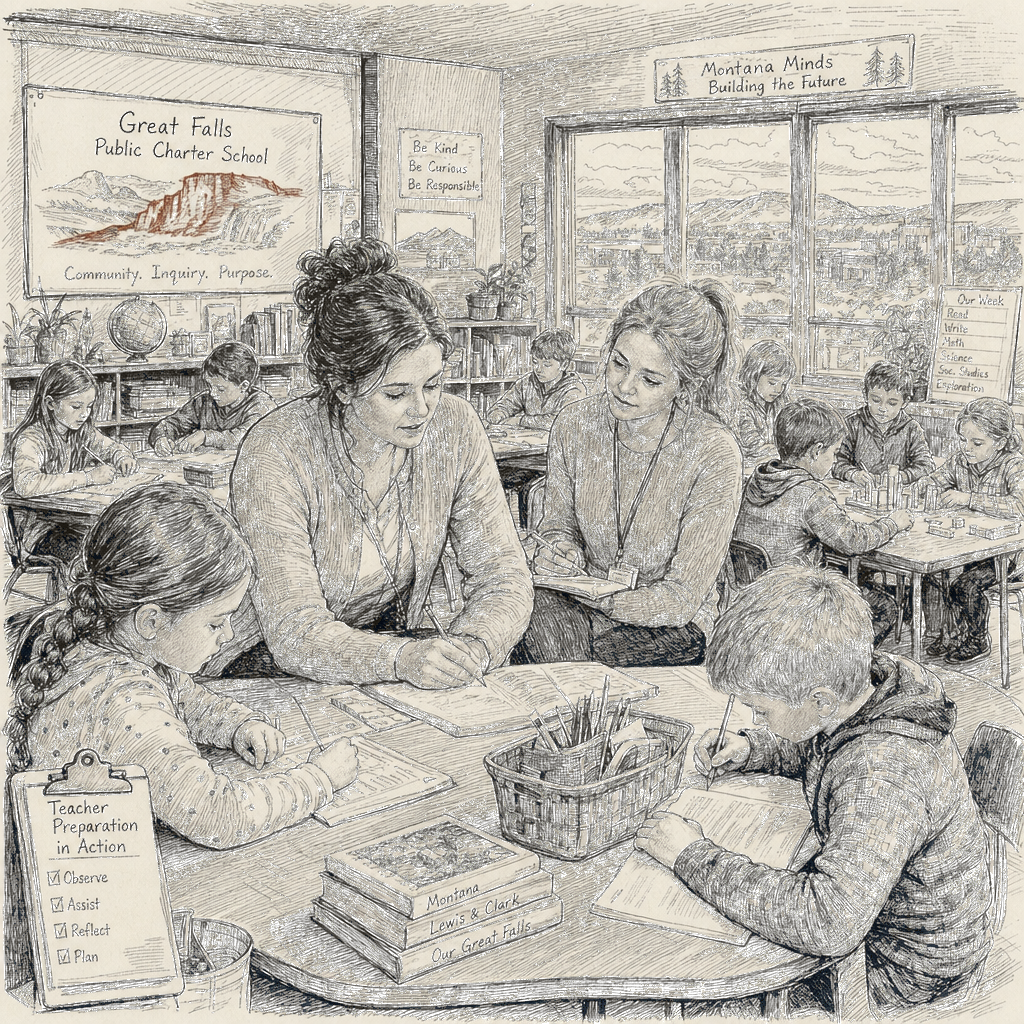
A public charter school in Great Falls, Montana, is in its second year of a program that trains future teachers inside a functioning K-6 elementary school. College students at Morningside Elementary earn three-year teaching degrees while working as paid teaching assistants and taking courses from the school’s own teachers — who hold master’s degrees and serve as adjunct professors for the University of Montana-Western.
The program, known as the CORE School at Morningside, is a partnership between Great Falls Public Schools and the University of Montana-Western in Dillon. District officials said they hope the model will build a pipeline of locally trained, experienced teachers for the district while giving existing classroom teachers additional support.
A public charter school in Great Falls, Montana, is midway through its second year of training future teachers inside a functioning elementary school, the Associated Press reported Tuesday.
The CORE School at Morningside Elementary places college students in K-6 classrooms full-time for three years, where they work as paid teaching assistants and take courses taught by the school’s own teachers. Those teachers hold master’s degrees and serve as adjunct professors for the University of Montana-Western, the program’s college partner based in Dillon. Great Falls Public Schools says the model is designed to build a local pipeline of credentialed, experienced teachers for the district.
“You get the immediacy and the skills to be able to work with what the day-to-day looks like,” said Katrina Kennett, an education professor at UM-Western and faculty lead of the degree program. “And you get that benefit of seeing the child development happening in front of you today.”
How the program came together
The CORE School grew from Montana legislation passed in 2023 that authorized local school districts to create their own charter models. Great Falls Public Schools submitted its charter application to the Montana Board of Public Education in fall 2023, and Morningside opened under the CORE model in August 2024. CORE stands for “Creation of teachers, Opportunities for students, Respect for the uniqueness of our community and Excellence in education.”
Marni Napierala, the program’s coordinator and UM-Western’s Great Falls liaison, said she had been intrigued for years by a more limited version of the model — college students placed in local elementary classes through a partnership she oversaw at Montana State University-Northern. But that program gave students only limited classroom time. She believed full-time immersion, more like an apprenticeship, would produce better-prepared teachers.
The idea, she said, always seemed out of reach.
“How do you make a school?” Napierala said. “That was always the barrier.”
Structure and enrollment
Eleven college students entered the program when Morningside opened in August 2024. A second cohort of 11 students began this past fall. The format is described as a “sprint degree”: students complete general education courses online through UM-Western and work straight through summers, while taking their education courses during the school year from Morningside’s adjunct teachers. The design allows students to earn a three-year bachelor’s degree without leaving Great Falls.
Grant funding from the Montana Office of Commissioner of Higher Education has covered tuition for students in their first and second years. Third-year students will be supported by the Montana Teacher Residency Program through the state Office of Public Instruction. Stakeholders at both institutions said they are seeking long-term grant sources to sustain support for future first- and second-year cohorts.
Morningside’s approximately 300 elementary students were drawn through a mix of priority placement for families in the school’s original attendance area — about 200 students — and a weighted lottery that admitted roughly 100 more. Administrators said the lottery was structured to keep Morningside’s demographics roughly in line with other district schools.
All teaching staff was newly hired for the charter model. Principal Jennifer Martyn said most came from within Great Falls Public Schools, though the transition disrupted some families.
“Some of the families who had been at Morningside, that change was hard for them,” Martyn said.
Who is enrolling
The program has attracted students who would not fit easily into a traditional four-year college experience. Daniela Pinneo has worked in Great Falls Public Schools for over a decade, primarily in special education, and said she enrolled in the sprint degree after finding that higher education credentials from Romania transferred only partially in the United States. Brooklyn Wood, 20, had worked at a daycare and taught swim lessons before learning about the program.
“I’ve never felt more at place with what I’m doing,” Wood said.
The waiting list of prospective college students for the program had nearly 30 names as of winter break, according to the report. Recruitment for a third cohort is set to begin in spring.
What comes next
The first cohort of sprint degree students will enter their third and final year in fall 2026, transitioning from teaching assistants to full-time student teachers for the entire school year. For the first time, Morningside will have first-year and third-year program students in the building at the same time.
Rachel Cutler, GFPS elementary coordinator of curriculum and assessment, said the program has been demanding for the classroom teachers who also serve as adjunct instructors, particularly as they develop new coursework. But she said teachers have found it energizing.
Kennett said the coordination among faculty, staff, and families at Morningside stood out.
“I walk into a lot of schools. There are committed people in all schools I go into,” Kennett said. “But having that coordination of commitment is special.”