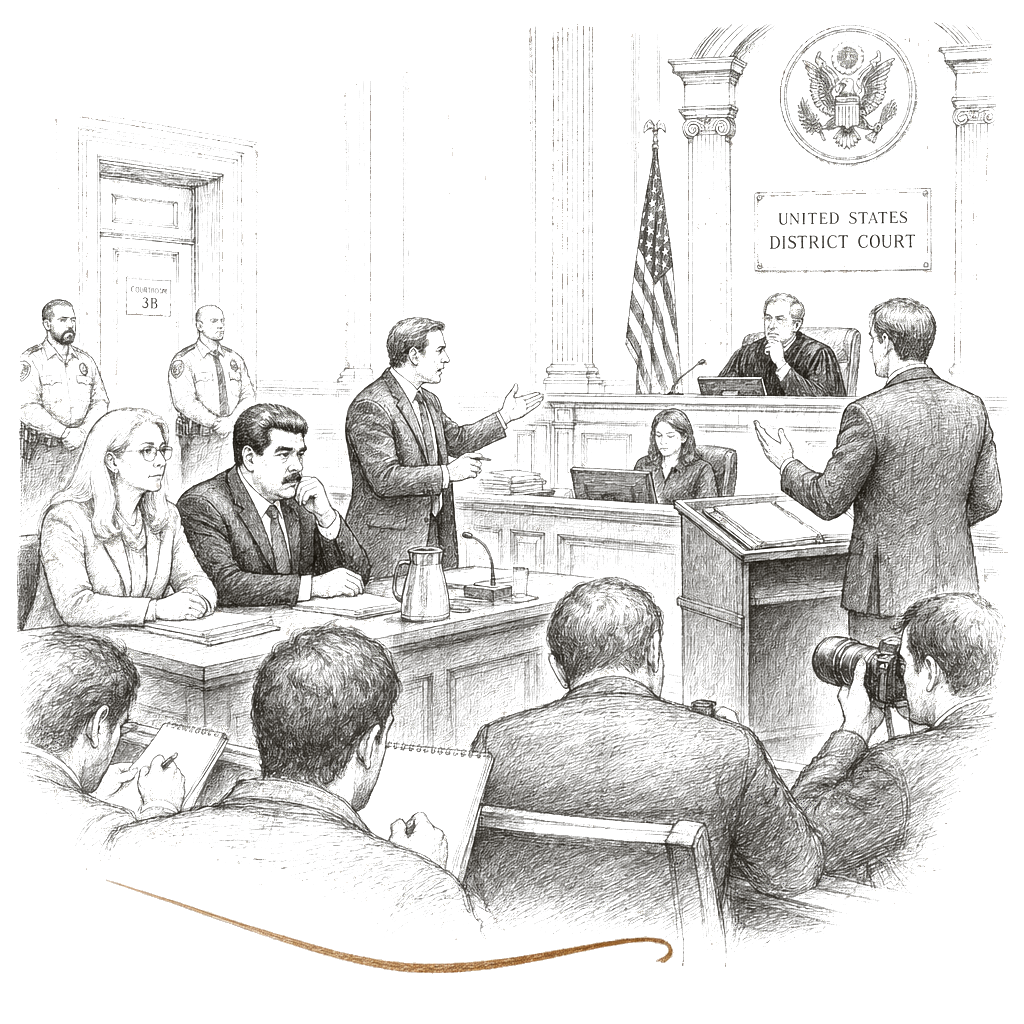
The arraignment opens what legal observers expect will be a protracted case involving a sovereignty immunity defense, contested jurisdiction over a military seizure, and immediate practical complications — including medical care for Flores, who appeared with bandages on her face, and the reach of U.S. sanctions that restrict how both defendants can pay their lawyers.
Nicolás Maduro, 63, and his wife Cilia Flores, 69, appeared Monday in federal court in New York City and pleaded not guilty to drug trafficking charges that carry potential life sentences, days after U.S. forces seized them from their Caracas home in a nighttime raid. Maduro told Judge Alvin Hellerstein, in Spanish through an interpreter, that he remains Venezuela’s president and that his capture was a kidnapping; he declared himself a prisoner of war. Their next court hearing is scheduled for March 17.
The arraignment opens what legal observers expect will be a protracted case, pitting a sovereignty immunity defense against a six-year-old U.S. indictment, while raising immediate questions about the medical condition of both defendants and whether Maduro can secure legal representation given long-standing U.S. sanctions on him and his wife.
Charges and immediate proceedings
Maduro is charged with narco-terrorism conspiracy. He and Flores are also charged with conspiracy to import cocaine into the United States and possessing machine guns. The Trump administration described the seizure as a “surgical law enforcement operation” to apprehend defendants in a criminal case U.S. prosecutors first brought six years ago.
Hellerstein, of the Southern District of New York, told the lawyers he would welcome requests for bail “whenever, and as often you think it appropriate.” Neither defendant made such a request Monday, though their lawyers suggested they might in the future.
Bail precedent works against defendants
Historical analogues offer little encouragement for a bail application. Manuel Noriega was not granted bail after U.S. forces accused him of drug trafficking, invaded Panama, and removed him as that country’s leader in 1989. Lawyers for Juan Orlando Hernández, the recently pardoned former president of Honduras who faced drug trafficking charges in the U.S., never sought bail. Nor did lawyers for Joaquín Guzmán, the drug lord known as “El Chapo,” when he was brought to the United States from Mexico.
Prosecutors could argue that Maduro and Flores — both charged with offenses that could carry life sentences — are flight risks.
Medical concerns for both defendants
Flores appeared in court with bandages on her forehead and over her temple and eyelid. Her lawyer, Mark Donnelly, told Hellerstein that she sustained “significant injuries” during her capture and needs an X-ray and medical evaluation because she may have a fracture or severe bruising on her ribs.
Maduro’s lawyer, Barry Pollack, told the judge that Maduro has “health and medical issues that will require attention” while detained, without specifying the nature of those issues. Hellerstein directed both legal teams to work with prosecutors to ensure appropriate medical care.
Both defendants are being held at the Metropolitan Detention Center in New York, which has a medical unit but has faced past criticism over care, including missed cancer diagnoses.
Consular access and sanctions complicate representation
Maduro told the judge he and Flores would like a consular visit, a right extended to non-citizens charged with crimes in the United States. The request faces a practical complication: Maduro ordered the closure of the Venezuelan embassy and consulates in the United States in early 2019. Venezuela’s mission to the United Nations remains open.
Consular access may also bear on finances. Both Maduro and Flores have been under U.S. sanctions for years, making it illegal for any American to accept money from them without a Treasury Department license. Hellerstein instructed prosecutors to work with defense counsel to ensure lawyers “can represent their clients zealously and fully.”
On Tuesday, Maduro expanded his legal team, adding Bruce Fein, a constitutional and international law specialist who served as assistant deputy U.S. attorney general under President Ronald Reagan.
Sovereignty immunity defense signals lengthy legal battle
Pollack told the court there would be “substantial” challenges to the validity of Maduro’s indictment. “Mr. Maduro is the head of a sovereign state and is entitled to the privileges and immunities that go with that office,” Pollack said. He also cited “issues about the legality of his military abduction.”
The sovereignty immunity argument has a notable precedent — and a notable failure. After U.S. forces removed Noriega from Panama in 1989, his lawyers raised the same defense. It ultimately failed, in part because Noriega never held the formal title of president during his six-year de facto rule.
Maduro claims to have won three popular elections, but the United States has not recognized him as Venezuela’s legitimate leader for years — a fact that could complicate his claim to sovereign immunity, since that protection has generally been reserved for recognized heads of state. Pollack’s challenge to that determination, and to the legality of the military seizure itself, is expected to generate appeals that could extend the pretrial phase for months or years.