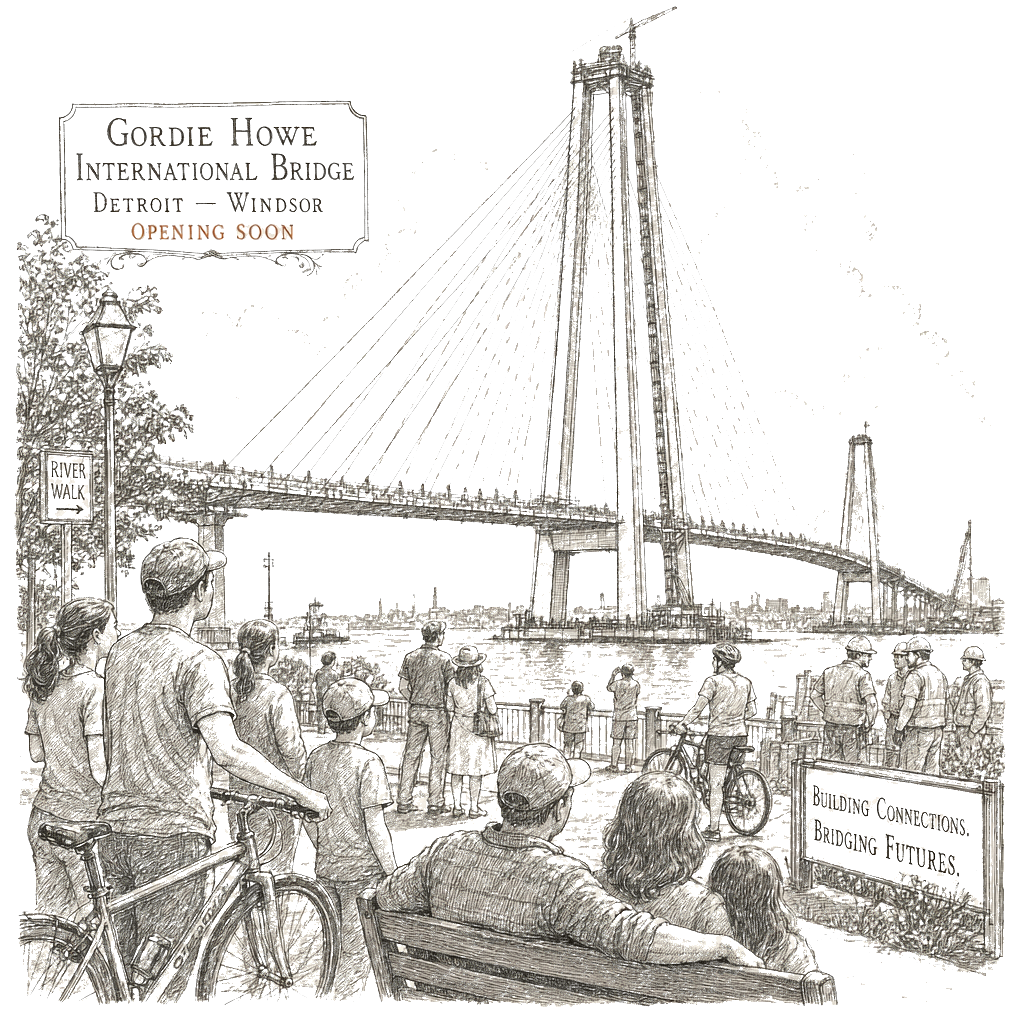
A new route for vehicles and people
The bridge will carry six lanes of vehicular traffic, three in each direction, and will connect Interstate 75 directly to Ontario’s Highway 401 without requiring trucks or cars to stop at traffic lights along the way, said Heather Grondin, chief relations officer for the Gordie Howe International Bridge.
“This bridge, along with the adjacent infrastructure, will connect directly from Interstate 75 to the Ontario highway system, known as Highway 401, without trucks or cars having to stop at traffic lights along the way,” Grondin said.
The bridge is also designed to contain vehicle backups within the port of entry, keeping congestion off I-75. Trucks will be required to shut off their engines during inspection to reduce noise and air pollution, Grondin said.
Pedestrians and cyclists will enter through a separate port of entry and must show a passport or enhanced license. Grondin said trail connections beyond the crossing are part of the design.
“We’ve done a lot of work to ensure that … people will have a destination when they go across the multiuse path and will be able to connect to much broader trail networks,” she said.
Only three other US-Canada crossings accommodate foot traffic: the Peace Bridge and Rainbow Bridge over the Niagara River and the Thousand Islands Bridge over the St. Lawrence River.
Breaking a private monopoly
The roughly $4.4 billion project was financed in Canadian dollars by the Windsor-Detroit Bridge Authority. Because Canada funded the bridge, it will recoup toll revenue and receive ongoing capital and availability payments to operate, maintain, and rehabilitate the span for the next 36 years, according to the Federal Highway Administration.
Jeff Rightmer, a professor of supply chain management at Wayne State University, said the public ownership structure addresses longstanding concerns about the existing crossings.
“The Ambassador Bridge is basically privately owned and controlled by one family, and I think there was nervousness around that,” Rightmer said. “The new bridge alleviates some of that monopoly that the Moroun family had.”
The Ambassador Bridge, which has four lanes of traffic, originally had an eight-foot-wide sidewalk for pedestrians. It was closed after the Sept. 11 attacks amid security concerns.
Rightmer said the added capacity will benefit the broader regional economy regardless of which crossing drivers choose.
“The ability to have more than the Ambassador Bridge, the tunnel and the Blue Water Bridge up in Port Huron is just huge for the region,” he said. “The ability to move more stuff back and forth is only going to benefit Michigan and Canada.”
Marathon stays its course
The Detroit Free Press International Marathon, which crosses the Ambassador Bridge into Canada and returns through the Detroit-Windsor Tunnel, has no immediate plans to reroute over the new span.
Aaron Velthoven, the race’s executive producer, said the Gordie Howe Bridge’s location makes a course change logistically prohibitive.
“The (Gordie Howe) Bridge is much further away from where we traditionally start and finish,” Velthoven said. “To even entertain something like that, we would have to dramatically change where we start and finish.”
Both bridges stand roughly 150 feet above the Detroit River at their highest points.