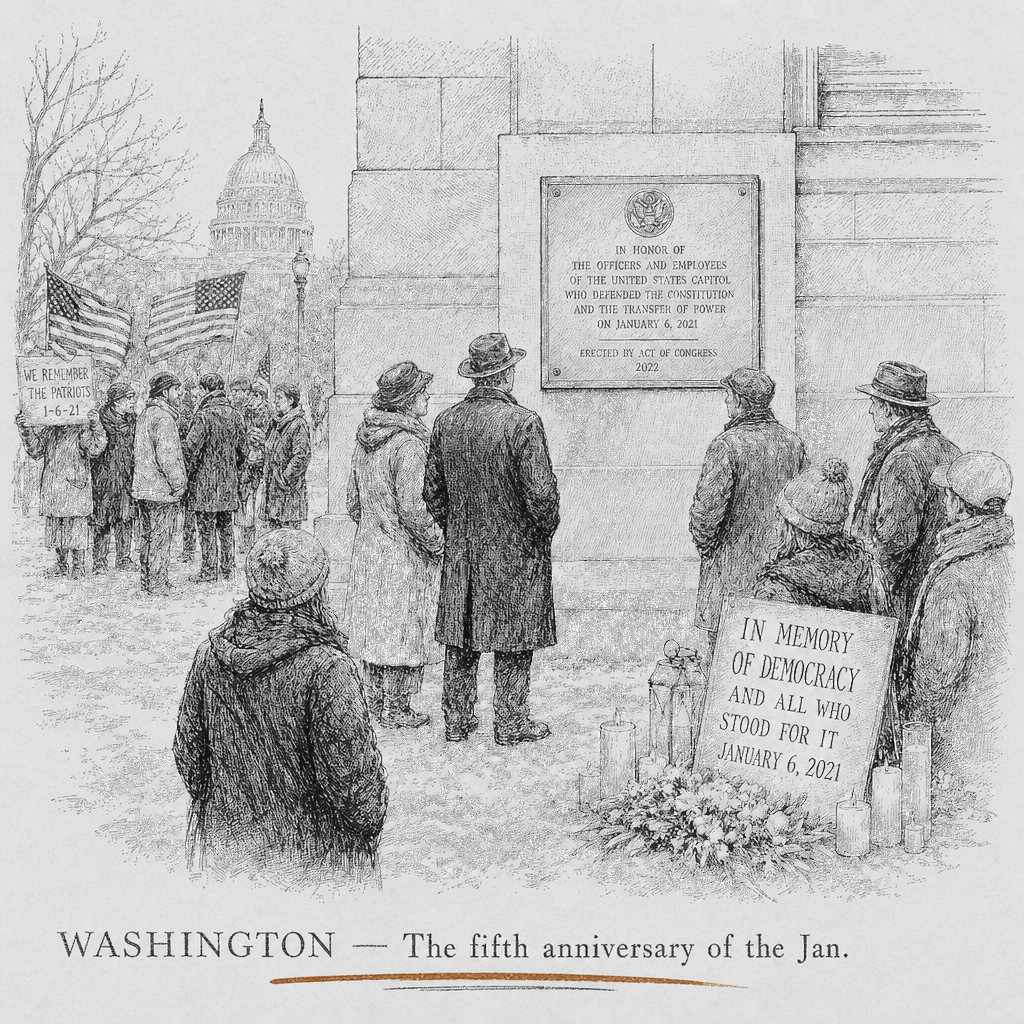
WASHINGTON — The fifth anniversary of the Jan. 6, 2021, assault on the U.S. Capitol brought rival ceremonies to Washington on Tuesday but no shared memorial, as Republicans and Democrats diverged sharply in their accounts of the day that killed at least five people and reshaped American politics.
The anniversary arrived without an official commemorative event, without the police plaque that federal law requires to be installed in the Capitol, and without consensus on who bears responsibility — divisions that continued to define Washington five years on.
Trump and Democrats mark the day separately
President Donald Trump spoke at the Kennedy Center — rebranded with the president’s name — to an audience of House Republicans, shifting blame for Jan. 6 onto the rioters themselves. He said he had intended for his supporters to go “peacefully and patriotically” to confront Congress as it certified Democrat Joe Biden’s 2020 election win, and blamed the media for focusing on other parts of his speech. The White House simultaneously issued a report presenting its own account of the events.
Democrats convened members of the House committee that investigated the Jan. 6 attack for a panel discussion at the Capitol. Rep. Jamie Raskin, D-Md., warned of what he called the GOP’s “Orwellian project of forgetting.”
House Democratic leader Hakeem Jeffries of New York said on the eve of the anniversary that officials in the administration “want to lecture the world about democracy when they’re undermining the rule of law at home.” Jeffries and Senate Democratic Leader Chuck Schumer held a candlelight vigil outside the Capitol with lawmakers and family members of police officers. Few Republicans joined in the day’s remembrances.
Witnesses recall the siege
Former U.S. Capitol Police officer Winston Pingeon testified at the Democratic panel. As a child, Pingeon said, he always dreamed of being a police officer — but on Jan. 6 he thought he was going to die in the mayhem on the Capitol steps. “I implore America to not forget what happened,” he said, urging the country to find common ground. “I believe the vast majority of Americans have so much more in common than what separates us.”
Pamela Hemphill, a rioter who refused Trump’s pardon, blamed the president for the violence and silenced the room as she apologized to the Capitol Police officer seated alongside her at the witness table. “I can’t allow them not be recognized, to be lied about,” Hemphill said of the officers who she said also saved her life as she fell and was trampled by the mob.
Former Rep. Adam Kinzinger of Illinois, one of two Republicans who served on the original Jan. 6 committee, also testified. Former Rep. Liz Cheney of Wyoming, the other Republican member, did not appear. Speaker Emerita Nancy Pelosi urged the country to reject persistent lies and violence.
Republicans dispute the Democratic account
Rep. Barry Loudermilk of Georgia, tapped by Speaker Mike Johnson of Louisiana to lead a new House committee examining alternative theories about Jan. 6, called Tuesday’s session a “partisan exercise” designed to hurt Trump and his allies. Johnson, before becoming House speaker, had led challenges to the 2020 election results and was among some 130 Republican lawmakers who voted that day to reject presidential results from some states.
Republicans have focused their scrutiny on security lapses at the Capitol — including the time it took for the National Guard to arrive, and the failure of police canine units to discover pipe bombs found that day outside Republican and Democratic party headquarters. The FBI arrested a Virginia man suspected of placing those devices; the man told investigators he believed someone needed to speak up for those who believed the 2020 election was stolen, authorities said.
“The Capitol Complex is no more secure today than it was on January 6,” Loudermilk said in a social media post.
The plaque that was never hung
The official plaque honoring Capitol Police officers for their defense of the Capitol on Jan. 6 has never been installed, despite a federal law requiring it. Johnson, in a statement issued on the eve of the anniversary, said the statute “is not implementable” and that proposed alternatives “also do not comply with the statute.”
Sen. Thom Tillis, R-N.C., displayed a replica of the plaque from the Senate floor and said he would push for a vote later in the week to ensure compliance with the law. Sen. Tommy Tuberville, R-Ala., objected to a separate resolution condemning the attack.
A march and the pardons
Enrique Tarrio, the former leader of the Proud Boys, organized a midday march of more than 100 people from the White House to the Capitol, retracing the path of the mob five years earlier. The march was held to honor Ashli Babbitt, who was shot and killed by police as she tried to climb through a window near the House chamber, and others who died in the siege and its aftermath. Babbitt’s mother was among those who gathered.
Tarrio was sentenced to 22 years in prison for seditious conspiracy for orchestrating the Jan. 6 attack. He was among more than 1,500 defendants whose charges were dropped after Trump issued a sweeping pardon upon returning to the White House. He called on the Trump administration to punish officials who investigated and prosecuted those who took part in the Jan. 6 attack. “They should be fired and prosecuted,” Tarrio told the crowd.
Deaths, indictment, and legal aftermath
At least five people died in the Capitol siege and its aftermath. Babbitt was shot by police at the Capitol. Capitol Police Officer Brian Sicknick died after battling the mob. Several law enforcement personnel died later, some by suicide.
The Justice Department indicted Trump on four counts related to a conspiracy to defraud voters ahead of Jan. 6. Former special counsel Jack Smith told lawmakers last month that the riot “does not happen” without Trump. Smith abandoned the case after Trump won the 2024 presidential election, citing Justice Department guidelines against prosecuting a sitting president.
The House impeached Trump on the sole charge of having incited the insurrection; the Senate acquitted him, with senior Republican senators saying at the time they believed the matter was best left to the courts. The Supreme Court, ahead of the 2024 election, ruled that ex-presidents have broad immunity from prosecution.