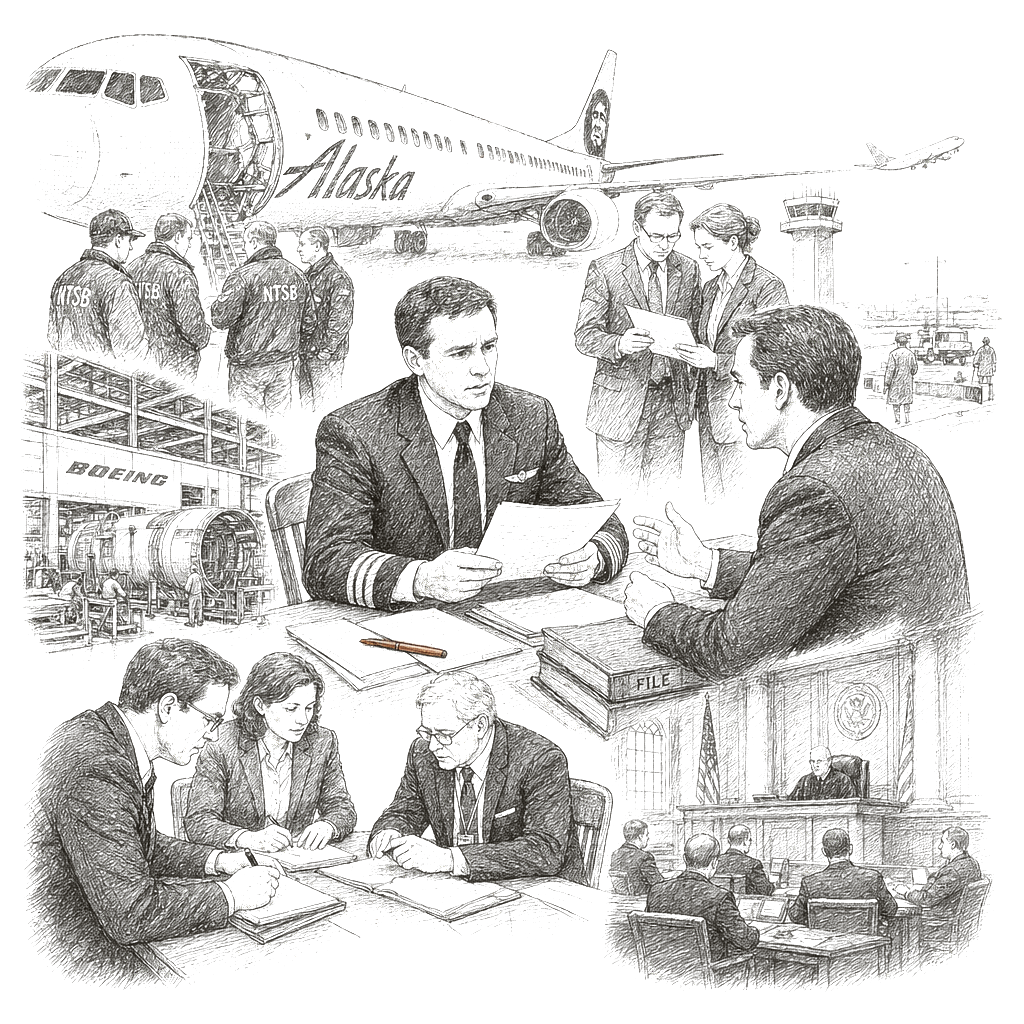
Captain Brandon Fisher, the Alaska Airlines pilot praised by the heads of the National Transportation Safety Board, the Federal Aviation Administration, and Boeing executives for safely landing Flight 1282 after a door plug panel separated from the aircraft in January 2024, has sued Boeing in an Oregon court. Fisher’s lawyers allege that Boeing, despite a federal finding that the blowout resulted from a manufacturing defect, attempted to shift blame onto him and the crew — leading some passengers to name Fisher in their own litigation against the manufacturer.
The lawsuit deepens the legal fallout from an incident that injured eight people aboard a Boeing 737 Max 9 carrying 177 passengers and crew. Federal investigators determined the blowout was caused by four missing bolts — a defect traceable to Boeing’s assembly process, not to any action by the flight crew.
Captain Brandon Fisher, the Alaska Airlines pilot praised by the heads of the National Transportation Safety Board and the Federal Aviation Administration, and even by Boeing executives, for safely landing Flight 1282 after a door plug panel separated from the aircraft in January 2024, has sued Boeing in an Oregon court. Fisher’s lawyers allege that Boeing, despite a federal investigation finding that the blowout resulted from a manufacturing defect, attempted to shift blame onto him and the crew — leading some passengers to name Fisher in their own lawsuits against the manufacturer.
“It was clear Boeing’s words were directed at Captain Fisher in attempt to paint him as the scapegoat for Boeing’s numerous failures,” lawyers William Walsh and Richard Mummolo wrote in the complaint.
The lawsuit describes a pilot who felt personally betrayed. “Because he had flown Boeing aircraft for the entirety of his employment with Alaska Airlines, Boeing’s attempts to blame him felt like a deep, personal betrayal by a company that claimed to hold pilots in the highest regard,” Walsh and Mummolo wrote.
What federal investigators found
The blowout occurred minutes after Flight 1282 departed Portland, Oregon, creating a roaring vacuum in the cabin. A 2-foot-by-4-foot section of fuselage covering an unused emergency exit behind the left wing had separated from the plane. Seven passengers and one flight attendant sustained minor injuries; all 177 people aboard survived. Only seven seats were unoccupied at the time, including the two closest to the opening.
The NTSB investigation found that four bolts securing the door plug panel had been removed during a repair as the Boeing 737 Max 9 was being assembled and were never replaced. Because the bolts sit behind interior panels, they would not have been visible during a preflight inspection by the pilot or airline personnel. Investigators found the door plug had been shifting gradually upward over the 154 flights before the incident, until it finally gave way.
Boeing and its key supplier Spirit Aerosystems — which has since been acquired by Boeing — were both implicated in the NTSB’s findings. Boeing factory workers told investigators they felt pressured to work too fast and were asked to perform tasks for which they were not qualified.
Expert and industry response
John Cox, CEO of the aviation safety consulting firm Safety Operating Systems and an experienced pilot, said the crew performed well under the circumstances and described Boeing’s litigation posture skeptically. “I think the Boeing lawyers were kind of grasping at straws,” Cox said.
Fisher’s lawsuit describes how he and his first officer acted quickly after losing cabin pressure — decreasing altitude and coordinating with air traffic controllers to avoid other aircraft while returning the plane safely to Portland.
Four flight attendants from Flight 1282 previously sued Boeing over the incident in summer 2024. Legal experts told the Associated Press that it is unusual for a pilot to bring a lawsuit in an incident in which he was not seriously hurt or killed.
Boeing’s safety record since the incident
Boeing declined to comment directly on Fisher’s lawsuit. CEO Kelly Ortberg, who took over the company in August 2024, has made improving safety a stated top priority. The FAA fined Boeing $3.1 million over safety violations identified after the door plug incident. In October, the FAA authorized Boeing to increase 737 Max production to 42 planes per month, citing satisfactory progress on safety measures.
Stan Deal, who headed Boeing’s commercial airplane unit at the time of the blowout, had commended the Alaska Airlines crew in a memo to employees following the incident.
Alaska Airlines declined to comment on the lawsuit but said the carrier remains “grateful to our crew members for the bravery and quick-thinking that they displayed on Flight 1282 in ensuring the safety of all on board.” The airline did not respond to a question about whether Fisher remains employed as a pilot.