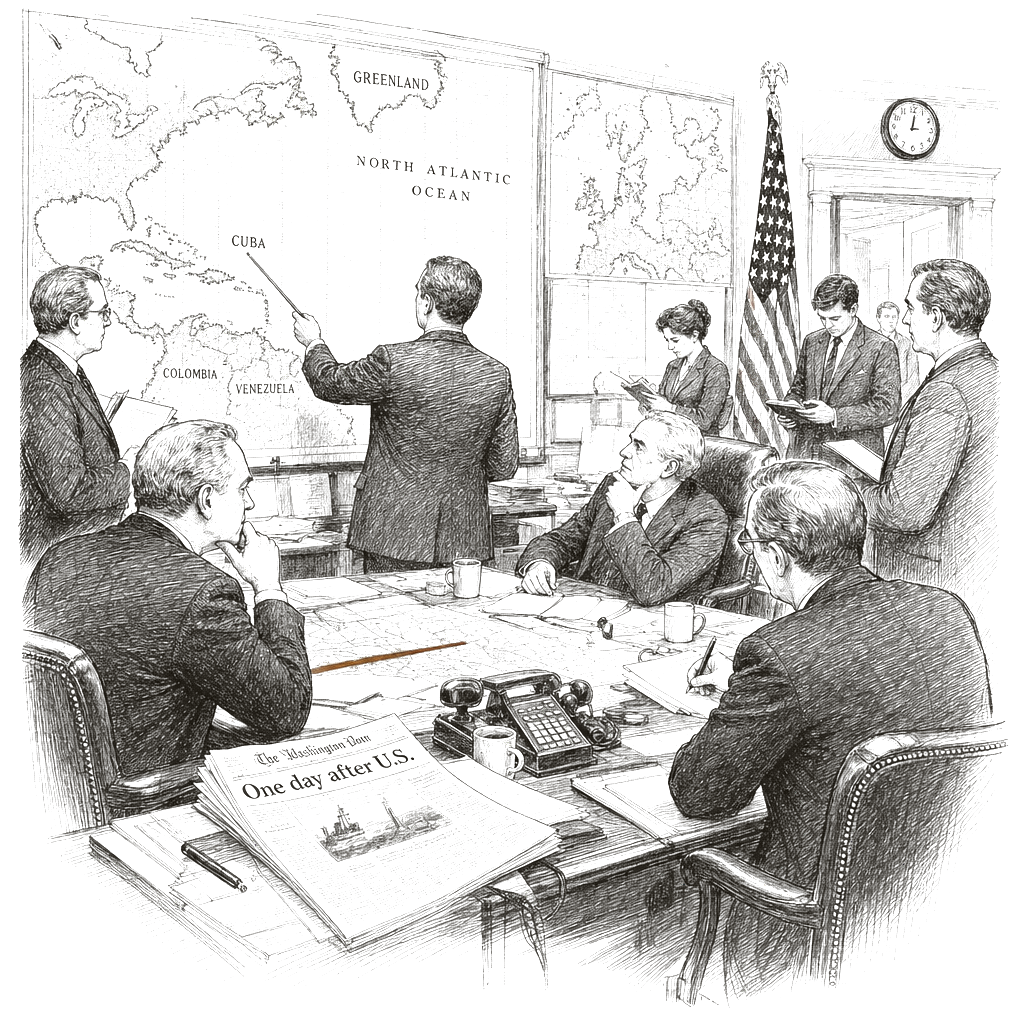
One day after U.S. forces captured Venezuelan President Nicolás Maduro in Caracas, President Donald Trump renewed his call Sunday for American control of Greenland and threatened military action against Colombia, while Secretary of State Marco Rubio warned that Cuba’s communist government is “in a lot of trouble.” Trump made the remarks aboard Air Force One as he flew back to Washington from his Florida home.
The statements, delivered within hours of the Venezuela operation, underscore the administration’s declared aim of restoring U.S. dominance across the Western Hemisphere — leaving allies and adversaries asking which government Washington might move against next.
Greenland
Trump cited Russian and Chinese naval activity near the Arctic island as justification for U.S. control.
“It’s very strategic right now,” Trump said. “Greenland is covered with Russian and Chinese ships all around. We need Greenland from a national security standpoint, and Denmark is not going to be able to do it.”
When The Atlantic asked whether the Venezuela operation presaged similar action on Greenland, Trump declined to commit. “They’re going to have to see for themselves. I really don’t know,” he said.
Denmark’s Prime Minister Mette Frederiksen pushed back in a written statement, saying Trump “has no right to annex” the territory and that Denmark already provides the United States broad access to Greenland through existing NATO security arrangements.
“Therefore, I would strongly urge the United States to stop threatening a historically close ally and another country and people who have made it very clear that they are not for sale,” Frederiksen said.
The diplomatic exchange was sharpened by a social media post from Katie Miller — a former Trump administration official and podcaster married to White House deputy chief of staff Stephen Miller — that showed an illustrated map of Greenland rendered in U.S. flag colors with the caption “Soon.” Denmark’s ambassador to Washington, Jesper Møller Sørensen, responded directly: “And yes, we expect full respect for the territorial integrity of the Kingdom of Denmark.”
Less than two weeks before Sunday’s remarks, Trump had named Louisiana Gov. Jeff Landry as his special envoy to Greenland. Landry said the voluntary role would help Trump “make Greenland a part of the United States.”
Cuba
Rubio, appearing on NBC’s “Meet the Press,” said Cuban personnel — not Venezuelan security staff — were guarding Maduro at the time of his capture and were running intelligence operations inside his government.
“It was Cubans who were guarding Maduro,” Rubio said. “He was not guarded by Venezuelan bodyguards. He had Cuban bodyguards.” Rubio said Cuban personnel also managed internal surveillance, including “who spies on whom inside, to make sure there are no traitors.”
Cuba’s government said in a statement read on state television Sunday night that 32 personnel died in the U.S. military operation in Venezuela.
Trump predicted the removal of Maduro — who had been supplying Cuba with subsidized oil — would accelerate an economic collapse in Havana.
“It’s going to fall,” Trump said of the Cuban government. “It’s going to fall definitely.”
Colombia
Trump also directed warnings toward Colombia and its president, Gustavo Petro, calling him “a sick man who likes to make cocaine and sell it to the United States.” When asked whether he could order a military operation against Colombia, Trump said: “Sounds good to me.”
The Trump administration sanctioned Petro, his family, and a member of his government in October 2025 over allegations of involvement in global drug trafficking. Colombia is the world’s leading producer of cocaine.
In September 2025, the United States added Colombia — at the time the largest recipient of U.S. assistance in the region — to a list of nations not cooperating in counter-narcotics efforts, the first such designation in nearly 30 years. The listing reduced U.S. aid to the country.
Background
The remarks fit a pattern laid out in the administration’s National Security Strategy, published last month, which named restoring “American preeminence in the Western Hemisphere” as a central pillar of Trump’s second term. Trump has also cited the 19th-century Monroe Doctrine and the Roosevelt Corollary — an expansion invoked when the United States supported Panama’s secession from Colombia to secure the Canal Zone — in defense of the approach. Trump has referred to the doctrine informally as the “Donroe Doctrine.”