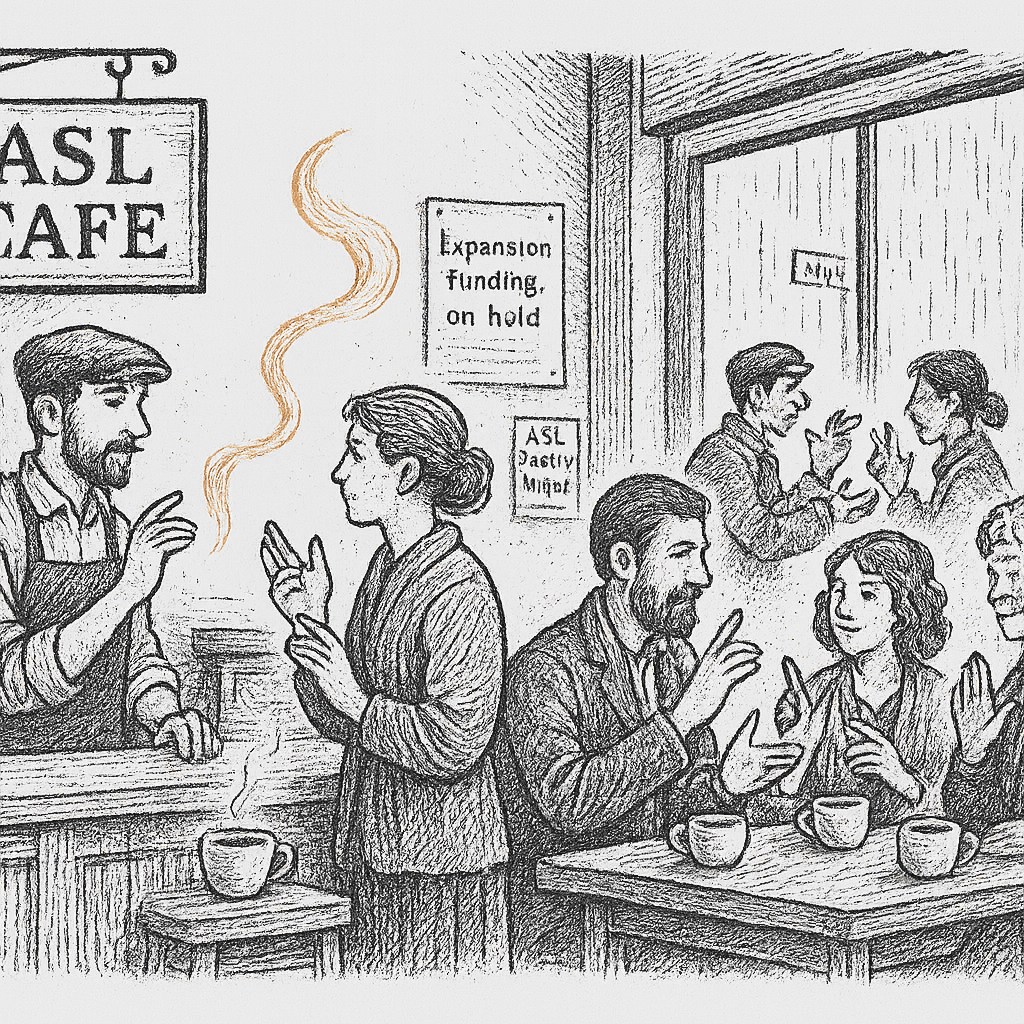
A Portland, Oregon cafe where American Sign Language is the primary language of business has drawn workers and patrons from across the country, The Oregonian/OregonLive reported. Woodstock Cafe, owned by the nonprofit CymaSpace, takes orders in ASL and offers non-signing customers a microphone that transcribes their words onto a screen. Plans to expand the site into a Deaf Equity Center stalled after much of the federal funding was cut following the change of presidential administration, according to one of the cafe’s founders.
The cafe illustrates both the barriers deaf and hard of hearing workers face in the broader labor market and the role community nonprofits play in filling gaps that shifting federal programs leave behind.
PORTLAND, Ore. — A Portland cafe where American Sign Language is the primary language of business has drawn workers from across the country by offering stable employment in a field where deaf and hard-of-hearing people can struggle to find jobs, The Oregonian/OregonLive reported.
Woodstock Cafe, owned by CymaSpace — a nonprofit focused on making art accessible to the Deaf community — takes orders in ASL. Customers who do not sign can speak into a microphone that transcribes their words onto a screen.
Andre Gray, who helped open the cafe, said the difficulty of finding employment is what motivates people to relocate to work there.
“So the cafe becomes their stable place. It’s their rock,” Gray said.
The cafe also hosts weekly ASL meetups and game nights. Sign Squad, held on Tuesdays, draws a wide range of participants: deaf signers, hearing students taking introductory ASL classes, and hard-of-hearing attendees who communicate through combinations of lip-reading, spoken word, and hand signals.
Amy Wachspress, who started learning sign language nine years ago as she lost her hearing, said the range of people the events bring together is what draws her back. Wachspress classifies herself as hard of hearing and primarily reads lips to communicate.
“What I just love about it is that there’s so many different people that come,” she said. “It’s so eclectic … just many different kinds of people from all different backgrounds. And the one thing we have in common is that we sign.”
Wachspress described one encounter she returns to often: a deaf toddler, born to hearing parents who wanted him immersed in Deaf culture, visited the cafe and encountered signing adults for the first time.
“He was just so beside himself excited when he realized that you could communicate with people using sign,” she said. “We were all so touched. … That’s the kind of thing that happens here at the cafe.”
Zach Salisbury, another regular, was born with a rare genetic disorder that causes gradual loss of hearing and sight; he uses a cochlear implant.
Expansion Plans Hit Funding Obstacle
CymaSpace had planned to acquire adjacent vacant buildings and develop a Deaf Equity Center at the site. Gray said much of that funding was cut following the change of presidential administration. The nonprofit said it hopes to secure support from private organizations and through a future crowdsourcing campaign.
“It gives power to the community as opposed to a fear of signing. We, as a community, are so proud of who we are,” Gray said.