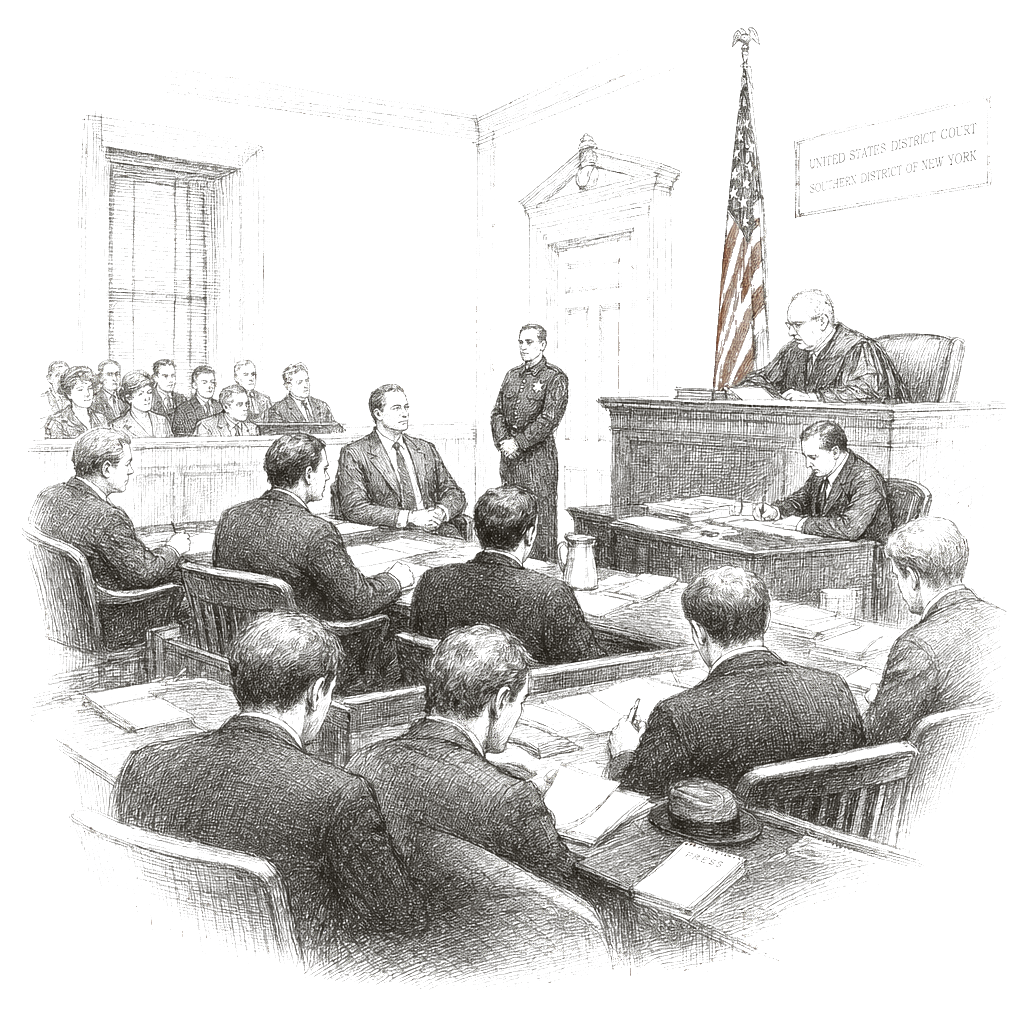
The arraignment opened what the Associated Press characterized as the most significant U.S. prosecution of a foreign head of state in decades, set against a broader diplomatic situation in which President Donald Trump has said the United States would “direct” Venezuela following Maduro’s removal from power.
Nicolás Maduro appeared in a Manhattan federal courtroom Monday, pleading not guilty to narcotics trafficking charges and declaring “I was captured” as he protested what he called his illegal removal from Venezuela. The hearing marked his first public appearance since U.S. forces extracted him and his wife, Cilia Flores, from their Caracas home in an overnight military operation Saturday — the opening of what the Associated Press characterized as the most significant U.S. prosecution of a foreign head of state in decades.
The case unfolds against a broader diplomatic situation in which President Donald Trump has said the United States would “direct” Venezuela following Maduro’s removal from power.
In the courtroom
Maduro, 63, was transported by helicopter from Brooklyn, where he is detained, to Manhattan, then taken to the courthouse in an armored vehicle. He and Flores appeared in leg shackles and prison clothing and listened through headsets as proceedings were translated into Spanish.
Maduro took extensive notes during the hearing and wished reporters a happy New Year as he entered the courtroom, according to the AP. He repeatedly characterized his arrest as an abduction.
“I have been kidnapped here since January 3, Saturday,” he said, according to AP, standing and leaning toward a table microphone. “I was captured in my home in Caracas.”
Federal District Judge Alvin Hellerstein, a 92-year-old jurist appointed by President Bill Clinton in 1998, cut him off. “There will be time and place to review all of this,” Hellerstein said, adding that Maduro’s attorney could raise such matters later. “At this moment, I only want to know one thing: Are you Nicolás Maduro Moros?”
“I am Nicolás Maduro Moros,” Maduro replied.
When asked about his plea, Maduro said through a court interpreter: “I am innocent. I am not guilty. I am a decent man, the constitutional president of my country.”
As marshals escorted Maduro from the courtroom, Pedro Rojas, 33, rose from the gallery and addressed him forcefully in Spanish. Rojas told reporters afterward that he had been imprisoned by the Venezuelan government. Maduro looked directly at Rojas and responded, according to AP: “I am a kidnapped president. I am a prisoner of war.”
Flores, who identified herself to the judge as “first lady of the republic of Venezuela,” also pleaded not guilty. She appeared with bandages on her forehead and right temple. Her attorney, Mark Donnelly, said she had suffered “significant injuries” during her capture.
The charges
A 25-page federal indictment charges Maduro and others with working with drug cartels to facilitate the shipment of thousands of tons of cocaine into the United States. The indictment also alleges that Maduro and Flores ordered kidnappings, beatings, and murders of individuals who owed drug money or undermined their alleged narcotics operation — including the killing of a cartel leader in Caracas. Both could face life sentences if convicted.
The legal battle ahead
Maduro’s defense attorney, Barry Pollack — a prominent Washington lawyer whose clients have included WikiLeaks founder Julian Assange — said he plans to challenge the legality of what he called a “military kidnapping.” Pollack said Maduro “is head of a sovereign state and is entitled to the privileges and immunities that come with that position.”
That argument echoes a defense raised without success by Panamanian leader Manuel Noriega after the United States conducted a similar military invasion in 1990. Washington does not recognize Maduro as Venezuela’s legitimate head of state, particularly following his disputed 2024 reelection.
Because Maduro is charged under the U.S. legal system, he carries the same rights as any other person accused of a crime in the country, including the right to a jury trial, the AP reported.
U.S. statements on Venezuela’s future
Trump said Saturday that the United States would “administer” Venezuela temporarily. On Sunday, he told reporters the U.S. was “in charge” and would “run it, fix it.” Secretary of State Marco Rubio sought to temper that characterization Sunday, saying the United States would not govern Venezuela day-to-day, beyond enforcing an existing oil embargo he described as a “quarantine.”
Before his capture, Maduro and his allies had argued that Washington’s hostility was motivated by a desire to control Venezuela’s oil and mineral reserves. Trump has said Maduro’s removal would allow more Venezuelan oil to flow, but oil prices rose 1.7% Monday, according to the AP, amid uncertainty about how quickly the country’s crude output could increase after years of reduced production and questions about governance and oversight of the energy sector.
Venezuela’s interim leadership
Delcy Rodríguez was sworn in as Venezuela’s interim leader Monday before National Assembly President Jorge Rodríguez, her brother. She called the U.S. action an “illegitimate military aggression.”
“I come with pain for the suffering caused to the Venezuelan people following an illegitimate military aggression against our homeland,” Rodríguez said at her swearing-in, according to AP. “I come with pain for the kidnapping of two heroes.”
Rodríguez had demanded the United States return Maduro, though on Sunday she adopted a more conciliatory tone in a social media post inviting cooperation with Trump and “respectful relations” with the United States.
Venezuelan congressman Nicolás Maduro Guerra, Maduro’s son, warned Monday that his father’s capture set a dangerous global precedent.
“If we normalize the kidnapping of a head of state, no country is safe,” Maduro Guerra said. “Today it is Venezuela. Tomorrow it could be any nation that decides not to submit. This is not a regional problem. It is a direct threat to global political stability.”
International reaction
The UN Security Council convened an emergency session Monday. A senior UN official said the United States may have violated international law with its unilateral military action, the AP reported. The body also highlighted the severe humanitarian needs of Venezuela’s population, which has endured a prolonged economic crisis.
Outside the Manhattan courthouse, police separated two groups of protesters: those opposed to the U.S. military action in Venezuela and those who supported the intervention.