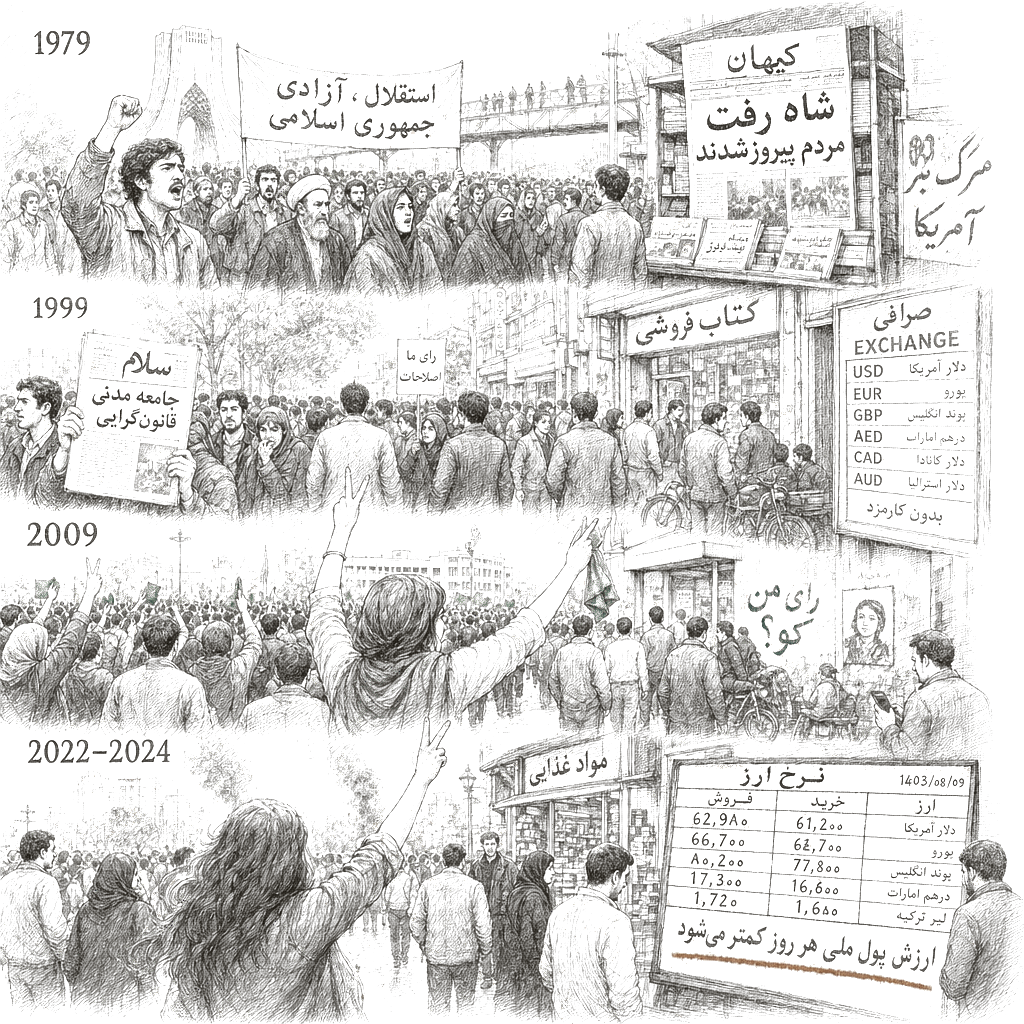
As protests over Iran’s currency collapse stretched into their second week in January 2026, unrest in the Islamic Republic entered a familiar pattern: a severe economic shock, mass demonstrations, and a government response that included severing the country’s internet and telephone connections to the outside world. The current demonstrations, triggered by the rial’s fall to 1.4 million to the dollar following tightening sanctions and a 12-day war with Israel, are at least the seventh major episode of mass unrest to shake Iran over the past 50 years, according to the Associated Press.
Each wave of protest since Iran’s 1979 founding has been met with lethal state repression and mass detention, yet successive governments have failed to prevent the next eruption. The chronicle below traces the six episodes that preceded the current unrest.
1979: Islamic Revolution
Iran’s first transformative protest wave brought down the monarchy. Students, oil workers, and others demanded political freedoms and mobilized against the autocratic ruler Shah Mohammad Reza Pahlavi, who was fatally ill and ultimately fled the country.
The revolution took hold in February 1979 under Ayatollah Ruhollah Khomeini, who installed a hard-line Shiite theocracy under his direct control. The new government executed thousands. Mass demonstrations subsided for years under the combined weight of the 1980s Iran-Iraq war and ongoing repression.
1999: Student protests
Students at Tehran University led protests after the killing of activists, intellectuals, and others in what became known as the “chain murders.” A security force crackdown on the campus ignited wider demonstrations. At least three people were killed and 1,200 were detained.
2009: Green Movement
In the summer of 2009, Iran’s reformist opposition raised allegations that the reelection of hard-line President Mahmoud Ahmadinejad was rigged. Millions nationwide protested over the following months in what became known as the Green Movement. A security force crackdown killed dozens and resulted in thousands of arrests.
2017-2018: Food price demonstrations
Anger over rising food prices and government plans to cut cash payments to poorer Iranians sparked demonstrations that began in Mashhad and spread nationally. More than 20 people were killed and hundreds were arrested.
2019: Gasoline protests
When the Iranian government announced a spike in subsidized gasoline prices, intense protests erupted across the country. Gas stations, banks, and stores were burned. Authorities shut off Iran’s access to the internet. More than 300 people were reportedly killed in the crackdown.
2022: Mahsa Amini protests
Protests began in September 2022 after Mahsa Amini, 22, died following her arrest by Iran’s morality police over what authorities said was failure to wear her hijab in compliance with regulations. United Nations investigators subsequently found Iran responsible for the “physical violence” that led to her death.
A months-long crackdown killed more than 500 people and resulted in over 22,000 detentions. Many Iranian women have continued to refuse to wear the hijab in the years since.
2025-2026: Rial protests
As sanctions tightened and Iran struggled in the aftermath of a 12-day war with Israel, the country’s rial currency collapsed, reaching 1.4 million to the dollar. Protests followed. Iranian authorities shut down internet and telephone networks connecting the country to the outside world after demonstrators responded to calls for nighttime rallies.