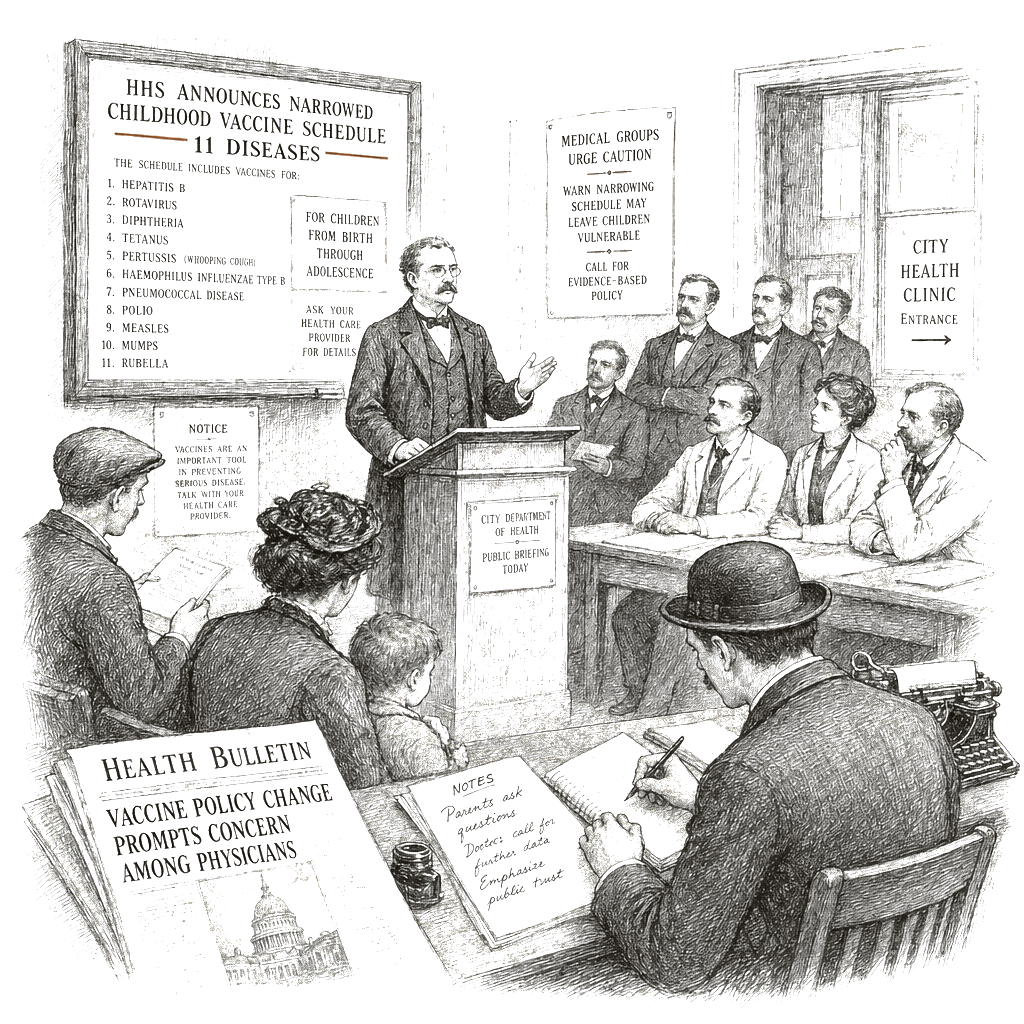
What Stays and What Changed
Among the diseases for which vaccination remains universally recommended are measles, whooping cough, polio, tetanus, chickenpox, and human papillomavirus. The guidance also reduces the recommended number of HPV vaccine doses from two or three shots, depending on age, to one for most children.
Vaccines against flu, rotavirus, hepatitis A, hepatitis B, some forms of meningitis, and RSV are now advised only for certain groups deemed high risk, or when doctors recommend them in what the guidance calls “shared decision-making.”
HHS officials said families who want any of the demoted vaccines will retain access to them and that insurance will continue to pay.
Administration Rationale
HHS said the changes came at Trump’s request in December 2025, when he asked the agency to review how peer nations approach vaccine recommendations. The agency said its comparison of 20 peer nations found the U.S. was an “outlier” in both the number of vaccinations and doses it recommended to all children.
“This decision protects children, respects families, and rebuilds trust in public health,” Kennedy said in a statement.
Trump, posting on Truth Social, called the new schedule “far more reasonable” and said it “finally aligns the United States with other Developed Nations around the World.”
Medical Groups Warn of Harm to Children
Leading medical organizations said the changes would cause harm.
“Abandoning recommendations for vaccines that prevent influenza, hepatitis and rotavirus, and changing the recommendation for HPV without a public process to weigh the risks and benefits, will lead to more hospitalizations and preventable deaths among American children,” said Michael Osterholm of the Vaccine Integrity Project, based at the University of Minnesota.
Dr. Sean O’Leary of the American Academy of Pediatrics said the comparison to other countries’ schedules was misapplied. Countries set recommendations based on disease levels in their populations and the capacity of their health systems, he said.
“You can’t just copy and paste public health and that’s what they seem to be doing here,” O’Leary said. “Literally children’s health and children’s lives are at stake.”
O’Leary also said the government was “pretty tone deaf” to drop its flu recommendation at the start of a severe flu season, citing that 280 children died from flu last winter — the most since 2009.
The American Academy of Pediatrics has issued its own childhood vaccine schedule that its members are following, continuing to broadly recommend the vaccines the administration demoted.
Dr. Sandra Fryhofer of the American Medical Association said the process lacked the required standard of rigor. “Changes of this magnitude require careful review, expert and public input, and clear scientific justification. That level of rigor and transparency was not part of this decision,” Fryhofer said. “The scientific evidence remains unchanged, and the AMA supports continued access to childhood immunizations recommended by national medical specialty societies.”
Most high-income countries recommend vaccinations against a dozen to 15 serious pathogens, according to a review by the Vaccine Integrity Project. France recommends all children be vaccinated against 14 diseases, compared to the 11 the U.S. now universally recommends under the new schedule.
How the Decision Was Made
The change was made by political appointees without input from the advisory committee that typically consults on the vaccine schedule, said senior HHS officials who spoke on the condition of anonymity because they were not authorized to discuss the changes publicly. Those officials said the new recommendations were a collaborative effort between federal health agencies but would not specify who was consulted.
Scientists at the CDC’s National Center for Immunization and Respiratory Diseases were asked in December to present to the agency’s political leadership about vaccine schedules in other countries. They were not allowed to give any recommendations and were not aware of any decisions about vaccine schedule changes, said Abby Tighe, executive director of the National Public Health Coalition, an advocacy organization of current and former CDC employees and their supporters.
Kennedy’s Prior Vaccine-Related Actions
The schedule change extends a series of vaccine-related policy moves Kennedy has made since taking office. In May 2025, Kennedy announced the CDC would no longer recommend COVID-19 vaccines for healthy children and pregnant women — a move public health experts questioned at the time, saying no new data justified the change. In June 2025, Kennedy fired an entire 17-member CDC vaccine advisory committee, later installing several replacements including multiple vaccine skeptics. In November 2025, Kennedy directed the CDC to abandon its position that vaccines do not cause autism, without supplying new evidence to support the change.
States and Access
States, not the federal government, have authority to require vaccinations for schoolchildren. While CDC recommendations typically influence those state regulations, some states have begun creating their own alliances to counter the Trump administration’s vaccine guidance.