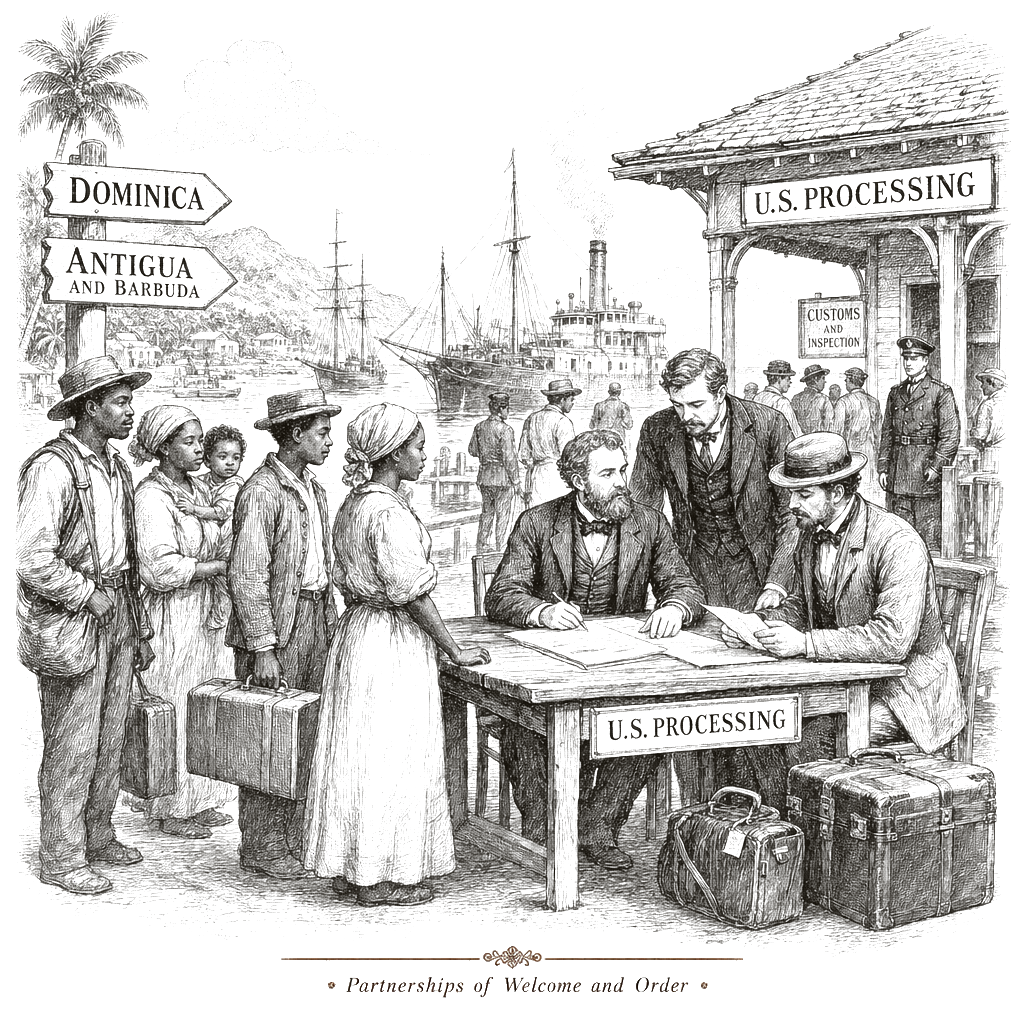
Two small Caribbean island nations, Dominica and Antigua and Barbuda, agreed Monday to accept asylum-seekers from the United States under separate arrangements with the Trump administration. Dominica Prime Minister Roosevelt Skerrit described his country’s agreement as “one of the primary areas of collaboration” with Washington, which recently imposed partial U.S. visa restrictions on both island nations. Antigua and Barbuda signed a non-binding memorandum of understanding; local officials said the island would not accept anyone with a criminal record.
The agreements extend a pattern of U.S. deals redistributing asylum-seekers to willing third countries — a strategy the Trump administration has already applied in arrangements with Belize and Paraguay — while Dominica’s opposition leader said the prime minister had yet to disclose basic details of the pact to the public.
PORT-OF-SPAIN, Trinidad — The United States reached a deal Monday with Dominica to send foreigners seeking U.S. asylum to the small Caribbean nation, as Antigua and Barbuda separately announced it had signed a non-binding agreement with Washington to share responsibility for refugees.
Dominica Prime Minister Roosevelt Skerrit described the arrangement as “one of the primary areas of collaboration” with the United States. Both Caribbean nations had recently been placed under partial U.S. visa restrictions, and Skerrit said his government had been in talks with American officials to resolve those entry limitations.
Skerrit said that during discussions with the U.S. State Department, “there have been careful deliberations of the need to avoid receiving violent individuals or individuals who will compromise the security of Dominica.” He did not say how soon the U.S. would begin sending asylum-seekers or how many would arrive.
The announcement prompted concern among residents of Dominica, which has a population of roughly 72,000. Thomson Fontaine, leader of the country’s main opposition party, said the prime minister had withheld critical details from the public.
“The prime minister still has not told the Dominican public what exactly he has agreed to, in terms of the numbers of persons that are going to come to Dominica, where will they be housed, how will they be taken care of,” Fontaine told the Associated Press.
Antigua and Barbuda said it had signed a non-binding memorandum of understanding with the United States “as part of its global efforts to share responsibility for refugees already present in its territory,” according to local government officials. Those officials said Antigua and Barbuda would not accept anyone with a criminal record.
The Trump administration has signed similar deals with Belize and Paraguay as it continues to pressure countries in Latin America and Africa to accept asylum-seekers. Last month, the administration announced it was expanding travel restrictions to an additional 20 countries; Dominica and Antigua and Barbuda were the only Caribbean nations on that list, and the restrictions took effect January 1.