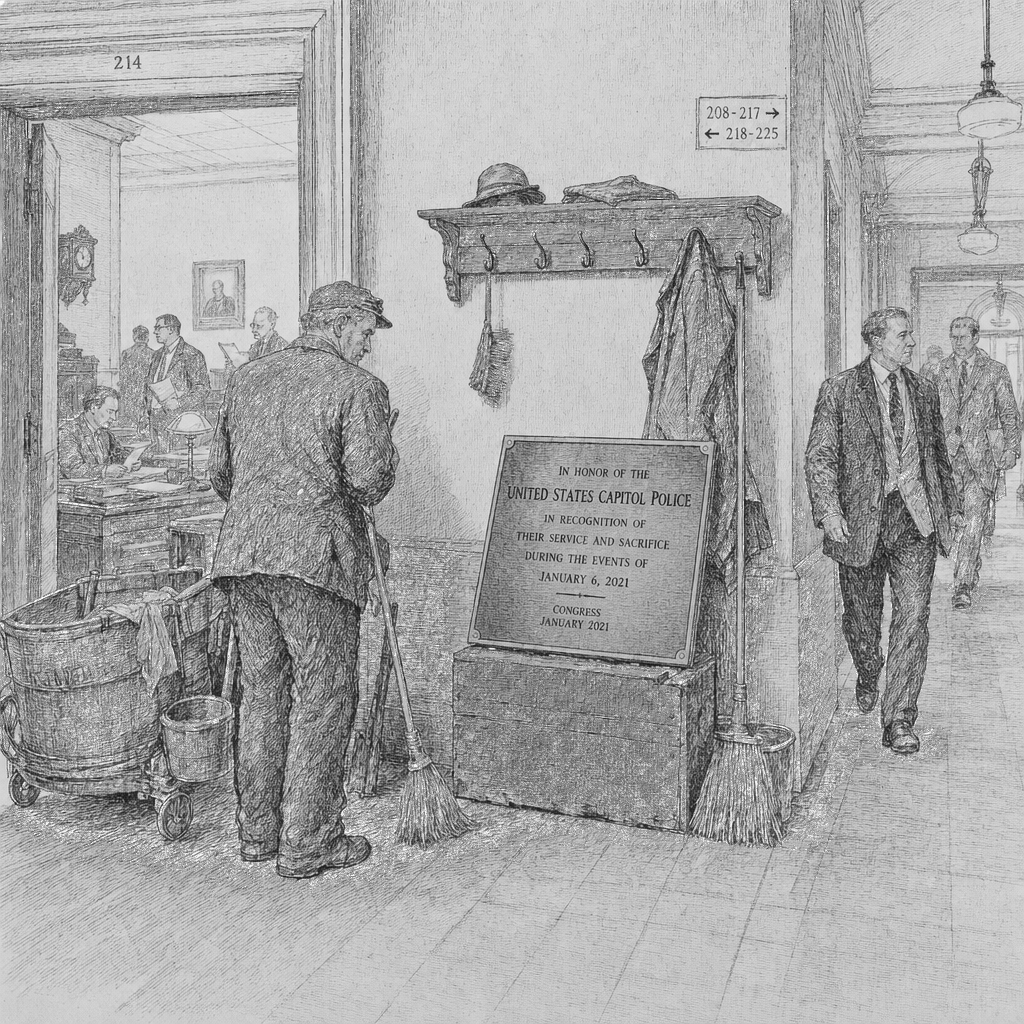
Officers sue; DOJ seeks dismissal
Officers Harry Dunn and Daniel Hodges, who fought the mob that day, filed suit over the failure to install the plaque. “By refusing to follow the law and honor officers as it is required to do, Congress encourages this rewriting of history,” the officers said in their court filing. “It suggests that the officers are not worthy of being recognized, because Congress refuses to recognize them.”
The Justice Department is seeking to have the case dismissed. U.S. Attorney Jeanine Pirro and other department attorneys argued that Congress had already publicly recognized law enforcement by approving the plaque, and that displaying it would not address the officers’ stated concerns. “It is implausible,” Justice Department attorneys wrote, to suggest installation of the plaque “would stop the alleged death threats they claim to have been receiving.”
The department also argued that the plaque is required to include the names of all law enforcement officers involved in the Jan. 6 response — a group numbering approximately 3,600.
Speaker cites legal barrier
Johnson’s office issued a statement saying the statute authorizing the plaque is “not implementable” and that proposed alternatives also “do not comply.” His spokesman said Democrats who wish to commemorate the police are free to work with the appropriate committees to develop a framework for proper vetting and consideration.
The Architect of the Capitol, which is responsible for obtaining and displaying the plaque, said it could not comment given the pending federal litigation.
Replicas fill the halls
About 100 members of Congress — mostly Democrats — have mounted poster-board replicas of the plaque outside their office doors, creating an informal chain of remembrances through the Capitol complex.
“That’s why you put up a plaque,” said Rep. Mary Gay Scanlon, D-Pa. “You respect the memory and the service of the people involved.”
Rep. Jamie Raskin, D-Md., who served on the Jan. 6 select committee, said the absence carries lasting consequences. “There are new generations of people who are just growing up now who don’t understand how close we came to losing our democracy on Jan 6, 2021,” he said.
Rep. Zoe Lofgren, D-Calif., who also served on the committee and has a replica outside her office, drew a comparison to other dates embedded in American memory. “Think about the dates in American history that we know only by the dates: There’s the 4th of July. There’s December 7th. There’s 9/11. And there’s January 6th,” she said. “They really saved my life, and they saved the democracy and they deserve to be thanked for it.”
Rep. Joe Morelle, D-N.Y., who helped lead the replica effort, said the proliferation of makeshift plaques stands as its own testament. “We should stop this silliness of trying to whitewash history — it’s not going to happen,” he said.
“I was here that day so I’ll never forget,” he said. “I think that Americans will not forget what happened.”
A contested legacy
At least five people died in the Jan. 6 riot and its aftermath, including Trump supporter Ashli Babbitt, who was fatally shot by police while trying to climb through a window toward the House chamber. More than 140 law enforcement officers were wounded, some gravely, and several died later, some by suicide.
About 1,500 people were charged in the Capitol attack, among the largest federal prosecutions in the nation’s history. When Trump returned to power in January 2025, he pardoned all of them within hours of taking office. Trump has called the events of that day a “day of love.” Johnson, who was among the lawmakers challenging the 2020 election results, is now the House speaker.
Douglas Brinkley, a professor of history at Rice University, said the historical standing of Jan. 6 remains unsettled. “The question of January 6 remains – democracy was on the guillotine — how important is that event in the overall sweep of 21st century U.S. history,” Brinkley said. “There’s not as much consensus on that as one would have thought on the fifth anniversary,” he said.
Rival hearings, no bipartisan memorial
The two parties are pursuing separate, parallel investigations. House Democratic Leader Hakeem Jeffries of New York announced that Democrats would reconvene Jan. 6 committee members Tuesday for a hearing to “examine ongoing threats to free and fair elections.” Republicans are not expected to participate.
Johnson has tapped Rep. Barry Loudermilk of Georgia to lead a Republican special committee that the speaker said would uncover the “full truth” of what happened. That committee is planning a hearing of its own this month.
Bipartisan memorial services for Jan. 6, once held, are no longer. Visitors can pass through the Capitol complex without encountering any formal reminder of what occurred there five years ago.
Where there was to be one bronze plaque, Morelle said, there are now 100 paper ones.