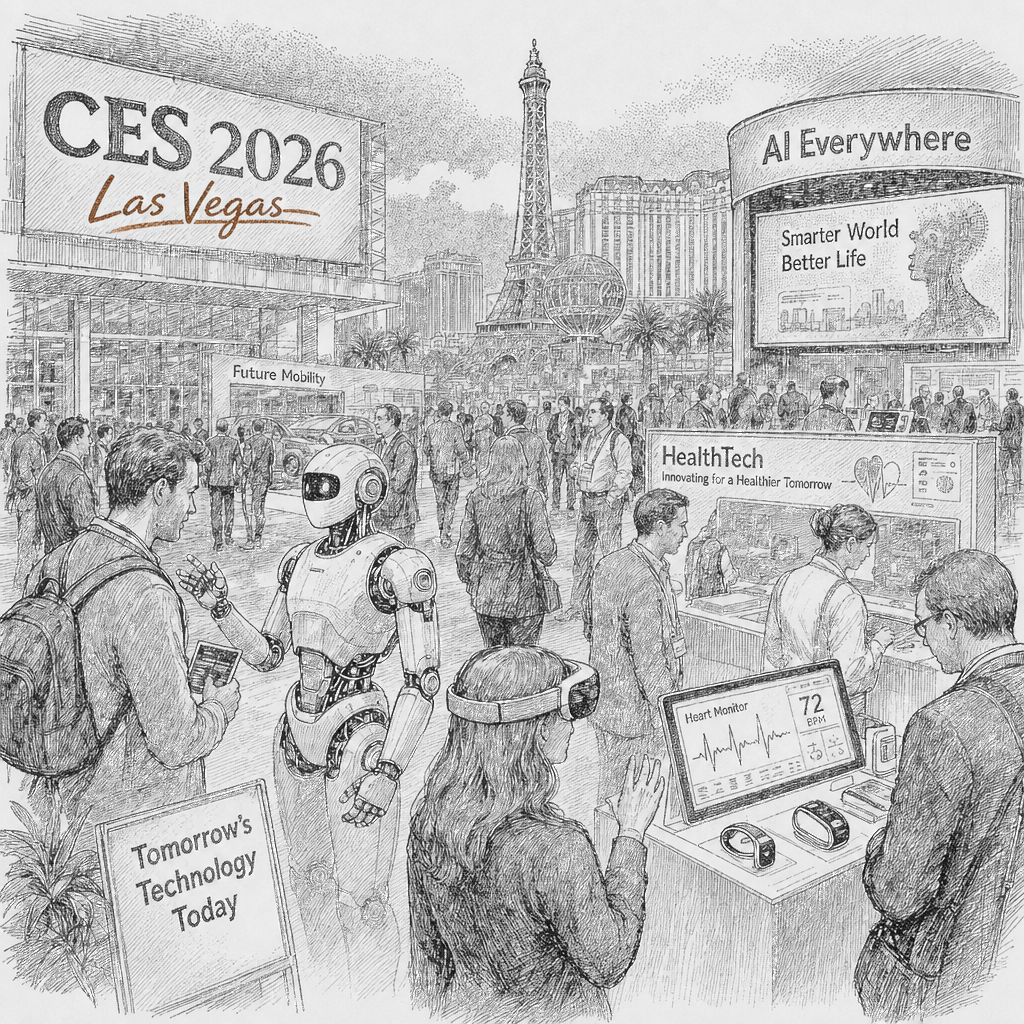
LAS VEGAS — CES 2026 opened this week in Las Vegas, assembling more than 3,500 exhibitors at the Consumer Technology Association’s annual trade show with artificial intelligence, humanoid robots, healthcare wearables, and mobility technology heading a packed agenda. Organizers expected attendance approaching the more than 141,000 visitors from over 150 countries who attended the 2025 edition.
AI is woven through nearly every product category at this year’s show, with keynotes from Nvidia’s Jensen Huang and AMD CEO Lisa Su anchoring an agenda that also features domestic robots from LG and Hyundai, a Verizon-backed disability-technology stage, and the debut of what organizers described as the first-ever small-scale nuclear energy device exhibited at CES.
LAS VEGAS — CES 2026 opened this week in Las Vegas with more than 3,500 exhibitors on the convention floor, as the Consumer Technology Association’s annual trade show showcased advances in artificial intelligence, robotics, healthcare, and mobility. Organizers expected attendance approaching the more than 141,000 visitors from over 150 countries who attended in 2025.
Keynotes from Nvidia’s Jensen Huang and AMD CEO Lisa Su anchored the agenda. Huang was set to showcase Nvidia’s latest productivity solutions, while Su was scheduled to share what organizers described as her “vision for delivering future AI solutions.” Lenovo CEO Yuanqing Yang was also expected to address AI applications.
AI across every category
Gary Shapiro, executive chair and CEO of the Consumer Technology Association, told the Associated Press that artificial intelligence remained the defining theme across product categories. “Obviously, using AI in a way that makes sense for people. We’re seeing a lot in robotics. More robots and humanoid-looking robots than we’ve ever had before,” Shapiro said.
AI applications in entertainment also drew attention. “AI is the future of creativity,” Shapiro said, describing a future in which content creators work with AI tools to reach broader audiences.
Humanoid robots draw the floor
Domestic robotics featured prominently among this year’s announcements. South Korean tech company LG announced it would demonstrate a household helper bot called CLOiD, designed to handle a range of home tasks. Hyundai also announced a major push on robotics and manufacturing advancements. Extended reality technology — virtual training environments for robots and other physical AI systems — was also expected to feature across exhibits.
Shapiro said the technology was advancing but unevenly. “You are seeing humanoid robots right now. It sometimes works, sometimes doesn’t,” he said, adding that the range of humanoid robots on display would only grow over the coming years.
Healthcare and wearables
Healthcare technology represented a second focal point. Beyond Medicine planned to demonstrate a prescription app targeting a specific jaw disorder. Exhibitors also addressed data shortages in fields including breast milk production research. Wearable health devices covering nearly every part of the body were set for wide display.
“All sorts of wearable devices for almost every part of the body. Technology is answering healthcare’s gaps very quickly and that’s great for everyone,” Shapiro said.
Mobility and energy
Mobility technology, including self-driving vehicles, autonomous boats, and drones, was set to feature throughout the show floor. Shapiro identified energy supply as his principal concern heading into the week.
“I’m concerned about getting enough energy to process all that AI,” he said. He noted that a Korean company planned to demonstrate what organizers described as the first-ever small-scale nuclear-powered energy creation device shown at CES, calling it part of a broader push to meet clean-energy demand from AI infrastructure.
First disability-focused stage
CES 2026 incorporated a dedicated exhibit stage for assistive technology for the first time. “We have a special focus at this show, for the first time, on the disability community,” Shapiro said. “Verizon set this whole stage up where we have all different ways of taking this technology and having it help people with disabilities and older people.”
AI bubble question
Shapiro pushed back on concerns about an AI investment bubble. “Well, there’s definitely no bubble when it comes to what AI can do,” he told the AP. He drew a distinction between the current AI sector and the dot-com era, noting that current AI companies carry substantial revenues unlike the late-1990s startups that raised money without revenue models. He said his greater concern was building the energy infrastructure necessary to sustain AI computing demands.