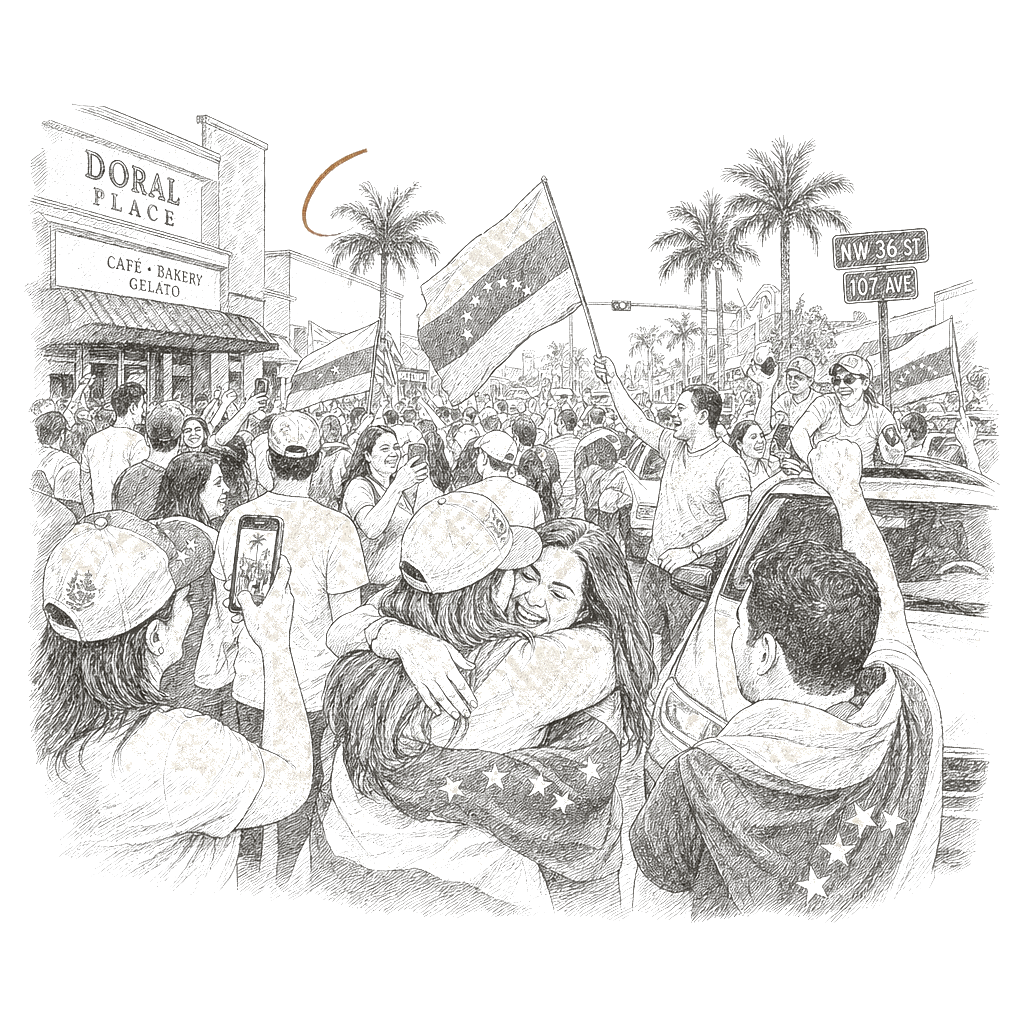
On Saturday, Venezuelans in South Florida gathered in Doral—home to one of the largest Venezuelan communities in the United States—to celebrate the news that President Nicolás Maduro had been captured by a U.S. military operation and flown out of the country. Revelers chanted “liberty,” draped Venezuelan flags over their shoulders, and watched the crowd grow after the word spread, with some people gathering outside a Venezuelan restaurant and others singing and dancing as the day continued.
Outside El Arepazo restaurant, a hub of Venezuelan life in Doral, one man held a cardboard sign with “Libertad” written in black marker while others chanted “Liberty! Liberty! Liberty!” For some, the operation represented more than political change; it carried the personal meaning of bringing families closer after years of separation.
Alejandra Arrieta, who came to the United States in 1997, described the moment as mixed but hopeful. “We’re like everybody — it’s a combination of feelings, of course,” Arrieta said. “There’s fears. There’s excitement. There’s so many years that we’ve been waiting for this. Something had to happen in Venezuela. We all need the freedom.”
David Nuñez also linked the outcome to family reunion. Nuñez said he fled to the United States six years ago after being persecuted in Venezuela for his political activism and has not seen his daughters—ages 8 and 17—since then. “The most important thing is that we’re going to be able to be with our families soon,” he said, adding, “At least for me, I haven’t seen my daughters in six years so I have a lot of mixed feelings. I’ve cried a lot. I’m really happy because I know that I’m going to be able to return to Venezuela very soon.”
Others pointed to a coming transition while acknowledging uncertainty. The AP reported that Trump said Saturday the U.S. government would run Venezuela at least temporarily and that the operation marked the culmination of stepped-up U.S. pressure. Even after Trump’s remarks, people continued gathering outside El Arepazo, where the crowd kept singing and waving flags as a percussionist played along.
In interviews with AP, Alexa Perez said she had waited a year for what she called “this moment.” “Thanks, President Trump. This is our second liberty. This our independence day from today on,” Perez said, describing the announcement as a “best wedding gift” because she married a week earlier. Her husband, Aldo Amenta, said they initially felt scared, excited and confused, but their mood improved after they learned their family members were safe.
Perez also responded positively to apparent U.S. plans to run the country at least temporarily and to use Venezuela’s oil reserves to sell to other nations. She said she believed Venezuela had “not received anything from Russia, Iran and China,” and she argued that a transition could improve conditions for ordinary people. “We are very poor, we have no hospital, we have no rights for our people,” Perez said. “So I think this is going to be a great transition. Because once you know how the U.S. works, you know that everything can work better.”
The celebration unfolded amid a backdrop of long-running migration from Venezuela. AP reported that about 8 million people have fled the country since 2014, initially settling in neighboring parts of Latin America and the Caribbean before increasingly targeting the United States, including routes through Colombia and Panama or via humanitarian parole. In South Florida, AP said concerns tied to Trump’s tough immigration policies gave way to celebration after Maduro was deposed in the American military operation early Saturday.
Niurka Meléndez, who fled Venezuela in 2015, said she was hopeful but cautious about what the ouster could mean for daily life. AP reported that Meléndez co-founded in New York the group Venezuelans and Immigrants Aid, which works to empower immigrants. “For us, it’s just the start of the justice we need to see,” she said in a phone interview.
Meléndez told AP that her homeland had reached a “breaking point” because of forced displacement, repression, hunger and fear, and she said international humanitarian support would be needed for recovery. “Removing an authoritarian system responsible for these crimes creates the possibility, not a guarantee, but a possibility, for recovery,” she said. “A future without criminal control over institutions is the minimum condition for rebuilding a country based on justice, rule of law, and democratic safeguards.”
In the meantime, at El Arepazo and around Doral, the immediate focus for many attendees remained what comes next—balancing relief and uncertainty as they marked the moment as a new start while still waiting for details about the transition.