Market reaction muted
Global oil prices moved little in the immediate aftermath of the intervention. U.S. crude oil lost 23 cents early Monday to $57.09 per barrel, while Brent crude, the international standard, fell 18 cents to $60.57 per barrel.
Analysts attributed the muted reaction in part to Venezuela’s status as an OPEC member — meaning its production is already factored into global supply projections — and to a current global surplus of oil.
Phil Flynn, a senior market analyst at the Price Futures Group, said political clarity would be the key variable. “But if it seems like the U.S. is successful in running the country for the next 24 hours, I would say there would be a lot of optimism that U.S. energy companies could come in and revitalize the Venezuelan oil industry fairly quickly,” he said.
Flynn said that if Venezuela becomes a production powerhouse, “that could cement lower prices for the longer term” and put additional pressure on Russia.
Infrastructure and investment gap
Francisco Monaldi, director of the Latin American energy program at Rice University, said the rebuilding challenge is both physical and political.
“The issue is not just that the infrastructure is in bad shape, but it’s mostly about how do you get foreign companies to start pouring money in before they have a clear perspective on the political stability, the contract situation and the like,” he said.
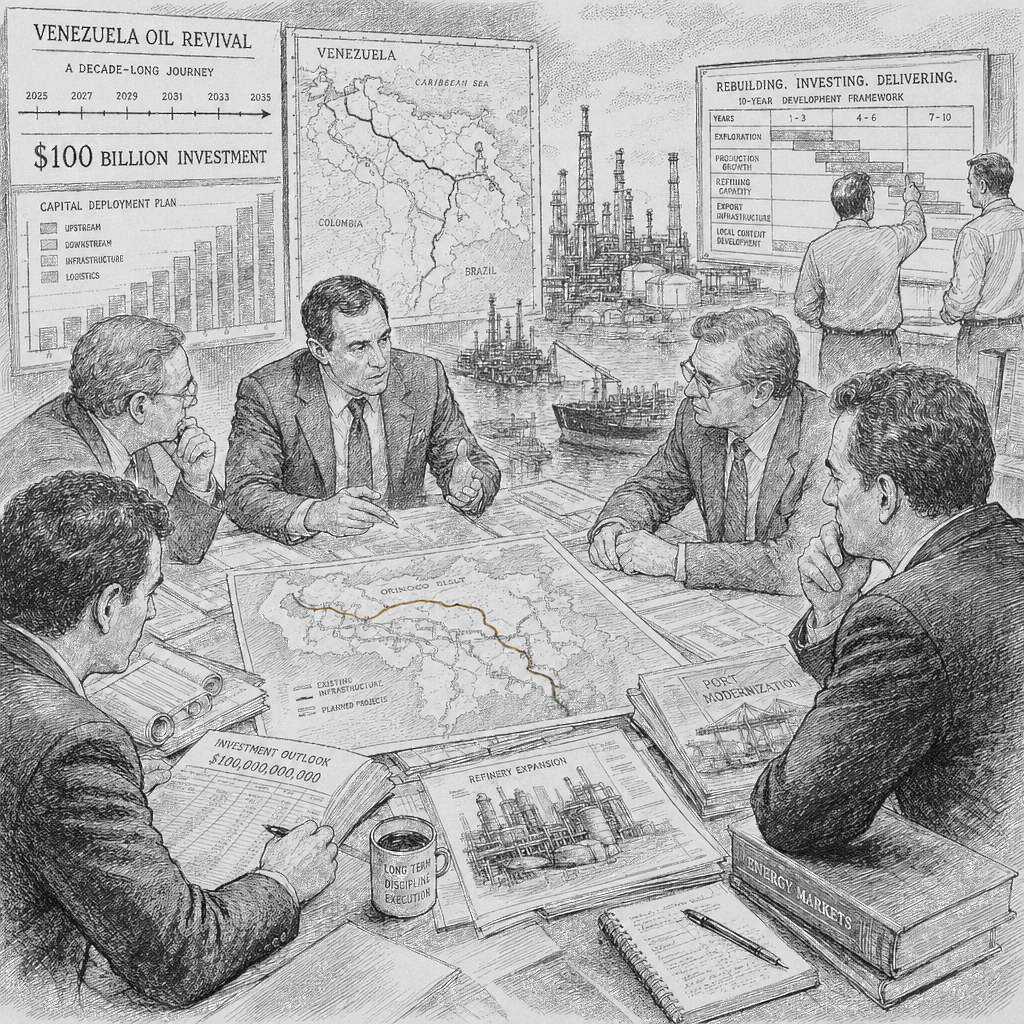
The scale of required investment is substantial, Monaldi said: “The estimate is that in order for Venezuela to increase from one million barrels per day — that is what it produces today — to four million barrels, it will take about a decade and about a hundred billion dollars of investment.”
No major American oil company announced plans to invest. Chevron is the only major U.S. firm with significant existing operations in Venezuela, producing about 250,000 barrels per day through joint ventures with state-owned Petróleos de Venezuela S.A., known as PDVSA. Chevron, which first invested in Venezuela in the 1920s, said Saturday it was focused on current operations, not expansion. “Chevron remains focused on the safety and wellbeing of our employees, as well as the integrity of our assets. We continue to operate in full compliance with all relevant laws and regulations,” spokesman Bill Turenne said.
ConocoPhillips spokesman Dennis Nuss said the company “is monitoring developments in Venezuela and their potential implications for global energy supply and stability. It would be premature to speculate on any future business activities or investments.” Exxon Mobil did not immediately respond to a request for comment.
The caution reflects a history of state expropriation. Then-President Hugo Chávez nationalized much of Venezuela’s oil production in 2007, forcing out ExxonMobil and ConocoPhillips.
Why Venezuela’s crude matters
Venezuela produces heavy crude oil used for diesel fuel, asphalt, and fuels for heavy equipment — a variety of crude in short supply globally because of sanctions on Venezuelan and Russian oil. American refineries on the Gulf Coast were built to process that kind of heavy crude at a time when U.S. domestic production was falling and Venezuelan supply was abundant; greater access to Venezuelan crude would help those refineries operate more efficiently, analysts said.
Flynn said Russia has benefited strategically from Venezuela’s production decline. “There’s been a big benefit for Russia to see Venezuela’s oil industry collapse. And the reason is because they were a competitor on the global stage for that oil market,” he said. A revival of Venezuelan production could allow Europe and other markets to reduce purchases of Russian heavy crude.
Legal questions
Matthew Waxman, a Columbia University law professor who served as a national security official in the George W. Bush administration — including in the State and Defense departments and on the National Security Council — said the seizure of Venezuelan resources raised unresolved questions under international law.
“For example, a big issue will be who really owns Venezuela’s oil?” Waxman wrote in an email. “An occupying military power can’t enrich itself by taking another state’s resources, but the Trump administration will probably claim that the Venezuelan government never rightfully held them.”
Waxman noted that “we’ve seen the administration talk very dismissively about international law when it comes to Venezuela.”