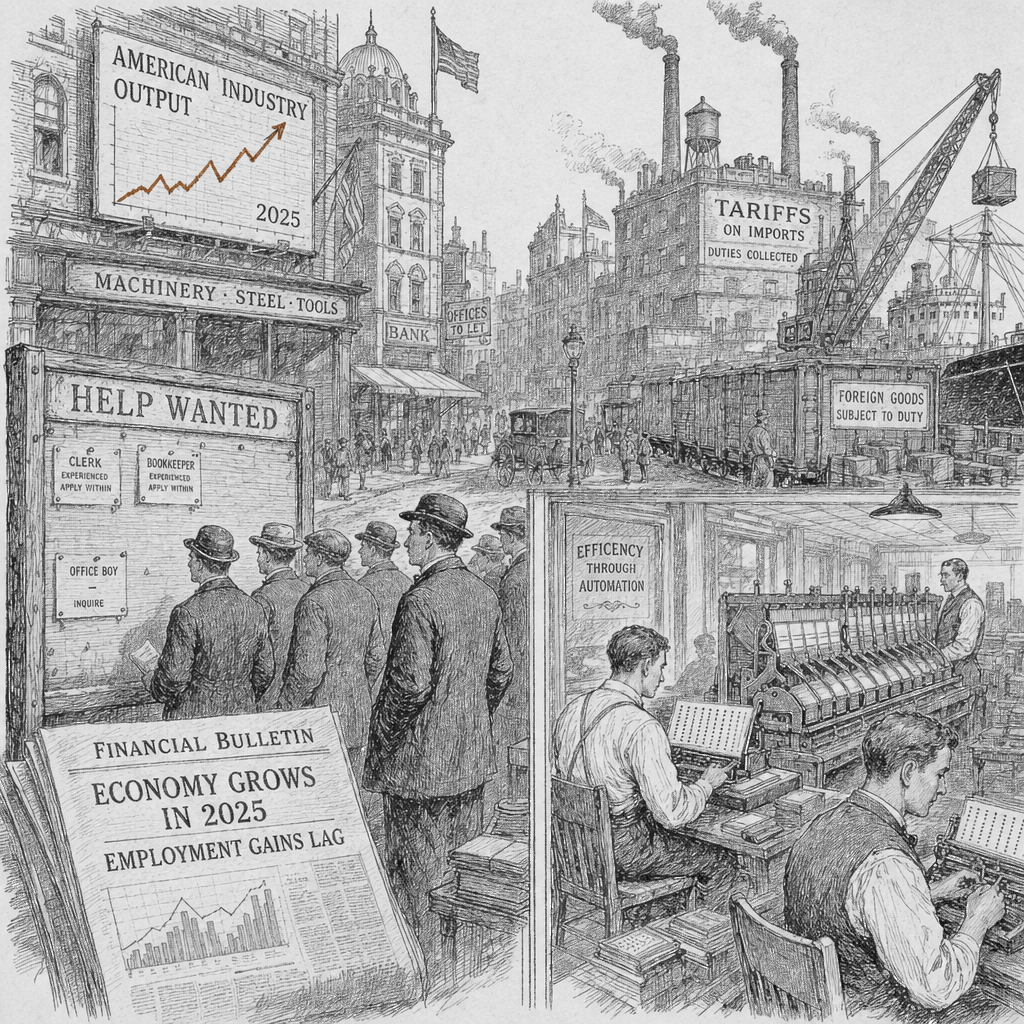
The U.S. economy expanded at its fastest quarterly pace in two years during 2025, yet job growth fell badly short of that performance as companies pulled back on hiring amid tariff uncertainty and the rapid spread of artificial intelligence, the Associated Press reported. The unemployment rate climbed from 4 percent in January to 4.6 percent by November — its highest level in four years — even as GDP grew at a 4.3 percent annual rate in the third quarter. The economy shed jobs outright in three separate months.
The divergence between growth and hiring left economists uncertain entering 2026 about whether last year’s weak job gains signal a stumbling economy or the early emergence of a “jobless expansion” — one in which AI enables companies to increase output without adding workers, raising the prospect that strong growth and a sluggish labor market could persist in tandem.
A Distorted Year for Growth
Solid consumer spending, fueled largely by higher-income households, drove much of 2025’s expansion. But the year’s growth figures were heavily distorted by competing forces.
A surge in imports during the first three months of the year — as businesses rushed to bring in goods from overseas ahead of Trump administration tariffs — caused the economy to shrink in the first quarter. Growth then rebounded sharply through the summer, reaching a 4.3 percent annual pace in the third quarter — the strongest showing in two years. The final quarter was weighed down by a six-week federal government shutdown in the fall, which disrupted data collection and was forecast by economists to have reduced fourth-quarter output by roughly one percentage point.
The shutdown compounded a longer-running problem: sparse and delayed economic data left Federal Reserve policymakers with an unusually clouded picture of the economy as 2026 began.
“2026 begins at a time when it is hard to say how 2025 ended,” Stephen Stanley, chief U.S. economist at Santander, said in a note to clients.
Hiring Failed to Follow Growth
Despite the strong third-quarter expansion, job gains weakened after the Trump administration announced sweeping tariffs in early April. The economy shed jobs outright in June, August, and October.
Layoffs nonetheless remained low throughout the year, producing what analysts described as a “low-hire, low-fire” labor market — one in which workers who kept their jobs faced limited competition from fresh hiring.
October’s losses totaled 105,000 — but most came from reductions in federal government employment tied to the Trump administration’s workforce restructuring, which took formal effect that month. Excluding government, businesses added an average of 75,000 jobs per month in the three months ending in November, a significant improvement from just 13,000 per month in the three months ending in August.
Still, hiring remained heavily concentrated in a narrow set of sectors: health care, restaurants and hotels, and government employment outside of October. Most large private-sector industries shed jobs over the course of the year.
AI and Tariffs Cited as Brakes on Hiring
Two forces dominated employers’ explanations for the year’s weak job market.
First, tariff uncertainty — as the administration imposed, then in some cases lowered, raised, or delayed duties — led many companies to put hiring decisions on hold while their cost structures remained unsettled. Second, executives across multiple industries told Federal Reserve officials they were deferring hiring while they assessed what artificial intelligence could do for their operations.
“AI, AI, AI, AI — that is all I have heard since this summer,” Federal Reserve Governor Christopher Waller said in December, describing what he had heard from business leaders to explain their reluctance to add workers.
The possibility that AI is enabling companies to expand output without proportionate hiring has raised concern among some economists about a prolonged “jobless expansion” — though the technology’s ultimate effect on labor markets remains uncertain.
Inflation Remained Above Target
Inflation stayed elevated throughout 2025 despite having fallen sharply from its post-pandemic highs in 2023 and 2024.
The Federal Reserve’s preferred measure, the PCE price index, ran at 2.8 percent year-over-year in September 2025 — little changed from the prior year and above the Fed’s 2 percent target. Consumer price inflation, as measured by the CPI, stood at 2.7 percent year-over-year in November after cooling modestly during that month.
Economists cautioned that the November CPI figures were distorted by the government shutdown, which delayed most price collection until the latter half of the month when holiday discounts were more prevalent.
Elevated costs became a significant political issue in 2025 state and local elections, surfacing in governors’ races in Virginia and New Jersey and in New York City’s mayoral contest — all three of which Democrats won.
An Unequal Recovery
Underlying the year’s headline growth figures was a pattern many economists described as a “K-shaped” economy — one in which strong spending by wealthier households masked deepening financial strain among lower-income families.
Wealthier Americans accounted for a rising share of consumer spending in 2025, meaning that robust aggregate growth statistics obscured weaker conditions for households lower on the income scale, where elevated prices and a tight job market combined to constrain spending power.
What Economists See Ahead
Some officials and analysts expressed measured optimism about 2026 despite the uncertainties.
Waller said 2026 “could turn out to be a better year,” adding: “Now whether that pulls the labor market along with it, I certainly hope it does.”
Stanley and other economists expected large tax refunds early this year — a product of Trump’s tax-cut legislation — to fuel consumer spending and support stronger growth. Companies may also resume hiring, they said, once reduced tariff uncertainty gives them clearer footing for business planning.
Risks remain, however. Some economists warned that early 2026 could bring a fresh uptick in inflation as companies implement annual price increases and pass through remaining tariff costs. Most expected inflation to continue cooling gradually toward the Fed’s 2 percent target over the course of the year.