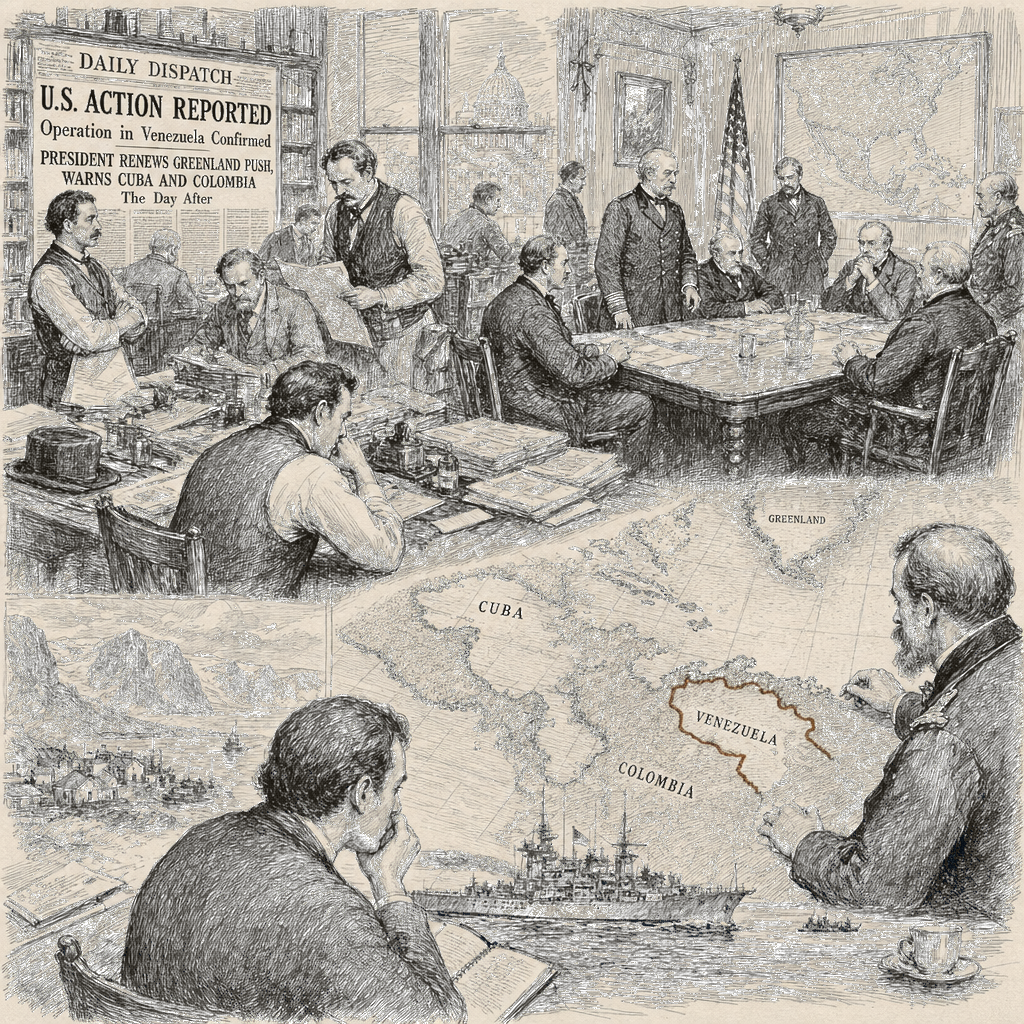
WASHINGTON — The day after a U.S. military operation ousted Venezuelan President Nicolás Maduro from power, President Donald Trump on Sunday renewed calls for American control of Greenland, threatened military action against Colombia over the cocaine trade, and Secretary of State Marco Rubio warned that Cuba’s communist government is “in a lot of trouble.”
The statements, made as Trump flew back to Washington from Florida, signaled that the administration views its Venezuela operation as a beginning, not an end point, for an assertive U.S. posture across the Western Hemisphere.
Trump’s rapid-fire comments raised alarm in allied capitals and sharpened a question spreading across the region: after Maduro, who is next?
Greenland: pressure on an ally
Trump told reporters aboard Air Force One that Greenland’s strategic position demands American control. “It’s so strategic right now. Greenland is covered with Russian and Chinese ships all over the place,” Trump said. “We need Greenland from the standpoint of national security, and Denmark is not going to be able to do it.”
When asked in an interview with The Atlantic what the Venezuela operation might portend for Greenland, Trump said: “They are going to have to view it themselves. I really don’t know.”
The Greenland question had receded from headlines in recent months before Trump revived it roughly two weeks before Sunday’s comments by announcing Louisiana Gov. Jeff Landry as a volunteer special envoy to the territory. Landry said his role would be to help Trump “make Greenland a part of the U.S.”
Trump has repeatedly called for U.S. jurisdiction over the Danish Arctic island since his presidential transition and has not ruled out military force to acquire it. His National Security Strategy, published in December, identifies restoring “American preeminence in the Western Hemisphere” as a central objective of his second term. He has also cited the 19th-century Monroe Doctrine and the Roosevelt Corollary — a doctrine the U.S. invoked to support Panama’s secession from Colombia and secure the Panama Canal Zone — as frameworks for his hemispheric ambitions.
Denmark pushes back
Danish Prime Minister Mette Frederiksen responded sharply, saying in a statement that Trump has “no right to annex” Greenland and noting that Denmark already provides the United States broad access to the territory through existing NATO security agreements.
“I would therefore strongly urge the U.S. to stop threatening a historically close ally and another country and people who have made it very clear that they are not for sale,” Frederiksen said.
Denmark also signed onto a European Union statement on Sunday underscoring that “the right of the Venezuelan people to determine their future must be respected,” as Trump vowed to “run” Venezuela and pressed its acting president, Delcy Rodriguez, to follow U.S. direction.
Anger in Denmark deepened after Katie Miller, a former Trump administration official turned podcaster who is married to White House deputy chief of staff Stephen Miller, posted an illustrated map of Greenland in the colors of the American flag with the caption “SOON.”
Denmark’s ambassador to Washington, Jesper Møller Sørensen, responded directly to the post. “And yes, we expect full respect for the territorial integrity of the Kingdom of Denmark,” Sørensen said.
Cuba: warning to a longtime adversary
Rubio, appearing on NBC’s “Meet the Press,” pointed to Cuba as a participant in Maduro’s government and issued a warning to Havana.
Rubio said Cuban bodyguards, not Venezuelan ones, had protected Maduro and that Cuba also controlled “internal intelligence” in his government — including “who spies on who inside, to make sure there are no traitors.”
The Cuban government announced in a statement read on state television that 32 of its officers were killed in the U.S. military operation in Venezuela.
Cuba had been one of Maduro’s most important allies and trading partners, supplying security personnel while Maduro’s Venezuela provided Havana subsidized oil. Trump said Cuba’s already-battered economy — long squeezed by a U.S. embargo — would deteriorate further now that Maduro was gone. “It’s going down,” Trump said of Cuba. “It’s going down for the count.”
Colombia: the sharpest threat
Trump reserved his most pointed language for Colombia and its leftist president, Gustavo Petro.
Trump told reporters that Colombia is “run by a sick man who likes making cocaine and selling it to the United States,” and predicted Petro would not remain in power long. Asked directly whether he might order a U.S. military operation against Colombia, Trump replied, “It sounds good to me.”
The Trump administration imposed sanctions in October on Petro, his family, and a member of his government over accusations of involvement in the global drug trade. Colombia is widely considered the world’s leading cocaine producer.
U.S. pressure on the region’s drug networks preceded Sunday’s comments. The administration had ordered lethal strikes on alleged drug-smuggling boats launched from Venezuela in the Caribbean, later expanding those operations to suspected vessels from Colombia in the eastern Pacific. In September, the U.S. designated Colombia as a country failing to cooperate in the drug war — the first such designation in nearly 30 years — triggering cuts to American assistance to a country that had been the top recipient of U.S. aid in the region.