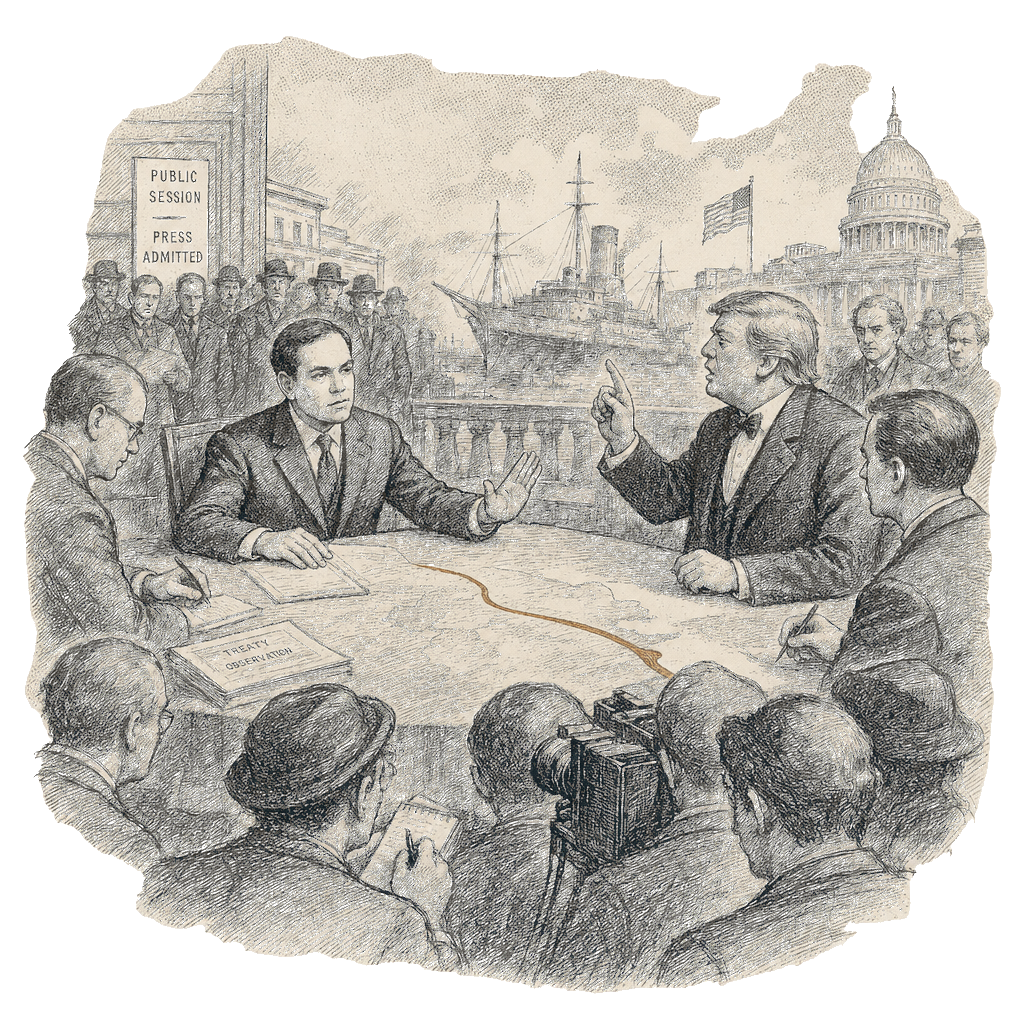
WASHINGTON — Secretary of State Marco Rubio sought Sunday to reassure critics that the United States would not govern Venezuela day-to-day following the military seizure of former leader Nicolás Maduro, even as President Donald Trump insisted Washington was “in charge” of the oil-rich nation. Rubio said the U.S. would enforce an existing oil quarantine on sanctioned tankers and use that leverage to press policy changes in Caracas. Trump, speaking aboard Air Force One en route from his Mar-a-Lago estate in Florida, said of Venezuela: “We’re going to run it, fix it.”
The public messaging divergence came one day after a U.S. operation extracted Maduro and his wife, Cilia Flores, from a military base in the capital — the most assertive American action to unseat a foreign government since the 2003 invasion of Iraq, according to the Associated Press. Maduro was due to make his first court appearance Monday in Manhattan’s federal court on narco-terrorism conspiracy charges.
Rubio draws distinctions
Rubio, appearing on CBS’s “Face the Nation,” framed U.S. leverage in terms of an oil quarantine already in place before Maduro was removed from power early Saturday, rather than any new governing authority.
“We continue with that quarantine, and we expect to see that there will be changes, not just in the way the oil industry is run for the benefit of the people, but also so that they stop the drug trafficking,” Rubio said.
He dismissed comparisons to past U.S. nation-building efforts in the Middle East. “The whole foreign policy apparatus thinks everything is Libya, everything is Iraq, everything is Afghanistan,” Rubio said. “This is not the Middle East. And our mission here is very different. This is the Western Hemisphere.”
Rubio said the U.S. would assess Venezuela’s new leadership by its actions. He did not rule out the presence of U.S. forces on the ground, saying the American military buildup in the region was already sufficient to stop drug-trafficking boats and sanctioned oil tankers. The blockade on sanctioned tankers, he said, “remains in place, and that’s a tremendous amount of leverage.”
Trump, for his part, offered a broader vision. He told reporters on Air Force One that he wanted interim Venezuelan leader Delcy Rodríguez to provide “total access” to the country’s oil operations and basic infrastructure.
“We need access to the oil and to other things in their country that allow us to rebuild their country,” Trump said.
Rodríguez shifts tone
Venezuela’s Supreme Court ruled Sunday that Rodríguez would serve as acting president. The shift in her public posture was pronounced: after the operation, she had called Maduro the country’s rightful leader and described the U.S. actions as an “atrocity.” By Sunday she had changed her approach.
“We invite the US government to collaborate with us on an agenda of cooperation oriented towards shared development within the framework of international law to strengthen lasting community coexistence,” Rodríguez wrote in an online post.
Trump, who earlier threatened that Rodríguez could “pay a very big price” if she did not comply with U.S. demands, said Sunday night that she was “cooperating.”
Cuban casualties acknowledged
Cuba announced that 32 Cuban security officers were killed in the U.S. operation. Trump acknowledged the deaths.
“You know, a lot of Cubans were killed yesterday,” Trump said. “There was a lot of death on the other side. No death on our side.”
Charges and legal questions
Maduro and his wife face U.S. narco-terrorism conspiracy charges stemming from a 2020 indictment. The Justice Department released a new indictment Saturday that described Maduro’s administration as a “corrupt, illegitimate government” fueled by a drug-trafficking operation that, according to prosecutors, flooded the United States with cocaine. The U.S. government has not recognized Maduro as Venezuela’s leader.
Legal experts raised questions about the lawfulness of the overnight operation, which was conducted without congressional approval. Scholars had also questioned aspects of the Trump administration’s earlier pressure campaign, including the bombing of boats accused of drug trafficking, as potentially stretching the limits of international law.
Trump’s stated intention to “run” Venezuela drew concern from some Democrats and unease within parts of his own Republican coalition, including factions that have opposed foreign interventions.
Capital falls quiet
Caracas was unusually quiet Sunday, with few vehicles on the streets and convenience stores, gas stations, and other businesses closed. Venezuela’s government continued to function, with ministers remaining in their posts. Maduro’s son, lawmaker Nicolás Ernesto Guerra, had not appeared in public since the operation; he had posted a government statement on Saturday repudiating his father’s and stepmother’s capture.
Venezuela’s incoming National Assembly was set to be sworn in at the legislative palace. The unicameral body was expected to remain under control of the ruling party.