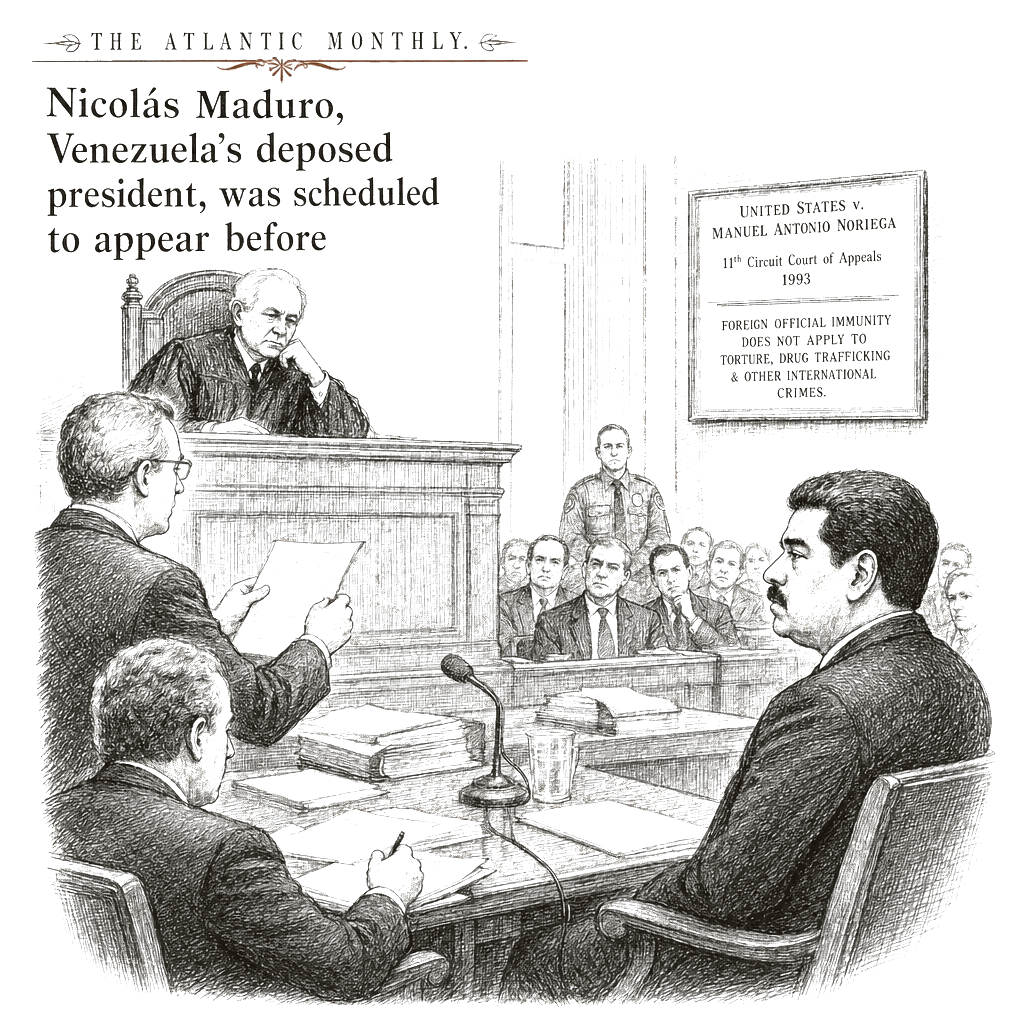
The Noriega legal foundation
The prosecution rests on a legal architecture developed in the Noriega era. In 1989, then-Assistant Attorney General Bill Barr issued a Justice Department opinion, six months before the U.S. invasion of Panama, holding that the United Nations Charter’s prohibition on the use of force in international relations does not bar the United States from carrying out “forcible abductions” abroad to enforce domestic laws. Supreme Court decisions dating to the 1800s have separately upheld American jurisdiction to prosecute foreigners regardless of whether their presence in the United States was lawfully secured, the Associated Press reported.
Legal experts said Trump’s ordering of the Venezuela operation without congressional authorization raises constitutional concerns, though those concerns are distinct from the immunity question. Now that Maduro is on U.S. soil, courts are likely to uphold the prosecution because — as with Noriega — the United States does not recognize him as Venezuela’s legitimate leader, experts said.
Barr, who as attorney general during the first Trump administration oversaw Maduro’s indictment, pushed aside criticism that the United States was pursuing regime change in Venezuela rather than enforcing domestic law.
“Going after them and dismantling them inherently involves regime change,” Barr said in an interview on Fox News Sunday. “The object here is not just to get Maduro. We indicted a whole slew of his lieutenants. It’s to clean that place out of this criminal organization.”
Noriega died in 2017 after nearly three decades in prison — first in the United States, then France, and finally Panama.
Where Maduro’s case diverges from Noriega’s
Not all legal analysts view the two cases as equivalent. Noriega never held the title of president during his six-year de facto rule, leaving a series of stand-ins to fill the role formally. Maduro, by contrast, claims to have won a popular mandate three times, and a number of governments — including China, Russia, and Egypt — recognized his disputed 2024 reelection.
“Before you ever get to guilt or innocence, there are serious questions about whether a U.S. court can proceed at all,” said David Oscar Markus, a Miami defense lawyer who has handled high-profile criminal cases involving Venezuela. “Maduro has a much stronger sovereign immunity defense than did Noriega, who was not actually the sitting president of Panama at the time.”
For U.S. courts, however, the only recognition that matters is that of the State Department, which considers Maduro a fugitive and has for months been offering a $50 million reward for his arrest. The first Trump administration closed the U.S. Embassy in Caracas and broke diplomatic relations with Maduro’s government in 2019, then recognized the opposition head of the National Assembly as Venezuela’s legitimate leader. The Biden administration largely maintained that policy.
Clark Neily, a senior vice president for criminal justice at the Cato Institute, said that pattern of executive deference makes judicial intervention unlikely. “Courts are so deferential to the executive in matters of foreign policy that I find it difficult for the judiciary to engage in this sort of hairsplitting,” Neily said.
The official-acts question
Maduro may have a marginally stronger argument for a more limited form of immunity covering official acts he undertook as Venezuela’s de facto leader — a theory that would not turn on whether the State Department recognizes him as head of state. But that defense also faces significant obstacles.
The indictment accuses Maduro of facilitating the shipment of thousands of tons of cocaine into the United States by providing law enforcement cover, logistical support, and partnerships with organizations designated as narco-terrorists.
“The government will argue that running a big narco-trafficking operation … should not count as an official act,” said Curtis Bradley, a University of Chicago Law School professor who previously served as a counselor of international law at the State Department.
Sanctions create an immediate practical obstacle
Beyond the legal arguments, Maduro faces a more immediate challenge: retaining counsel. He and his wife, Cilia Flores, who was also captured, have been under U.S. sanctions for years, making it illegal for any American attorney to accept payment from them without first obtaining a license from the Treasury Department. Venezuela’s caretaker government, now led by Maduro’s vice president, Delcy Rodríguez, is similarly barred from conducting business in the United States under existing sanctions.
The U.S. has previously prosecuted other foreign leaders on drug trafficking and corruption charges. Juan Orlando Hernández, the former president of Honduras, was convicted in 2024 on drug trafficking and weapons charges and sentenced to 45 years in prison. Trump announced plans in November to pardon Hernández, a move that drew criticism from some Republicans who said it undercut the administration’s counternarcotics strategy — the same strategy centered against Maduro.
After Noriega’s arrest, the Justice Department implemented a policy requiring the attorney general to personally sign off on any charges against a sitting foreign president, given the implications for U.S. foreign policy. Barr, as attorney general, personally oversaw Maduro’s indictment under that framework.