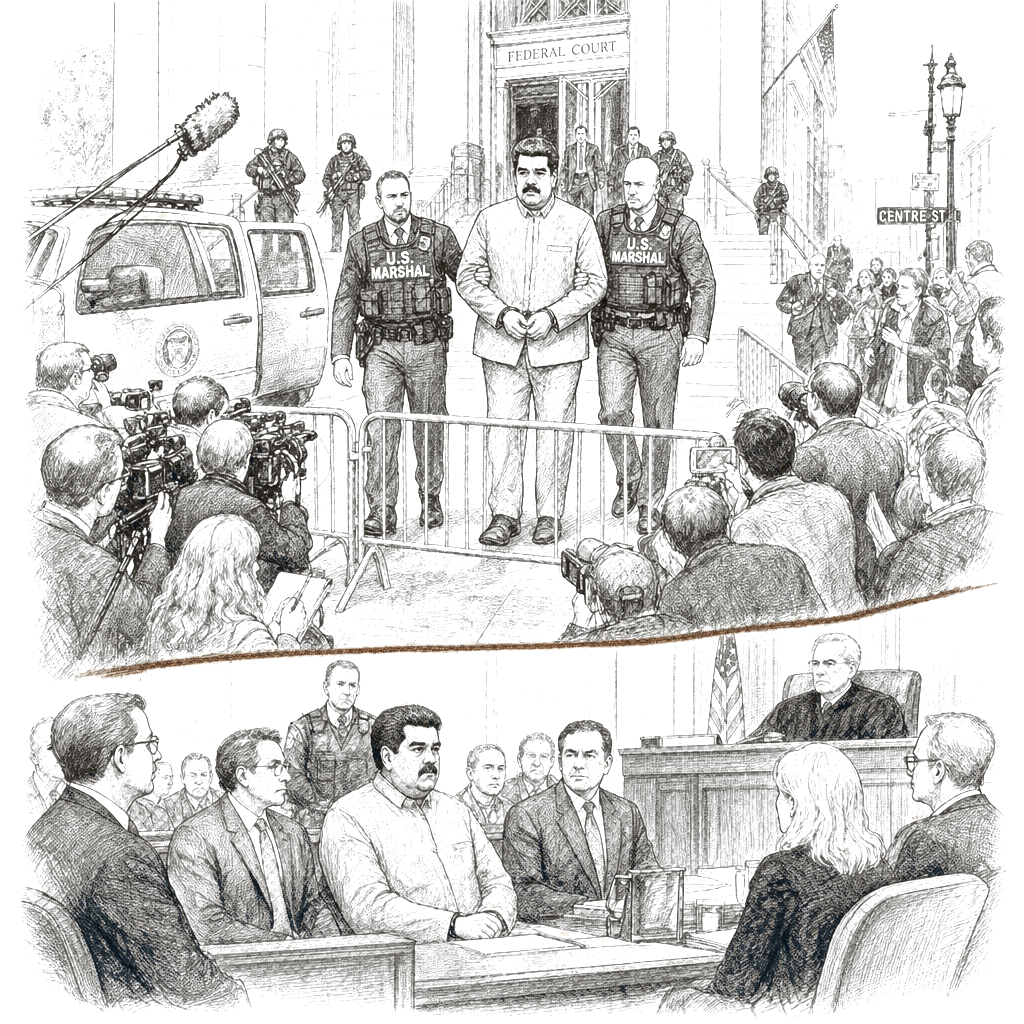
The charges
The Southern District of New York indictment, filed under seal just before Christmas and unsealed Saturday, charges Maduro on four counts: narco-terrorism conspiracy, cocaine importation conspiracy, possession of machine guns and destructive devices, and conspiracy to possess machine guns and destructive devices. Flores and three others are also named.
Attorney General Pam Bondi said in a post on X that Maduro and Flores “will soon face the full wrath of American justice on American soil in American courts.” A White House social media account posted video showing Maduro smiling as two federal agents escorted him through a Drug Enforcement Administration office in New York.
What the indictment alleges
The indictment accuses Maduro of partnering with “some of the most violent and prolific drug traffickers and narco-terrorists in the world” to allow the shipment of thousands of tons of cocaine into the United States. Prosecutors allege that as much as 250 tons of cocaine moved through Venezuela annually by 2020, transported on go-fast vessels, fishing boats, container ships and planes from clandestine airstrips.
The indictment identifies the Sinaloa Cartel and the Tren de Aragua gang as organizations that allegedly worked directly with the Venezuelan government, which the indictment says then received a share of drug profits. Maduro allowed “cocaine-fueled corruption to flourish for his own benefit, for the benefit of members of his ruling regime, and for the benefit of his family members,” according to the indictment.
A U.S. intelligence assessment published in April, drawing on input from all 18 agencies of the intelligence community, found no coordination between Tren de Aragua and the Venezuelan government — a finding that appears to conflict with the indictment’s characterization of that relationship.
The indictment also accuses Maduro and Flores of ordering kidnappings, beatings and murders “against those who owed them drug money or otherwise undermined their drug trafficking operation,” including the killing of a local drug boss in Caracas. Flores is separately accused of accepting hundreds of thousands of dollars in bribes in 2007 to arrange a meeting between a drug trafficker and the director of Venezuela’s National Anti-Drug Office — and of then funneling a portion of resulting bribe payments to herself.
Operation described as a law enforcement action
Secretary of State Marco Rubio and Gen. Dan Caine, chairman of the Joint Chiefs of Staff, said at a news conference that the military raid was carried out at the request of the Justice Department. Rubio characterized the operation as “basically a law enforcement function,” adding that it represented a case where the “Department of War supported the Department of Justice.” Rubio called Maduro “a fugitive of American justice with a $50 million reward” over his head.
Background
The charges Maduro now faces mirror those brought against him in Manhattan federal court in 2020 during Trump’s first term. Two nephews of Flores were convicted in a related case: they were recorded in 2015 agreeing to send “multi-hundred-kilogram cocaine shipments” from Maduro’s “presidential hanger” at a Venezuelan airport, and were sentenced in 2017 to 18 years in prison for conspiring to send tons of cocaine into the United States. Both were released in 2022 as part of a prisoner swap for seven imprisoned Americans.
Successive U.S. administrations have raised concerns about Venezuela’s role as a transit point for cocaine and a refuge for criminal networks. Reliable data on drug transit routes is difficult to confirm; the vast majority of cocaine departing South America originates in Colombia and Ecuador and moves through the eastern Pacific Ocean rather than the Caribbean, according to the Associated Press.