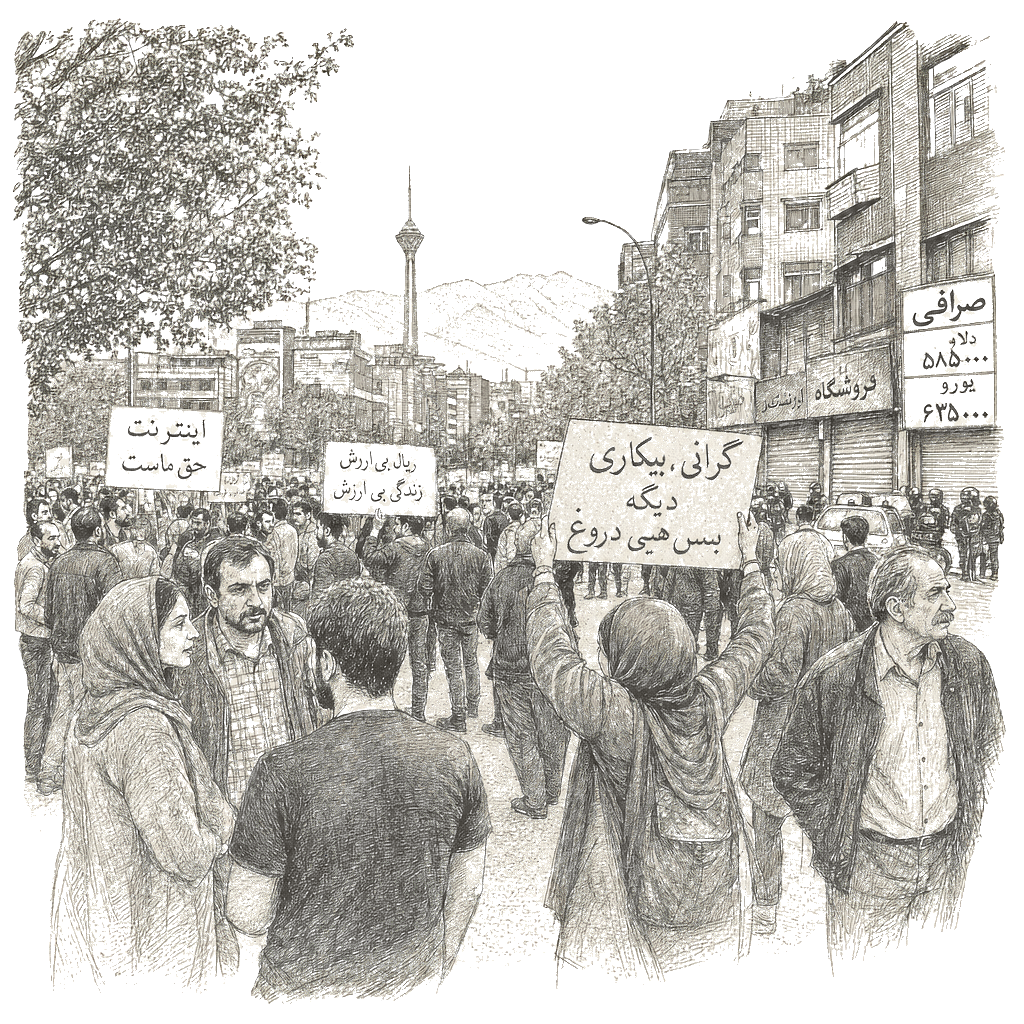
Nationwide demonstrations demanding economic relief have spread across all of Iran’s 31 provinces, according to data from the U.S.-based Human Rights Activists News Agency, as the Islamic Republic’s government shut down the internet and deployed security forces against protesters. The agency reported Thursday that more than 600 protests have taken place nationwide, with a death toll of at least 2,615 and 18,470 people arrested. Iran’s rial has fallen to more than 1.4 million per dollar while an annual inflation rate of about 40 percent erodes living standards, the Associated Press reported.
The demonstrations mark the most serious challenge to Iran’s government in years, combining economic grievances with the aftermath of a June war in which the United States bombed Iranian nuclear sites and United Nations sanctions reimposed in September accelerated the rial’s collapse. President Donald Trump has warned of U.S. consequences if Iranian authorities escalate their response to protesters, a threat given added weight after U.S. forces seized Venezuelan President Nicolás Maduro, a longtime Iranian ally.
How far the protests have spread
The Human Rights Activists News Agency, a U.S.-based group that relies on an activist network inside Iran and has been accurate in past episodes of unrest, said the data it gathered through Thursday showed demonstrations in all 31 provinces of the country. The Iranian government has not released overall casualty figures for the demonstrations, the AP reported. The AP said it was unable to independently verify the death toll or arrest count because of the internet shutdown; Iranians regained the ability to dial abroad from mobile phones on Tuesday after the government lifted partial restrictions.
Journalists face additional obstacles inside Iran, including requirements to obtain permission before traveling around the country and the threat of harassment or arrest by authorities, the AP reported. Iranian state media has provided little information about the demonstrations, and online videos have offered only brief, unsteady glimpses of street scenes or the sound of gunfire. The protests were continuing despite Supreme Leader Ayatollah Ali Khamenei’s statement that “rioters must be put in their place,” according to the AP.
Why the demonstrations began
The collapse of the rial has led to a widening economic crisis. Prices for meat, rice, and other staples have risen sharply, the AP reported.
In December, the government introduced a new pricing tier for nationally subsidized gasoline, raising the cost of some of the world’s cheapest fuel and adding to household pressure. Tehran plans to review prices every three months going forward, raising the prospect of further increases. Iran’s Central Bank also ended, in recent days, a preferential subsidized dollar-rial exchange rate for all products except medicine and wheat, a step the AP said is expected to push food prices higher.
The protests began in late December with merchants in Tehran before spreading, the AP reported. While initially focused on economic issues, protesters soon began chanting anti-government statements as well. Anger has simmered for years, particularly after the 2022 death of 22-year-old Mahsa Amini in police custody, which triggered nationwide demonstrations at the time. Some protesters have chanted in support of Iran’s exiled Crown Prince Reza Pahlavi, who has called for protests, the AP reported.
Trump warns of consequences
Trump has issued repeated warnings about Iran’s response to the demonstrations. “We’re watching it very closely,” Trump said. “If they start killing people like they have in the past, I think they’re going to get hit very hard by the United States.”
Trump has also said that if Tehran “violently kills peaceful protesters” the U.S. “will come to their rescue,” the AP reported. That warning has taken on new weight after American troops captured Maduro, whose government has been a longtime ally of Tehran.
Iran’s regional alliances weakened
The protests arrive as the network of governments and militant groups Iran calls its “Axis of Resistance” has suffered a series of setbacks. Israel has fought a devastating war in the Gaza Strip against Hamas, and killed the top leadership of Hezbollah, the Shiite militant group in Lebanon that Iran has backed for decades, the AP reported. A rapid offensive in December 2024 overthrew Syrian President Bashar Assad, who had served as a key Iranian partner for years. Yemen’s Iranian-backed Houthi fighters have been struck repeatedly by Israeli and U.S. airstrikes.
Iran itself fought a 12-day war with Israel in June, during which the United States bombed Iranian nuclear sites, the AP reported. The United Nations reimposed sanctions on Iran in September over its nuclear program, contributing to the rial’s fall.
China has remained a major buyer of Iranian crude oil but has not provided overt military support, the AP reported. Russia, which has relied on Iranian drones in its war on Ukraine, has also held back from offering military backing.
Nuclear program and Western concerns
Iran has maintained for decades that its nuclear program is peaceful, though its officials have increasingly threatened to pursue a nuclear weapon, the AP reported. The International Atomic Energy Agency’s director-general has warned that Iran could build as many as 10 nuclear bombs should it decide to weaponize its program, according to the AP.
U.S. intelligence agencies have assessed that Iran has not yet begun a weapons program but has “undertaken activities that better position it to produce a nuclear device, if it chooses to do so,” the AP reported.
Iran recently announced it had stopped enriching uranium at all sites in the country, a move the AP described as a signal intended to keep open the possibility of sanctions relief negotiations. No significant diplomatic talks have taken place in the months since the June war, the AP reported.
A decades-long rupture
Iran and the United States were close allies under Shah Mohammad Reza Pahlavi, who purchased American military weapons and allowed U.S. technicians to operate intelligence-gathering posts near the Soviet Union. The CIA supported a 1953 coup that cemented the shah’s rule, according to the AP.
The relationship shattered after the Islamic Revolution of 1979, led by Ayatollah Ruhollah Khomeini, which established Iran’s current theocratic government. Later that year, university students seized the U.S. Embassy in Tehran, triggering a 444-day hostage crisis that severed diplomatic relations between the two countries, the AP reported.
Relations rose briefly with the 2015 nuclear deal, in which Iran agreed to significantly limit its atomic program in exchange for the lifting of sanctions. Trump withdrew the United States from that accord in 2018, reigniting tensions that have intensified since Hamas’s Oct. 7, 2023, attack on Israel, the AP reported.